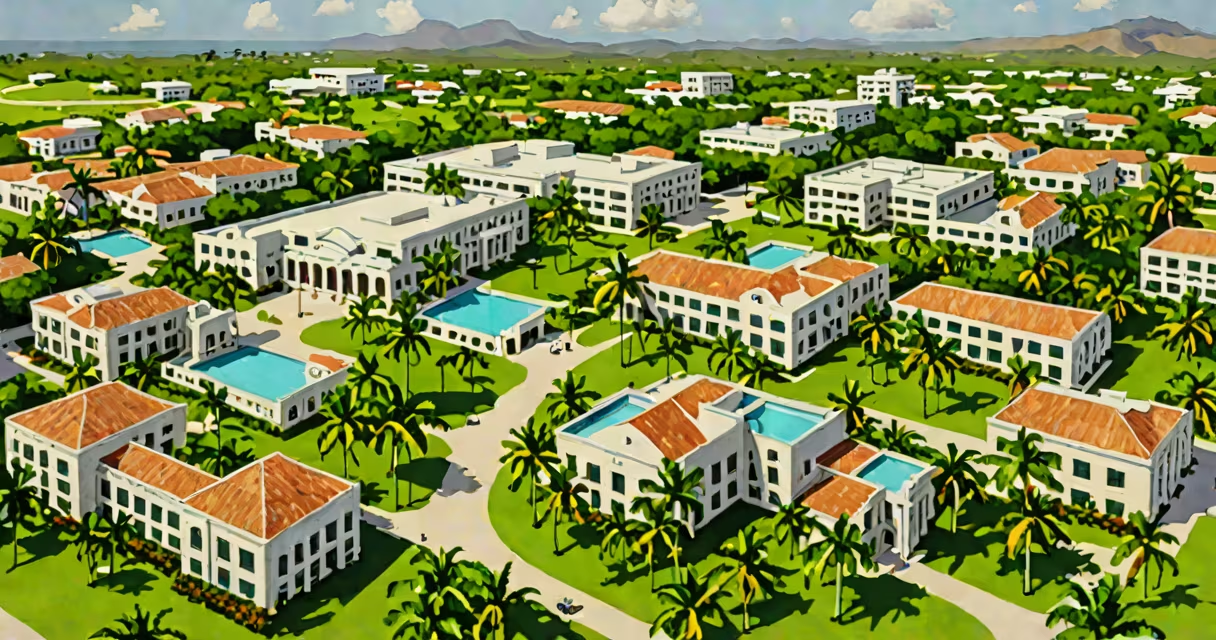
All Saints University School of Medicine is a private medical school located in the Caribbean that grants the Doctor of Medicine (MD) degree and is accredited by the Caribbean Accreditation Authority for Education in Medicine and Health Professions (CAAM-HP). The institution prepares students for U.S. medical licensure and residency through a structured curriculum delivered primarily in English.
The school operates under a model common among Caribbean medical schools: students complete foundational sciences in a classroom setting, then transition to clinical rotations in U.S. hospitals. This structure allows applicants who may not have gained admission to U.S. medical schools to pursue a path toward becoming licensed physicians in the United States.
Founded in 2006 and based on the island of St. Vincent and the Grenadines, All Saints University School of Medicine is recognized by the World Directory of Medical Schools (WDOMS) and listed in the Educational Commission for Foreign Medical Graduates (ECFMG) database. These listings are essential for students seeking to apply for U.S. residency programs through the National Resident Matching Program (NRMP).
All Saints University School of Medicine follows a two-phase structure. The first phase, lasting approximately 18 months, covers preclinical subjects such as anatomy, physiology, biochemistry, and pharmacology. Instruction occurs via a combination of live lectures, small-group tutorials, and self-directed study modules. Students access course materials through a dedicated learning management system.
During the second phase, students enter clinical clerkships in the United States. Rotations span core specialties including internal medicine, surgery, pediatrics, obstetrics and gynecology, psychiatry, and family medicine. These rotations take place at approved teaching hospitals across states like New York, Florida, and Pennsylvania. The school maintains partnerships with institutions that meet ACGME standards for residency training sites.
A student who completes all required clerkships and passes the United States Medical Licensing Examination (USMLE) Step 1 and Step 2 CK is eligible to apply for U.S. residency programs. Success rates vary annually, but in 2022, 68% of graduates matched into U.S. residency programs, according to the NRMP's official report.
Accreditation is critical for legitimacy. All Saints University School of Medicine holds accreditation from CAAM-HP, which evaluates institutions based on criteria aligned with U.S. and Canadian standards. CAAM-HP accreditation helps the school meets minimum benchmarks for faculty qualifications, facilities, student support services, and outcomes reporting.
The school is listed in the World Directory of Medical Schools (WDOMS), maintained by the World Health Organization (WHO) and the Foundation for Advancement of International Medical Education (FAIMER). This listing confirms that the MD degree is recognized internationally and qualifies graduates for licensing exams in multiple countries.
Despite this, some U.S. state medical boards do not recognize all Caribbean medical schools as equivalent to U.S.-based programs. For example, California requires additional verification steps for foreign-trained physicians. Applicants must confirm eligibility with their intended state board before enrolling.
| Accrediting Body | Recognition Status | Impact on U.S. Licensure |
|---|---|---|
| CAAM-HP | Full accreditation | Meets U.S. residency application requirements |
| WDOMS | Listed | Validates degree for international licensing |
| ECFMG | Eligible | Required for USMLE exam registration |
One widespread misunderstanding is that all Caribbean medical schools are unregulated or offer "diploma mills." This is false. All Saints University School of Medicine is not a diploma mill. It is subject to external oversight, publishes annual outcome reports, and participates in national matching processes.
Another misconception is that graduates face automatic disqualification from U.S. residencies. In reality, 2022 data from the NRMP shows that 56% of all Caribbean medical school graduates matched into U.S. residency programs-higher than the average match rate for U.S. allopathic medical schools in some years. All Saints University's match rate in 2022 was 68%, above the Caribbean average.
Some assume that clinical training in the U.S. is guaranteed. That is incorrect. Students must secure their own rotation placements through competitive applications. The school provides guidance and resources, but success depends on individual performance, letters of recommendation, and interview readiness.
Consider Marcus, a 26-year-old biology graduate from Texas who did not gain admission to any U.S. medical school after three attempts. He applied to All Saints University School of Medicine in 2020. After acceptance, he completed his preclinical year in St. Vincent, studying 12 hours per day using a hybrid schedule with live Zoom sessions and recorded lectures.
In 2021, Marcus traveled to New York City for his internal medicine rotation at a Level 1 trauma center. He rotated through outpatient clinics, inpatient wards, and emergency departments. His performance earned him a strong letter of recommendation from his attending physician, which helped him secure a competitive match in family medicine in 2023.
"The pace was intense," Marcus said during a follow-up interview. "But the school's advising team helped me prepare for interviews. I didn't expect to match at my top-choice program, but I did."
While All Saints University School of Medicine shares the goal of producing licensed physicians with U.S. medical schools, key differences exist. Tuition at All Saints averages $35,000 per year, compared to $50,000-$70,000 annually at public U.S. medical schools. However, students often incur higher travel and living costs due to relocation for clinical rotations.
Admission standards differ too. All Saints considers MCAT scores, GPA, and personal statements, but the average MCAT score for admitted students is 498 (25th percentile), slightly below the national average for U.S. medical schools (504). Acceptance rates are higher-around 40%-but this reflects lower competition rather than reduced rigor.
The U.S. Department of Education classifies All Saints University as a "foreign" institution. This affects federal financial aid eligibility. Students must rely on private loans or scholarships. In contrast, U.S. medical schools allow access to Pell Grants and Direct Loans.
All Saints University School of Medicine provides a viable pathway to U.S. medical licensure for students who do not gain admission to domestic programs. It delivers a U.S.-aligned curriculum, supports clinical training in American hospitals, and maintains accreditation recognized by national bodies. While challenges remain-especially around funding and residency competitiveness-the school enables qualified individuals to pursue careers in medicine.
For those considering alternative routes, understanding the structure, accreditation status, and outcomes of institutions like All Saints University School of Medicine is essential. It is not a shortcut, but a distinct educational track with measurable results. As with any medical school, success depends on commitment, preparation, and performance.