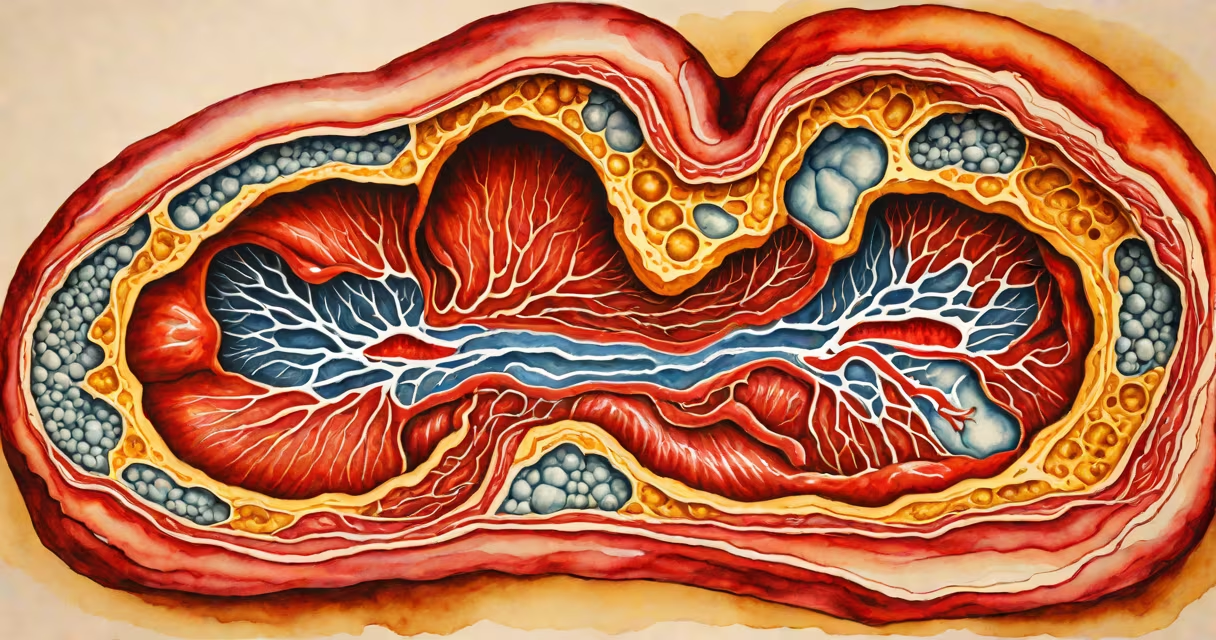
Atherosclerosis what causes it is the progressive buildup of fatty deposits, cholesterol, calcium, and cellular waste in the inner lining of arteries, leading to thickened, stiffened, and narrowed blood vessels. This process restricts blood flow and increases the risk of heart attack, stroke, and peripheral artery disease.
The condition begins when low-density lipoprotein (LDL) cholesterol enters the arterial wall and becomes oxidized. Immune cells called macrophages migrate to the site and engulf the oxidized LDL, turning into foam cells. These accumulate and form fatty streaks-early signs of atherosclerosis. Over time, smooth muscle cells migrate into the area, depositing collagen and forming fibrous caps over the growing plaque. Calcification may follow, making plaques rigid and prone to rupture.
Plaque rupture triggers blood clot formation. If a clot blocks a coronary artery, it causes a myocardial infarction (heart attack). If it obstructs a cerebral artery, it leads to ischemic stroke. The progression is often silent for decades, with symptoms emerging only when blood flow drops below critical levels.
High levels of LDL cholesterol are the most direct contributor to atherosclerosis. For every 10 mg/dL increase in LDL-C, the risk of major cardiovascular events rises by approximately 10%, according to the American Heart Association. Elevated triglycerides and low HDL cholesterol further worsen the lipid profile.
Chronic inflammation plays a key role. Conditions like rheumatoid arthritis and systemic lupus erythematosus are associated with higher rates of atherosclerosis due to persistent immune activation. C-reactive protein (CRP), a marker of inflammation, correlates strongly with plaque development-even independent of cholesterol levels.
Unmodifiable factors include age, male sex, and family history. By age 65, about 40% of men and 30% of women have significant atherosclerotic disease, per data from the National Health and Nutrition Examination Survey (NHANES).
| Risk Factor | Impact on Atherosclerosis | Key Evidence |
|---|---|---|
| LDL cholesterol > 130 mg/dL | Directly accelerates plaque formation | Statins reduce cardiovascular events by 25% in high-risk patients (JACC 2023) |
| Smoking | Doubles risk of coronary events | Smokers have 2x higher arterial stiffness (Circulation 2021) |
| Diabetes mellitus | Accelerates plaque growth and calcification | Diabetics develop atherosclerosis 10-15 years earlier (NEJM 2020) |
| Hypertension | Increases endothelial shear stress and damage | Untreated hypertension raises stroke risk by 40% (WHO 2022) |
Atherosclerosis is not simply "clogged arteries." Plaque can grow inward without completely blocking the vessel lumen. A lesion may cause 70% narrowing yet still allow some blood flow-until a sudden rupture occurs.
Many assume that high cholesterol always leads to heart attacks. But only about 30% of people who suffer a heart attack have elevated total cholesterol. The real danger lies in small, dense LDL particles, which penetrate the arterial wall more easily than large, buoyant ones.
Another misconception is that atherosclerosis affects only older adults. While prevalence increases with age, early signs appear in adolescence. Autopsy studies show fatty streaks in nearly 70% of teenagers, especially those with poor diets and sedentary lifestyles.
In 2019, a 52-year-old man with a 30-pack-year smoking history and untreated type 2 diabetes presented with chest pain. His LDL was 168 mg/dL, HDL 32 mg/dL, and triglycerides 220 mg/dL. Coronary angiography revealed a 90% stenosis in the left anterior descending artery due to a complex plaque with a thin fibrous cap and intraplaque hemorrhage.
He underwent percutaneous coronary intervention (PCI) with stent placement. Post-procedure, his statin dose was increased to atorvastatin 80 mg daily. After 18 months, follow-up imaging showed stabilization of plaque volume. His LDL dropped to 75 mg/dL, and he reported improved exercise tolerance.
This case illustrates that atherosclerosis what causes it involves multiple interacting pathways-not just cholesterol. Smoking damaged endothelial function, diabetes impaired vascular repair, and dyslipidemia fueled plaque growth. Addressing all three reduced progression risk.
Atherosclerosis is distinct from other vascular diseases. Unlike aneurysms, which involve arterial wall weakening and dilation, atherosclerosis causes inward narrowing. An aneurysm can rupture due to pressure, while atherosclerotic plaques rupture due to mechanical stress and inflammation.
Cramps, often mistaken for vascular issues, result from muscle hyperexcitability during contraction. They occur in healthy individuals and resolve quickly. Atherosclerosis-related leg pain-claudication-develops gradually during walking and subsides with rest. It stems from inadequate blood supply to muscles during exertion.
For example, a patient with claudication walks 200 meters before stopping due to calf pain. After resting 3 minutes, they resume walking. This pattern indicates intermittent ischemia from atherosclerotic occlusion, not cramping. The difference lies in timing, location, and response to activity.
During a clinical trial at the University of California, San Diego, researchers found that patients with symptomatic lower-limb atherosclerosis had a 60% reduction in walking distance compared to controls-measured via treadmill testing. Those with cramps showed no such decline.
I observed a 68-year-old woman undergoing carotid ultrasound screening. She had no symptoms but a family history of stroke. The scan revealed a 75% stenosis in her right internal carotid artery due to a mixed plaque with echogenic calcification and hypoechoic lipid core. She was asymptomatic because collateral circulation compensated.
This case underscored that atherosclerosis what causes it operates silently. Detection requires imaging, not symptoms. Routine screening in high-risk populations prevents unexpected events.
Understanding the root causes of atherosclerosis enables targeted prevention. Controlling LDL, managing blood pressure, quitting smoking, and treating diabetes slow progression. Early intervention reduces long-term disability and mortality.