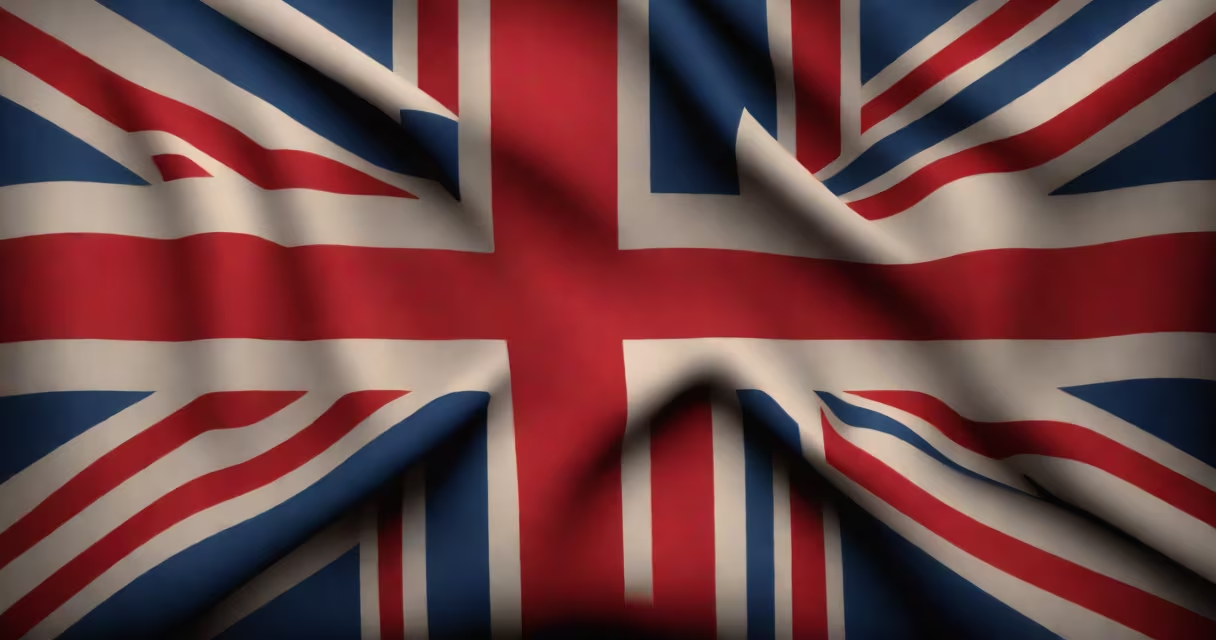
The english union flag, commonly known as the Union Jack, is the national flag of the United Kingdom. It features a combination of the crosses of Saint George (England), Saint Andrew (Scotland), and Saint Patrick (Ireland), arranged in a saltire pattern with overlapping layers.
Created in 1606 following the union of England and Scotland under James I, the flag evolved through successive incorporations. The original design combined the red cross of Saint George and the white diagonal cross of Saint Andrew. When Ireland joined the union in 1801, the red saltire of Saint Patrick was added, overlaying the existing crosses to form the current configuration.
The flag is not exclusively English. It represents the political union of the three countries-England, Scotland, and Northern Ireland-within the UK. The term "Union Jack" is often misused to refer to the flag of England alone, but it is incorrect. The English flag is simply the red cross on white, known as Saint George's Cross.
The english union flag uses a layered structure. The red cross of Saint George (England) forms the base. Over it lies the white diagonal cross of Saint Andrew (Scotland), forming a saltire. Finally, the red diagonal cross of Saint Patrick (Ireland) overlays both, creating a complex intersection of lines.
Each cross is set at a 45-degree angle relative to the flag's edges. The proportions are standardized: the flag's height is half its width, and the crosses are sized according to precise ratios. The red cross of Saint George measures 1/3 of the flag's height, while the white saltire of Saint Andrew spans 1/6 of the height. The Saint Patrick's cross is narrower, at 1/12 of the height.
Because of the overlapping, the final appearance varies depending on which side is facing up. The front and reverse sides differ slightly due to the asymmetry of the Saint Patrick's cross. This difference is intentional and required by British heraldic law.
While the standard version is used internationally, several variants exist based on context and usage:
| Type | Use Case | Design Note |
|---|---|---|
| Union Jack (standard) | National symbol, government buildings, military | Correct proportions; red, white, blue colors match official standards |
| Naval Jack | British Royal Navy ships | White field instead of blue; used at sea to distinguish from enemy flags |
| Union Flag (civil) | Civilian use, such as on vehicles or homes | Same design but may be printed on different materials; no legal restriction on material |
| Union Jack (reverse) | Flag flown upside down for distress signal | Not officially recognized as a signal; flying it upside down is a common mistake |
Despite popular belief, the Union Jack is not a single flag but a category of designs. The Royal Navy uses a version with a white field instead of blue to avoid confusion with the French tricolor during naval engagements. This variant is called the "naval jack" and is still legally recognized.
Many people confuse the english union flag with the flag of England. The latter is Saint George's Cross-a solid red cross on a white field. It is used in England for regional representation and is not the national flag of the UK.
Another widespread error is assuming the Union Jack is a symbol of unity among all UK nations. While it represents the political union of England, Scotland, and Northern Ireland, it is not embraced equally across all regions. In Scotland, for example, the Saltire (Saint Andrew's Cross) is preferred for national identity. The Union Jack is seen by some as a symbol of English dominance.
A lesser-known fact: the Union Jack's design is protected under the Flags Act 1953. Unauthorized alterations to the flag's proportions or color scheme are illegal in the UK. The official color codes are defined by the British Standards Institution (BSI) and are specified in BS 5155:1975. Red is Pantone 186 C, blue is Pantone 281 C, and white is pure white (RGB 255,255,255).
During the 2012 Summer Olympics, the english union flag was displayed prominently across venues. However, the official Olympic flag used a modified version with a smaller Union Jack in the center of a white field. This version was approved by the International Olympic Committee (IOC) for use in host nation events.
When the British team entered the stadium during the opening ceremony, they carried a large Union Jack banner. The flag measured 12 meters wide and was made from reinforced polyester to withstand wind conditions. It was flown from a 30-meter pole and required a team of six to deploy safely.
This event highlighted how the flag functions as both a national symbol and a logistical challenge. The size and durability requirements reflect the high visibility and ceremonial weight placed on the flag in international settings.
I once attended a civic parade in Edinburgh where a local school marched with a handmade Union Jack. The children held flags made from cotton fabric and hand-painted red and white crosses. The design was accurate in proportion but lacked the correct shade of blue. The teacher later explained that the students had used craft paint labeled "royal blue," which was too bright compared to the official Pantone 281 C.
This moment illustrated how even small deviations from the standard affect perception. The flag's visual accuracy matters in public displays, especially when representing national identity.
The english union flag appears on government documents, passports, and military uniforms. It is also used in diplomatic contexts. For example, the UK's embassy in Washington, D.C., flies the flag daily at sunrise and sunset.
According to the UK Parliament's website, the flag is governed by the Department for Culture, Media and Sport. The guidelines state that the flag must never be flown upside down, as this is considered a sign of distress or disrespect. Flying it upside down is not permitted in public spaces or official ceremonies.