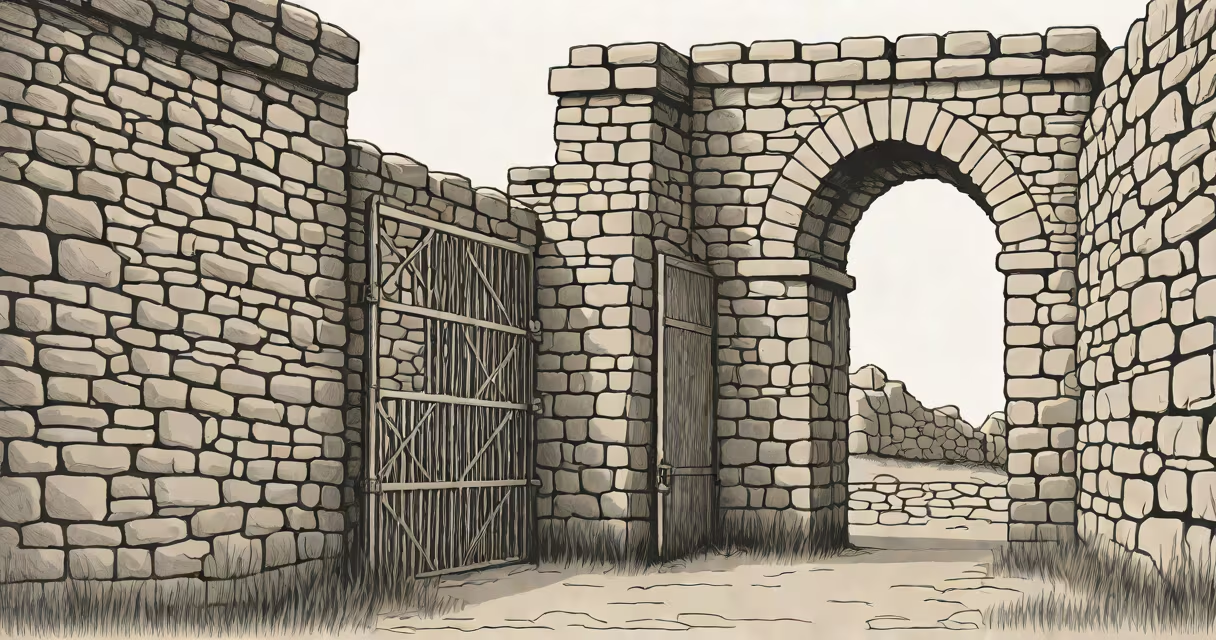
Fortification in the Bible describes divine protection and spiritual strength, often portrayed through physical structures like city walls or metaphorically as God's presence shielding believers from danger. The term appears in both literal and symbolic contexts across the Old and New Testaments.
In Hebrew, the root word for fortification is *māṣōn* (מָצֹן), meaning "stronghold" or "refuge." This concept appears in passages such as Psalm 18:2, where David calls God his "rock," "fortress," and "deliverer." These images reflect a worldview where safety is not earned through human effort alone but granted by divine intervention. The New Proof continues this theme, using *phylakterion* (φυλακτήριον) in Greek to describe spiritual safeguards, particularly in Matthew 23:16, where Jesus critiques religious leaders who neglect justice while focusing on ritual purity.
Fortification is not merely about walls. It is about trust in God's sovereignty. When Israel built walled cities like Jerusalem and Bethel, those structures were both practical defenses and symbols of God's covenantal promise. Deuteronomy 28:1-2 states that obedience brings blessings including secure borders and strongholds. Conversely, disobedience led to the destruction of cities like Jericho, which fell not because of weak walls but due to broken faith.
Biblical fortification operates on two levels: physical and spiritual. Physical fortifications included massive stone walls, gates, towers, and moats. Ancient Israelites fortified cities like Hazor and Megiddo during periods of conflict. Excavations at Hazor, conducted by Yigael Yadin, revealed a complex system of ramparts and defensive towers dating to the 13th century BCE. These were not just military installations-they reflected theological beliefs about God's role in national security.
Spiritually, fortification means relying on God as a shield. Psalm 34:7 says, "The angel of the Lord encamps around those who fear him, and delivers them." This verse uses imagery of divine protection akin to a fortified camp. The idea is that God surrounds the faithful like a wall, making them impervious to harm unless He permits it. In Romans 8:31, Paul asks, "If God is for us, who can be against us?"-a rhetorical affirmation of divine fortification as ultimate security.
Modern readers sometimes mistake fortification as a call to build personal barriers-emotional, social, or financial. But the biblical model rejects isolationism. Instead, it emphasizes openness to community and dependence on God. Jesus taught that true strength lies in vulnerability: "Come to me, all you who are weary and burdened, and I will give you rest" (Matthew 11:28). Here, rest is the opposite of fortification in the military sense-it's surrender, not defense.
The Bible presents multiple forms of fortification, ranging from literal structures to metaphysical protections. Below is a breakdown of key types:
| Type | Description | Example |
|---|---|---|
| Physical Walls | Stone barriers around cities, designed to resist siege weapons and enemy forces. | Jerusalem's walls rebuilt under Nehemiah (Nehemiah 2:17-18). |
| Divine Encampment | God's presence as a protective barrier, often described through fire or cloud. | Exodus 13:21-22: "The Lord went ahead of them in a pillar of cloud to guide them... and in a pillar of fire to give them light." |
| Internal Fortress | Mental and emotional resilience rooted in faith, not external structures. | Proverbs 18:10: "The name of the Lord is a strong tower; the righteous run to it and are safe." |
| Ritual Protection | Practices like wearing tassels (tzitzit) or placing blood on doorposts to invoke divine safeguarding. | Passover instructions in Exodus 12:13: "When I see the blood, I will pass over you." |
A lesser-known fact is that some biblical fortifications were temporary. The Tabernacle, for example, was a portable sanctuary-its "walls" were curtains and poles. This design emphasized mobility and divine presence over permanence. As Exodus 25:8 states, "Let them make me a sanctuary, so that I may dwell among them." The focus was not on enduring structure but on sacred space shaped by faith.
Fortification appears most frequently in books focused on law, prophecy, and poetry. Deuteronomy outlines legal requirements for city planning, including the construction of gates and watchtowers. The book of Ezekiel contains detailed visions of a restored Jerusalem with precise measurements for walls and gates, suggesting that fortification was tied to divine order and holiness.
Psalm 46 offers one of the clearest statements on spiritual fortification: "God is our refuge and strength, an ever-present help in trouble." This psalm was likely composed during times of war or political instability. Its message is not that God builds walls-but that He is the wall. When enemies surround, the believer stands firm because God is present.
Some modern Christian teachings misinterpret fortification as a call to build emotional or relational barriers. But the Bible consistently opposes isolation. In Ephesians 4:2-3, Paul urges believers to "be completely humble and gentle; be patient, bearing with one another in love. Try to keep the unity of the Spirit through the bond of peace." Unity, not separation, is the goal. True spiritual fortification includes openness to others, even when under threat.
One common error is equating biblical fortification with militarism. While ancient Israel did engage in warfare, the scriptures never glorify conquest. Instead, they emphasize God's control over battle outcomes. In Joshua 6, the fall of Jericho happened not through force but through obedience-Israel marched around the city for seven days, blowing trumpets. The walls collapsed because God acted, not because of strategy.
Another misconception is that fortification implies self-reliance. The Bible repeatedly shows that reliance on God is the only sustainable form of protection. In 2 Chronicles 14:11, King Asa prays, "Lord, there is no one like you to help the powerless against the mighty." He does not prepare armies-he calls out to God. His victory came not from walls but from prayer.
A non-obvious distinction is that biblical fortification is not always permanent. Some cities were destroyed despite their fortifications-because God's judgment superseded human engineering. The prophet Jeremiah warned Jerusalem that even its strong walls would not save it if the people turned away from God (Jeremiah 39:8). This underscores that spiritual alignment matters more than architectural strength.
I once visited the ruins of Masada in Israel-a mountain fortress where Jewish rebels held out against Roman forces in 73 CE. The site features thick walls, water cisterns, and storage rooms. Yet the final act was not a battle, but mass suicide. The defenders chose death over surrender. This contrasts sharply with the biblical ideal: God's fortification is not about holding out until the last breath, but about trusting in deliverance even amid defeat.
Consider Psalm 18:2 again: "The Lord is my rock, my fortress, and my deliverer." David wrote this after surviving Saul's pursuit. He wasn't hiding behind walls-he was running through forests and caves. His fortress was not stone, but God's presence. That distinction remains important today: true fortification is not a place, but a relationship.
Understanding fortification in the Bible reveals a deeper truth: protection comes not from what we build, but from whom we trust. When faced with uncertainty, the biblical response is not to reinforce walls, but to return to prayer. The fortress is not a structure-it is a promise.
Fortification in the Bible is not about strength in isolation. It is about belonging to a community sustained by faith. The strongest fortress is not made of stone, but of trust in God's unchanging character.