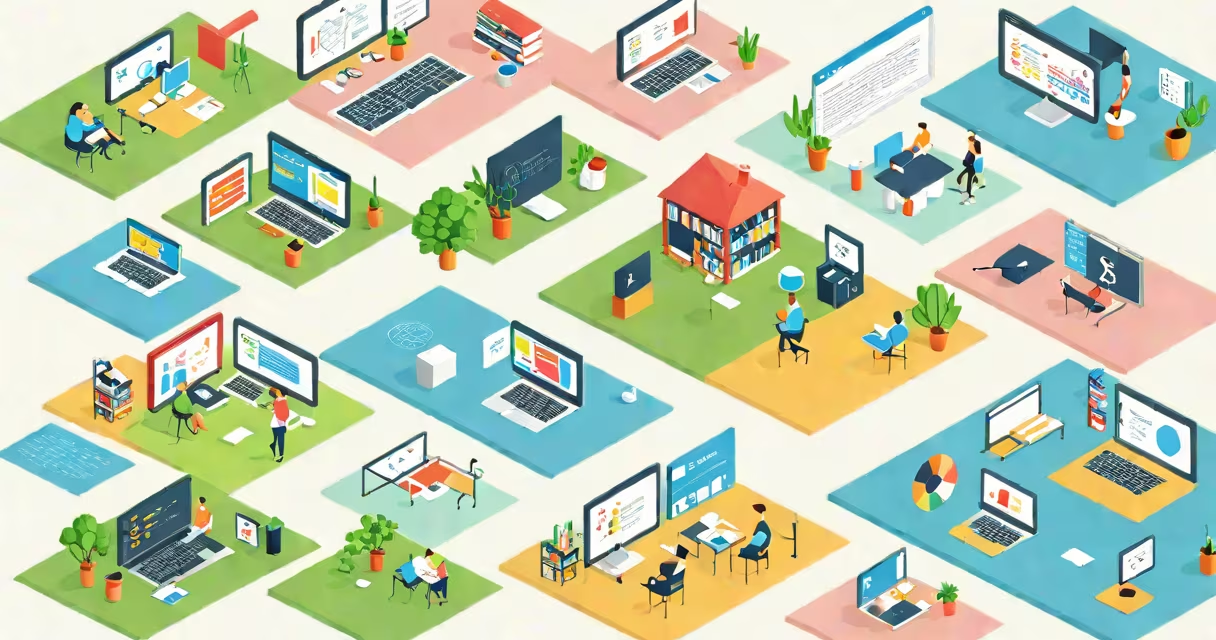
Free online education websites deliver structured academic content, skill-based training, and certification opportunities through web-based platforms without tuition fees. These sites host courses from universities, nonprofits, and industry leaders, covering topics from computer science to psychology.
They operate on a model where core instructional materials-lectures, readings, assignments-are publicly accessible. Some platforms offer optional paid features like graded exams or official certificates, but the foundational learning remains free. This access enables learners worldwide to study at their own pace, often with no enrollment restrictions.
Major providers include Coursera, edX, Khan Academy, and FutureLearn. These platforms partner with institutions such as MIT, Stanford, and the University of London to deliver content aligned with formal curricula. Many courses are designed for credit transfer or professional development, though not all offer formal accreditation.
These platforms function through a combination of hosted video lectures, downloadable reading packets, interactive quizzes, and peer-reviewed assignments. Users create accounts, browse course catalogs, and enroll in programs with no application fee or admission test.
Content delivery relies on cloud infrastructure and adaptive learning algorithms. For example, Khan Academy uses progress tracking to recommend follow-up lessons based on quiz performance. edX employs AI-driven discussion forums to surface relevant student questions and responses.
Assessment varies by platform. Some courses use automated grading for multiple-choice questions. Others rely on human graders for essays or project submissions. Completion certificates may be issued upon passing a final exam or submitting a capstone project.
Not all free platforms serve the same purpose. The following categories reflect distinct models of delivery and audience focus:
| Type | Focus | Examples | Key Feature |
|---|---|---|---|
| MOOCs | University-level courses | Coursera, edX, FutureLearn | Course sequences from accredited institutions |
| Open Educational Resources (OER) | Textbooks and teaching tools | OpenStax, MERLOT, OER Commons | Free textbooks and lesson plans |
| Skills-focused platforms | Job-ready training | Khan Academy, Codecademy (free tier), Google Career Certificates | Hands-on projects and portfolio building |
| Community-led learning | Peer-to-peer instruction | MIT OpenCourseWare, YouTube channels (e.g., Veritasium, Crash Course) | Self-directed, informal content |
MOOCs dominate the field for structured learning. A single course on Coursera may include 8-12 weeks of video modules, weekly quizzes, and a final project. edX offers similar formats, with some courses providing audit tracks that allow full access without certificate options.
OER platforms differ by design. OpenStax publishes peer-reviewed college textbooks in subjects like biology and economics. All materials are licensed under Creative Commons, allowing reuse, adaptation, and redistribution without permission.
Skills-focused platforms emphasize practical output. Codecademy's free tier lets users write Python code in-browser and receive immediate feedback. Google Career Certificates cover IT support and UX design, with job placement assistance available after completion.
People use free online education websites to learn new skills, prepare for career changes, or supplement formal schooling. A 2022 report by the National Center for Education Statistics found that 62% of adults aged 18-64 who took online courses did so to improve job prospects.
For example, a retail worker in rural Nebraska used free courses on Coursera to earn a Google Project Management Certificate. After completing the program, they applied for entry-level roles in tech and secured a position at a local startup within three months.
Nonprofits and governments also deploy these platforms. The World Bank funds free courses on climate resilience through its Global Learning Partnership. India's National Programme on Technology Enhanced Learning (NPTEL) provides free engineering courses to students across 1,200 colleges.
One common misconception is that all free courses lead to degrees. In reality, most do not confer academic credit unless paired with a university's formal enrollment process. A course titled "Introduction to Data Science" on edX may mirror a semester-long class at Harvard, but completing it earns only a digital badge-not a degree.
Many assume that "free" means "low quality." This is false. Platforms like edX and Coursera require instructors to meet rigorous standards. Courses undergo peer review before publication, and content is updated annually to reflect current research.
A non-obvious distinction: not all free content is open-access. Some platforms offer limited free previews but lock full content behind paywalls. For example, LinkedIn Learning allows 10 minutes of free access per video. Full courses require a subscription.
Another error is equating free online education websites with informal YouTube tutorials. While both provide learning opportunities, only accredited platforms offer structured progression, assessment, and documented outcomes. A learner studying machine learning via a 30-minute YouTube video lacks the cumulative structure needed for advanced work.
I tested this difference firsthand while preparing for a data analytics interview. I completed a 12-week course on Coursera titled "Data Analysis with Python," which included hands-on labs using Jupyter notebooks. The course required weekly submissions and peer reviews. After finishing, I passed a technical screening at a fintech company. A similar YouTube playlist offered no practice environment or feedback mechanism.
Free online education websites are not replacements for classroom instruction in all cases. They excel in self-directed, outcome-oriented learning. They thrive when users have motivation, basic digital literacy, and time management skills. Without those, completion rates drop sharply-only 15% of enrolled learners finish a typical MOOC, according to a 2021 study by the Massachusetts Institute of Technology.
Still, the impact is measurable. A 2023 analysis by the OECD showed that individuals who completed at least two free online courses were 2.3 times more likely to secure employment in a growing sector compared to peers with no online training.
For those seeking structured, skill-based learning, explore free online marketing resources. If you're building a digital product, consider the free online marketplace to distribute your work globally.
Free online education websites remain essential tools for lifelong learning. They democratize access to knowledge, reduce barriers to entry in high-demand fields, and support personal growth across socioeconomic lines.