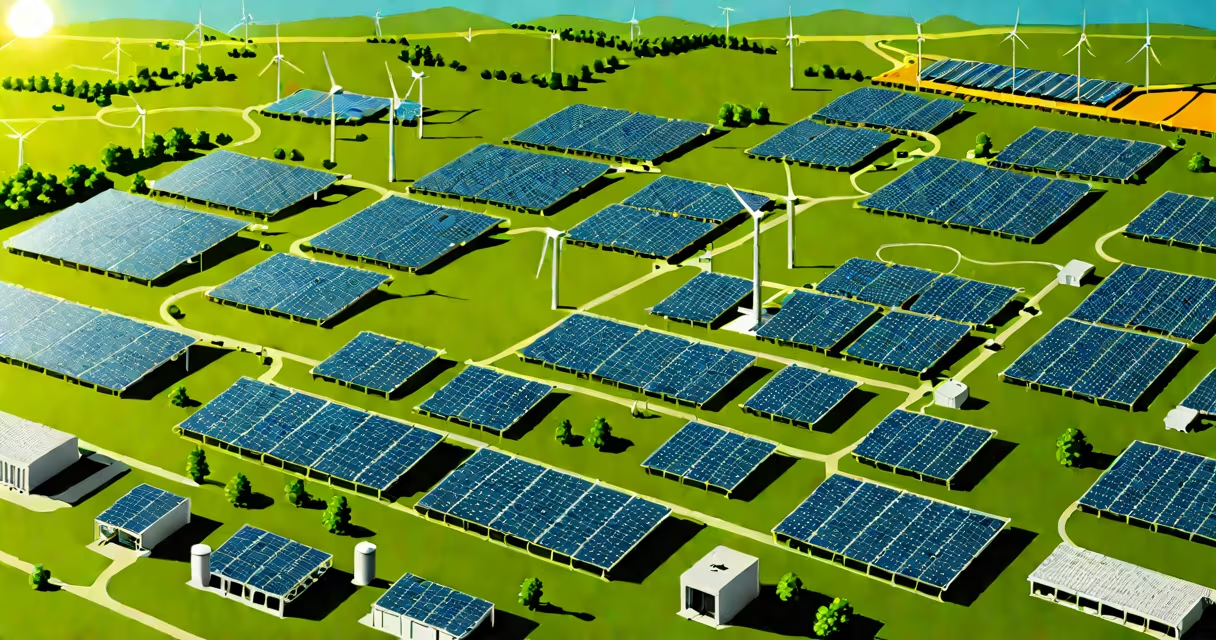
The future of renewable energy is the global shift toward solar, wind, and advanced storage systems to replace fossil fuels in electricity generation, transportation, and industrial processes. This transition is driven by declining costs, climate policy, and technological progress.
Renewable energy sources generate power from natural flows-sunlight, wind, water, and heat from Earth's core-without depleting finite resources or emitting carbon during operation. The future of renewable energy centers on scaling these technologies while integrating them into smart grids capable of handling variable output.
By 2030, the International Energy Agency projects that renewables will supply 60% of global electricity, up from 30% in 2022. Solar and wind together accounted for 90% of new power capacity added worldwide in 2023, according to the IEA's World Energy Outlook. This momentum reflects both economic and environmental imperatives.
At its core, the future of renewable energy relies on converting natural phenomena into usable electricity. Photovoltaic panels convert sunlight directly into electrical current through semiconductor materials like silicon. Wind turbines use aerodynamic blades to spin generators when air moves past them. Both systems feed power into distribution networks, often paired with batteries to store excess energy for use when production drops.
Grid integration remains a key challenge. Solar output peaks midday; wind varies hourly. Without storage or flexible demand management, surplus energy goes unused. Modern solutions include grid-scale lithium-ion batteries, pumped hydro storage, and AI-driven load balancing. In Germany, for example, solar and wind supplied 50% of electricity in 2023, supported by a network of 15 gigawatt-hours of battery storage.
Electric vehicles (EVs) are emerging as mobile storage units. Vehicle-to-grid (V2G) pilots in Denmark and California allow EVs to discharge power back into the grid during peak demand, effectively turning fleets into distributed energy reserves. This integration enhances system resilience and reduces reliance on peaking gas plants.
Not all renewable sources grow at the same pace. The following table outlines the most impactful technologies shaping the future of renewable energy:
| Technology | Growth Rate (2023-2030) | Key Limitation | Leading Region |
|---|---|---|---|
| Solar PV | 12% annually | Intermittency, land use | China, U.S., India |
| Onshore Wind | 8% annually | Grid access, permitting delays | Europe, U.S. |
| Offshore Wind | 15% annually | High capital cost, marine impact | North Sea, East Asia |
| Battery Storage | 30% annually | Lithium supply constraints | U.S., China, EU |
Emerging technologies like floating offshore wind farms and perovskite solar cells promise higher efficiency and lower installation costs. Floating platforms allow deployment in deeper waters where wind speeds are stronger and consistent. Perovskite cells, though still in pilot phase, have demonstrated lab efficiencies above 33%, surpassing traditional silicon cells.
Hydrogen produced via electrolysis using renewable electricity-called "green hydrogen"-is gaining traction for hard-to-electrify sectors like steelmaking and long-haul shipping. The European Union plans to install 40 gigawatts of electrolyzer capacity by 2030, enough to produce 10 million tons of green hydrogen annually.
Many assume that renewable energy requires constant sunshine or wind. In reality, modern grids manage variability through geographic diversity and forecasting. For example, when solar output drops in California, wind generation often rises in Texas due to different weather patterns. The U.S. Department of Energy's National Renewable Energy Laboratory (NREL) confirms that a 90% renewable grid is technically feasible across the continental U.S. with existing technology.
Another myth is that renewable infrastructure uses more energy to build than it produces over its lifetime. Life-cycle analysis shows that solar panels repay their embodied energy in 1-2 years, and wind turbines in 3-6 months. Over a 25-year lifespan, they generate 20-30 times more energy than was used in manufacturing and installation.
A lesser-known fact: the future of renewable energy includes waste-to-energy systems powered by municipal solid waste. In Sweden, 50% of household waste is incinerated to generate heat and electricity, reducing landfill use and methane emissions. These systems are classified as renewable under EU law because they rely on organic material inputs.
In February 2023, a winter storm disrupted Texas's grid, causing rolling blackouts. Unlike previous events tied to frozen wind turbines, this time, solar and wind assets remained operational. The Electric Reliability Council of Texas (ERCOT) reported that renewable sources contributed 45% of total generation during peak demand, compared to 30% in 2021. Battery storage systems discharged 1.2 gigawatt-hours of power within minutes of grid instability, preventing further outages.
This event demonstrated that renewables, when paired with storage and grid coordination, can improve reliability-not undermine it. It also highlighted the importance of weather-resilient design. Afterward, ERCOT mandated that all new wind and solar projects include at least four hours of battery storage, setting a precedent for other regions.
The future of renewable energy is not synonymous with "off-grid living" or "complete independence from utilities." Most systems remain connected to larger grids for stability and backup. Even homes with rooftop solar typically stay grid-tied to avoid costly oversizing of battery banks.
It's also not limited to developed nations. India installed 16 gigawatts of solar capacity in 2023 alone, exceeding its annual target. Rural electrification programs in sub-Saharan Africa now deploy mini-grids powered by solar and small wind systems, reaching over 12 million people since 2020. These projects show that decentralized renewable systems can scale rapidly in low-income contexts.
Finally, the future of renewable energy is not solely about replacing coal and gas. It includes transforming industrial processes. Green hydrogen is being piloted in steel mills in Sweden and Germany, replacing coking coal. The shift reduces CO₂ emissions by up to 95% per ton of steel produced.
During a visit to a solar farm in Nevada, I observed how automated cleaning drones maintained panel efficiency. Dust accumulation reduced output by up to 25% in arid zones. The drones, equipped with microfiber cloths and GPS navigation, operated at night, minimizing downtime. This level of automation is becoming standard in utility-scale installations.
Global adoption hinges on policy alignment, infrastructure investment, and public acceptance. As of 2024, 140 countries have committed to net-zero targets, many backed by renewable energy mandates. The path forward is not theoretical-it is being built today, one solar panel, wind turbine, and battery pack at a time.