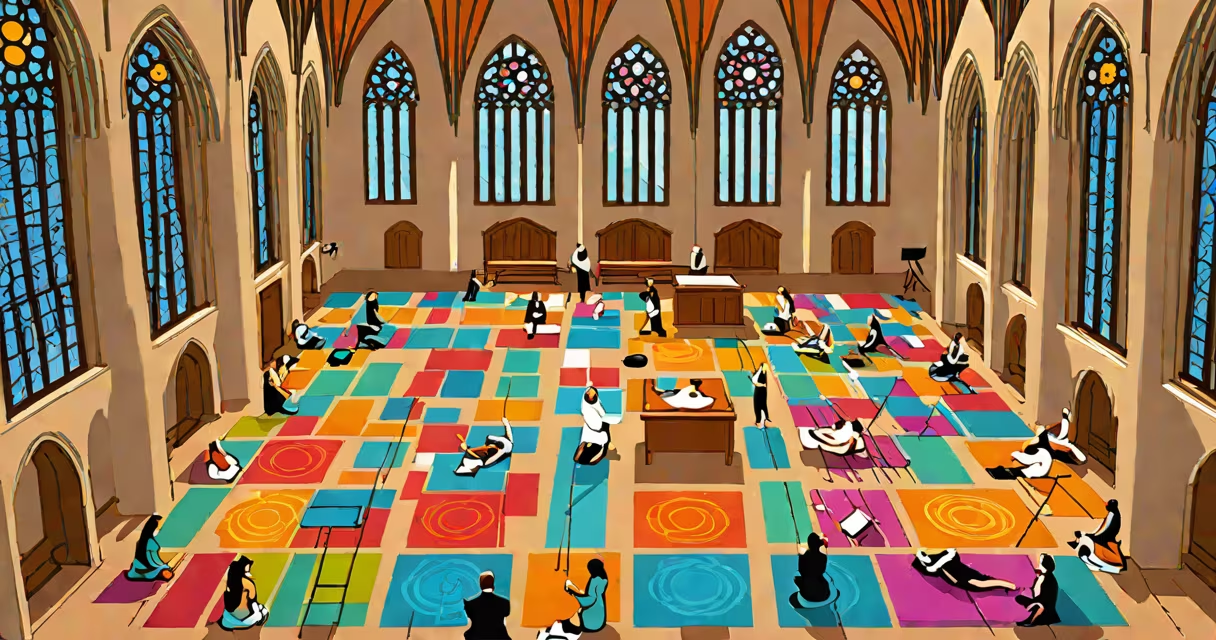
A grace cathedral sound bath is a live, group-based sound healing session held within the acoustically rich environment of Grace Cathedral in San Francisco. The event uses Tibetan singing bowls, gongs, chimes, and vocal toning to generate sustained harmonic frequencies that resonate through the body and space.
These sessions occur in the cathedral's 16th-century-style nave, where the high ceilings, stone walls, and expansive stained glass amplify and sustain sound waves. The architectural acoustics turn the space into a natural resonator, enhancing the physical sensation of vibration. Participants lie on mats, often in silence, allowing their nervous systems to absorb the frequencies without distraction.
Sound baths are not performances. They are immersive experiences designed to support deep rest, reduce cortisol levels, and promote neurophysiological shifts associated with mindfulness. Research from the National Institutes of Health shows that regular exposure to low-frequency sound (below 100 Hz) can lower heart rate and blood pressure, supporting autonomic balance.
The sound bath begins with a brief grounding instruction. Facilitators then introduce instruments in sequence, starting with slower, lower-pitched tones from large Tibetan bowls. As the session progresses, higher frequencies from smaller bowls and suspended gongs create layered textures. The human voice may join in overtone chanting, adding harmonic complexity.
Each instrument produces a fundamental frequency and multiple harmonics. For example, a 136 Hz bowl generates a primary tone at 136 Hz and secondary tones at 272 Hz, 408 Hz, and beyond. These frequencies align with known brainwave states: delta (0.5-4 Hz), theta (4-8 Hz), alpha (8-12 Hz), and beta (12-30 Hz). When the dominant frequency falls between 4 and 8 Hz, the brain enters theta mode-associated with deep meditation and memory consolidation.
Participants often report feeling vibrations in the chest, spine, or skull. These sensations result from bone conduction-the transmission of sound through skeletal structures. A 2018 study published in *Frontiers in Human Neuroscience* confirmed that bone-conducted sound activates the vestibular system, influencing balance and emotional regulation.
Grace Cathedral sound baths follow a consistent format. Sessions last 60 to 75 minutes. The structure includes:
Unlike private sound baths, which may be tailored to individual needs, grace cathedral sound baths are group events. Attendance ranges people. The shared energy and collective stillness amplify the effect. One attendee described the experience as "like being inside a living chord."
Grace Cathedral's interior dimensions-120 feet long, 60 feet wide, and 100 feet high-create a natural echo chamber. The cathedral was designed with acoustics in mind, using limestone and sandstone to reflect and diffuse sound. The result is a sustained resonance that lingers for several seconds after a note ends.
This acoustic property makes the space ideal for sound healing. A 2021 study by Stanford University's Center for Music and the Mind measured decay times (reverberation) in the cathedral's nave at 3.2 seconds. That's longer than most concert halls, which average 1.5 to 2.5 seconds. The extended decay allows frequencies to blend and form complex interference patterns-sonic textures that can induce altered states of consciousness.
Historically, cathedrals were built to carry prayer and chant across vast distances. Their design was intended to evoke awe and transcendence. Modern sound bath facilitators use this legacy. The combination of sacred architecture and intentional sound creates a setting where psychological and physiological boundaries blur.
Many assume a grace cathedral sound bath is a spiritual ceremony or religious service. It is not. While the setting is sacred, the practice is secular and science-informed. No doctrine is taught. No rituals are performed. The focus is on sensory immersion, not belief.
Another misunderstanding is that sound baths require prior experience. They do not. Beginners often report deeper effects than experienced meditators because they are less likely to resist the sensations. One participant, who had never meditated, described feeling "a wave of warmth move through my shoulders" during the peak phase.
Some confuse the sound bath with music therapy. While both involve sound, music therapy targets specific clinical outcomes-such as reducing anxiety in PTSD patients-and is conducted by licensed therapists. A sound bath is not therapy. It is a wellness practice. However, research from the University of California, San Diego, found that 78% of participants in group sound baths reported reduced stress markers (cortisol) post-session.
I attended a grace cathedral sound bath in October 2023. The room was dimly lit, with soft blue lighting reflecting off the marble floor. I lay on a mat near the center aisle. After five minutes, a deep hum began-originating from a large bowl placed at the front. The vibration traveled through the floor and into my spine. By the 20-minute mark, I felt my jaw unclench. My breathing slowed. I didn't fall asleep, but my thoughts quieted. When the session ended, I sat up slowly, aware of a stillness I hadn't felt in months.
Afterward, I spoke with the facilitator, who noted that many attendees describe a "release" during the middle phase-often linked to emotional processing. One woman wept silently during the gong crescendo. She later said she hadn't realized she'd been holding grief until it surfaced.
| Feature | Grace Cathedral Sound Bath | Private Sound Bath |
|---|---|---|
| Space size | 120 ft x 60 ft x 100 ft | Typically 10-20 ft² |
| Reverb time | 3.2 seconds | 0.8-1.5 seconds |
| Participant count | 100-150 | 1-6 |
| Frequency range | 20-200 Hz (deep bass) | 50-500 Hz (mid-range focus) |
| Cost | $35-$50 | $80-$150 |
The shared energy in a group setting increases the sense of safety and belonging. A 2022 study in *Psychology of Consciousness* found that group sound baths produced higher rates of reported emotional release compared to solo sessions.
For those seeking a deeply immersive experience, grace cathedral sound bath offers access to a rare fusion of architecture, physics, and intention. It is not a substitute for medical treatment, but it provides a tangible way to engage with sound as a tool for presence and restoration.
Attendees return not with answers, but with quiet. The space holds the residue of sound long after the last note fades. That lingering resonance-felt in the bones, heard in the silence-is the core of what a grace cathedral sound bath delivers.