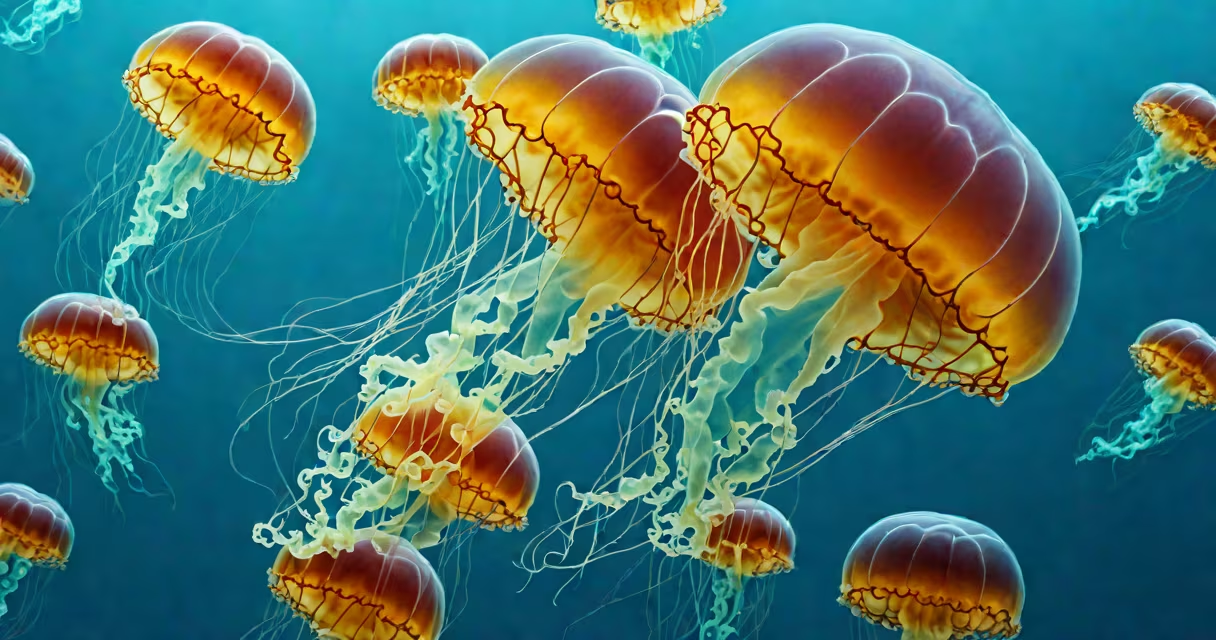
Jellyfish are soft-bodied, transparent sea creatures with long trailing tentacles that sting. They live in oceans worldwide and have existed for over 500 million years, making them older than dinosaurs.
Jellyfish belong to a group called cnidarians, which includes corals and sea anemones. Their bodies are made mostly of water-about 95 percent-and they lack brains, hearts, or bones. Instead, they rely on a simple nerve net to sense light, touch, and movement. This allows them to drift with ocean currents while hunting small plankton using their stinging cells.
One of the most surprising facts about jellyfish is that some species glow in the dark. This bioluminescence happens when proteins in their tissues react with oxygen, producing a blue or green light. Scientists study this trait to develop new tools for tracking cancer cells in medical research.
Jellyfish don't swim like fish do. Instead, they pulse their bell-shaped bodies up and down to push water backward, creating forward motion. This method is slow but energy-efficient, ideal for drifting through vast ocean expanses.
They capture prey using specialized stinging cells called nematocysts. These cells contain tiny harpoons that shoot out when touched. A single jellyfish can have thousands of these cells along its tentacles. When a tiny shrimp or plankton brushes against a tentacle, the nematocyst fires, injecting venom that paralyzes the prey.
Once caught, food moves through a central digestive cavity. Waste exits through the same opening used for eating-there's no separate anus. This simple internal design supports survival in nutrient-poor waters.
Jellyfish come in many shapes and sizes. The most common types include:
| Type | Size | Sting Severity | Notable Feature |
|---|---|---|---|
| Moon jellyfish | Up to 10 inches wide | Mild | Translucent bell with four horseshoe-shaped gonads visible inside |
| Box jellyfish | Up to 6 inches | Extremely dangerous | Has 24 eyes arranged in clusters; causes severe pain and can be fatal |
| Comb jellies | Up to 1 foot long | None | Uses rows of cilia (tiny hair-like structures) to swim; not true jellyfish |
While box jellyfish are found in tropical coastal areas like northern Australia, moon jellyfish appear in temperate seas around Europe and North America. Comb jellies inhabit both shallow and deep ocean zones and are often seen glowing at night.
Many people think jellyfish are fish. They're not. Jellyfish are invertebrates and not related to fish, mammals, or reptiles. They don't have fins, gills, or skeletons. Their name comes from their gelatinous appearance, resembling a jelly or mold.
Another myth is that all jellyfish sting humans. Most species have stingers too weak to affect people. Moon jellyfish, for example, rarely cause discomfort beyond a mild tingling. Only a few species-like the box jellyfish-pose serious risks. Even then, fatalities are rare and usually result from allergic reactions or delayed treatment.
A lesser-known fact: some jellyfish can reverse aging. The species Turritopsis dohrnii, known as the "immortal jellyfish," can revert from its adult form back to its juvenile polyp stage under stress. This cycle can repeat indefinitely, theoretically allowing it to live forever unless eaten or diseased.
The lion's mane jellyfish (Cyanea capillata) holds the record for longest tentacles among all jellyfish species. Its tentacles can stretch up to 120 feet-longer than a blue whale. Found in cold Arctic and North Atlantic waters, it feeds on zooplankton, small fish, and even other jellyfish.
In 2015, researchers documented a lion's mane jellyfish off the coast of Norway measuring 7 feet across and with tentacles extending over 100 feet. This specimen was photographed and studied by marine biologists at the University of Bergen. Its size highlights how little we still know about deep-sea life.
I once watched a video of a lion's mane jellyfish being gently towed behind a research boat during a survey. The crew had to carefully reel it in to avoid tangling the lines. The sight of such a massive creature moving slowly through the water left me stunned-its translucent bell glowed faintly under the surface light.
Jellyfish play key roles in ocean ecosystems. They serve as food for sea turtles, sunfish, and some birds. When jellyfish populations grow rapidly-called blooms-they can disrupt fisheries by consuming fish larvae and competing for resources.
Climate change may be increasing jellyfish numbers in some regions. Warmer waters and overfishing reduce predators like tuna and sea turtles, allowing jellyfish to thrive. Scientists monitor these shifts to understand broader impacts on marine health.
For kids interested in ocean exploration, learning jellyfish facts opens doors to marine biology, environmental science, and conservation. Understanding these ancient creatures helps build awareness of ocean protection efforts.