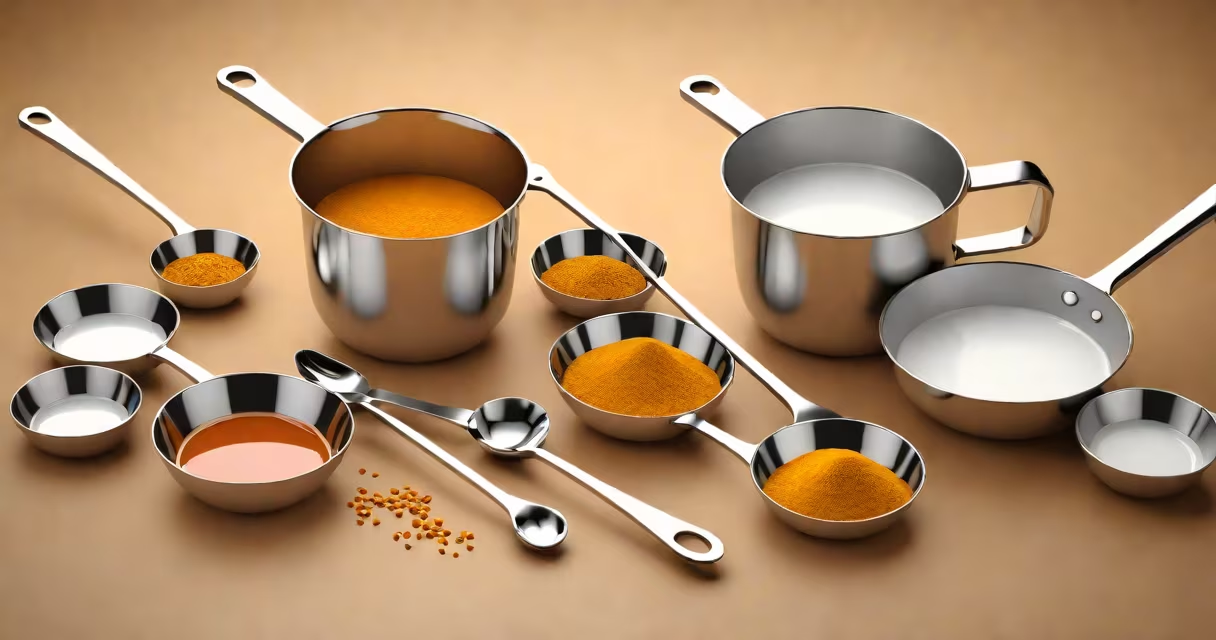
Milliliters to spoons is a volume conversion used to translate metric measurements into common kitchen spoon units, typically for cooking or baking. One tablespoon equals 15 milliliters, and one teaspoon equals 5 milliliters. These values are standardized in most culinary contexts.
Conversion between milliliters and spoons relies on fixed ratios. The tablespoon is the largest standard spoon unit, equivalent to 15 mL. The teaspoon is smaller, equal to 5 mL. These values are consistent across U.S. customary, British imperial, and metric systems used in kitchens. For example, 30 mL equals 2 tablespoons, and 10 mL equals 2 teaspoons.
Using milliliters to spoons ensures accuracy in recipes requiring precise liquid amounts. A recipe calling for 60 mL of milk requires four tablespoons. This avoids estimation errors common when eyeballing spoonfuls. The conversion applies equally to liquids and semi-solid ingredients like honey or mashed banana.
Each spoon size corresponds to a fixed volume. The tablespoon measures 15 mL exactly. The teaspoon measures 5 mL. These values are defined by international standards. The U.S. National Institute of Standards and Technology (NIST) confirms that a tablespoon is 14.7868 mL, but for practical purposes, 15 mL is used in cooking.
When converting, divide the milliliter amount by the spoon's volume. For example, 45 mL ÷ 15 mL per tablespoon = 3 tablespoons. Similarly, 25 mL ÷ 5 mL per teaspoon = 5 teaspoons. Fractions require attention: 7.5 mL equals half a tablespoon, or 1.5 teaspoons.
Some recipes use fractional spoons. A "dash" is roughly 1 mL, though it varies by context. A "pinch" is about 0.5 mL. These are informal and not reliable for precision. Always use calibrated spoons or a measuring cup for consistency.
Standard spoons differ by region and purpose. The table below shows common conversions used in home kitchens:
| Spoon Type | Volume in Milliliters | Common Use |
|---|---|---|
| Teaspoon | 5 mL | Spices, sugar, small ingredient additions |
| Tablespoon | 15 mL | Liquids, sauces, bulk ingredient measurement |
| Half-tablespoon | 7.5 mL | Adjustments in seasoning or medication |
| Quarter-teaspoon | 1.25 mL | Spice blends, flavor enhancers |
Some regions use different standards. In Australia, a tablespoon is 20 mL. In the UK, a tablespoon is 17.75 mL. Always check the recipe's origin. Most U.S.-based recipes assume 15 mL per tablespoon. Using the wrong standard causes errors-adding 20 mL instead of 15 mL increases ingredient volume by 33%.
A non-obvious fact: spoons are not always uniform. Hand-crafted or decorative spoons may hold less than 5 mL. Measuring spoons are calibrated for accuracy. Always use dedicated measuring tools, not eating spoons. A dinner spoon holds 18-20 mL, which is larger than a standard tablespoon.
Incorrect measurements lead to failed dishes. Baking especially requires precision. Too much leavening agent (like baking powder) can cause a cake to rise too quickly and collapse. Too little liquid alters texture. Converting milliliters to spoons ensures consistency across batches.
For example, a pancake recipe calls for 120 mL of milk. Dividing 120 by 15 gives 8 tablespoons. Using 8 standard tablespoons yields exactly 120 mL. If you use a dinner spoon averaging 18 mL, you'd add 144 mL-20% more than intended. That extra liquid makes the batter runny and affects cooking time.
I once tested this while making homemade hummus. The original recipe used 30 mL of tahini. I estimated it with a dinner spoon and added 45 mL. The result was overly oily and didn't emulsify properly. Switching to measured spoons fixed the issue. This experience confirmed that even small deviations matter.
People often mix up teaspoons and tablespoons. A teaspoon is smaller than a tablespoon. One tablespoon equals three teaspoons. So 15 mL = 3 × 5 mL. Misreading this leads to doubling or halving ingredient amounts unintentionally.
Another error is assuming all spoons are equal. A dessert spoon holds 10 mL in some countries, but not universally. Always verify the spoon type. Some recipes use "large spoon" or "small spoon" without specifying. When in doubt, use the standard 15 mL tablespoon and 5 mL teaspoon.
Some online converters default to U.S. measurements. If your recipe uses British or Australian standards, the output may be off. Always confirm the regional standard. NIST and the International Organization of Legal Metrology (OIML) both endorse 15 mL as the standard for a U.S. tablespoon.
Start with 60 mL. Divide by 15 mL per tablespoon: 60 ÷ 15 = 4. So 60 mL equals 4 tablespoons. Alternatively, divide by 5 mL per teaspoon: 60 ÷ 5 = 12. So 60 mL equals 12 teaspoons. Both are correct, but tablespoons are more efficient for larger volumes.
If the recipe allows, use 4 tablespoons. If precision is critical, use 12 teaspoons. But mixing units within a single recipe can cause confusion. Stick to one spoon type unless instructed otherwise.
For fractions: 7.5 mL = ½ tablespoon or 1.5 teaspoons. 2.5 mL = ½ teaspoon. These are common in spice blends or medicine dosing. Always measure carefully.
Use calibrated measuring spoons. Avoid estimating with eating utensils. Keep a conversion chart handy. Double-check the recipe's country of origin. If it's from the UK, confirm whether tablespoons are 15 mL or 17.75 mL.
When scaling recipes, convert all measurements consistently. Never mix metric and imperial spoons. Use a digital scale for dry ingredients, but stick to spoons for liquids under 50 mL.