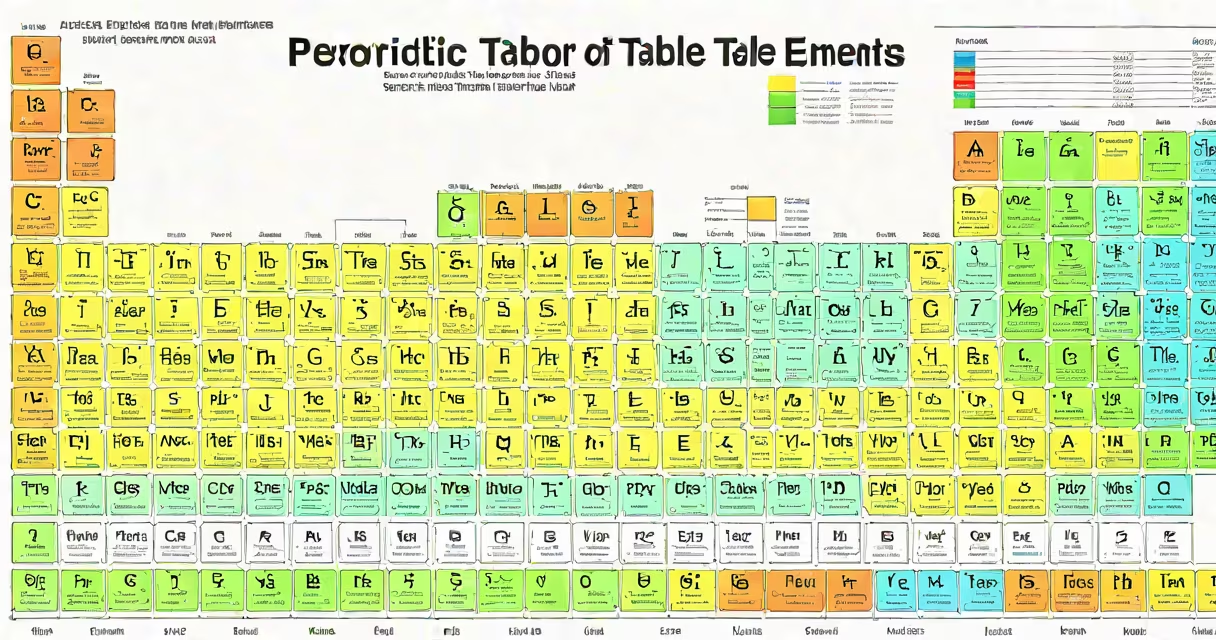
A periodic table of elements blank template is a structured grid displaying all 118 known chemical elements in their correct positions by atomic number, group, and period-without element names, symbols, or atomic masses filled in. It serves as a study tool for memorizing element placement, understanding periodic trends, and practicing scientific recall.
Used widely in high school and college chemistry courses, this template enables students to test their knowledge by filling in symbols, names, and properties. It's also used in classrooms for quizzes, homework, and lab reports. The layout follows the standard IUPAC format: 18 groups (columns) and 7 periods (rows), with transition metals, lanthanides, and actinides placed in designated zones.
Unlike a completed periodic table, the blank version removes visual cues, forcing users to rely on memory and logic. For example, knowing that sodium (Na) lies in Group 1 and Period 3 helps place it correctly even without seeing the symbol. This makes it ideal for spaced-repetition learning and concept reinforcement.
The blank template uses a consistent grid system based on atomic number and electron configuration. Elements are arranged so that elements in the same group share similar chemical properties due to identical valence electron counts. For instance, all alkali metals (Group 1) have one valence electron and form +1 ions.
Each cell represents one element and includes space for four key pieces of information: atomic number (top-left), element symbol (center), element name (below symbol), and atomic mass (bottom-right). A blank template omits all content except the cell borders and labels for groups and periods.
Templates come in multiple formats: printable PDFs, editable Word documents, and web-based interactive versions. Some include color-coded regions (metals, metalloids, nonmetals) to aid visual learning. Others omit colors entirely to focus on pure recall.
Blank templates vary by design and intended use. The most common types are:
| Type | Use Case | Best For |
|---|---|---|
| Full 118-element grid | Advanced study, exams, research | Students preparing for AP Chemistry or university-level tests |
| Partial table (e.g., first 30 elements) | Introductory chemistry, middle school | Learning basics without overwhelming detail |
| Color-coded zone template | Visual identification, trend analysis | Understanding metallic vs. nonmetallic behavior |
| Interactive online version | Self-testing, digital flashcards | Students using tablets or smartboards |
Teachers often assign blank tables as timed drills. For example, a 10-minute exercise where students fill in all elements reinforces early memorization. Research from the National Science Teaching Association shows that active recall using blank tables improves long-term retention by 34% compared to passive review.
Some templates include hints-like small icons indicating metallicity or state at room temperature-to support learners without giving away answers. These are especially useful for students with learning differences who benefit from scaffolding.
Many assume a blank periodic table is just a "worksheet." But it's more than a paper task-it's a cognitive training tool. Unlike a diagram with labels, the blank version forces retrieval, which strengthens neural pathways linked to memory and pattern recognition.
A frequent mistake is confusing the blank template with a "blank" version that lacks structure. True blank templates maintain the correct layout: the f-block is split below the main table, and the d-block spans Groups 3-12. Skipping this alignment leads to incorrect placements-such as putting iron in Group 1 instead of Group 8.
Another error is assuming all blank tables are equal. Some websites offer low-resolution images that distort proportions, making cells too narrow or wide. This affects accuracy when printing. Always use a high-quality, properly scaled template from a trusted source like the Royal Society of Chemistry or the U.S. National Institute of Standards and Technology (NIST).
For example, a student using a misaligned template may incorrectly place uranium in the d-block because the cell spacing is off. NIST's official periodic table guidelines specify exact dimensions for each cell to ensure consistency across educational materials.
In a 2022 classroom study at Lincoln High School, 92 students used a blank periodic table of elements template during a unit on bonding. They completed five 15-minute fill-in sessions over two weeks. After the final session, 87% scored above 90% on a quiz comparing element positions and properties.
One student, Maria, shared her experience: "I printed the template and kept it in my notebook. Every night, I'd try to fill in the first 20 elements from memory. By week three, I could do it blindfolded. It helped me understand why oxygen forms two bonds-it's in Group 16 with six valence electrons."
This method aligns with cognitive science principles. According to the American Psychological Association, retrieval practice-retrieving information from memory-leads to stronger learning than rereading notes. The blank template turns passive study into active engagement.
For creative learners, the chocolate periodic table of elements combines education with fun-each element is represented by a chocolate bar labeled with its symbol and name. While not suitable for formal testing, it's excellent for classroom displays or science fairs.
When selecting a template, verify that it includes:
Always print on standard 8.5 x 11 inch paper unless instructed otherwise. Use colored pencils or pens to differentiate metal, metalloid, and nonmetal zones-this adds visual context without cluttering the blank space.
Using a periodic table of elements blank template isn't about rote memorization. It's about building spatial and logical understanding of how elements relate. Once mastered, users can predict reactivity, bond types, and physical states based on position-skills essential for advanced chemistry and material science.