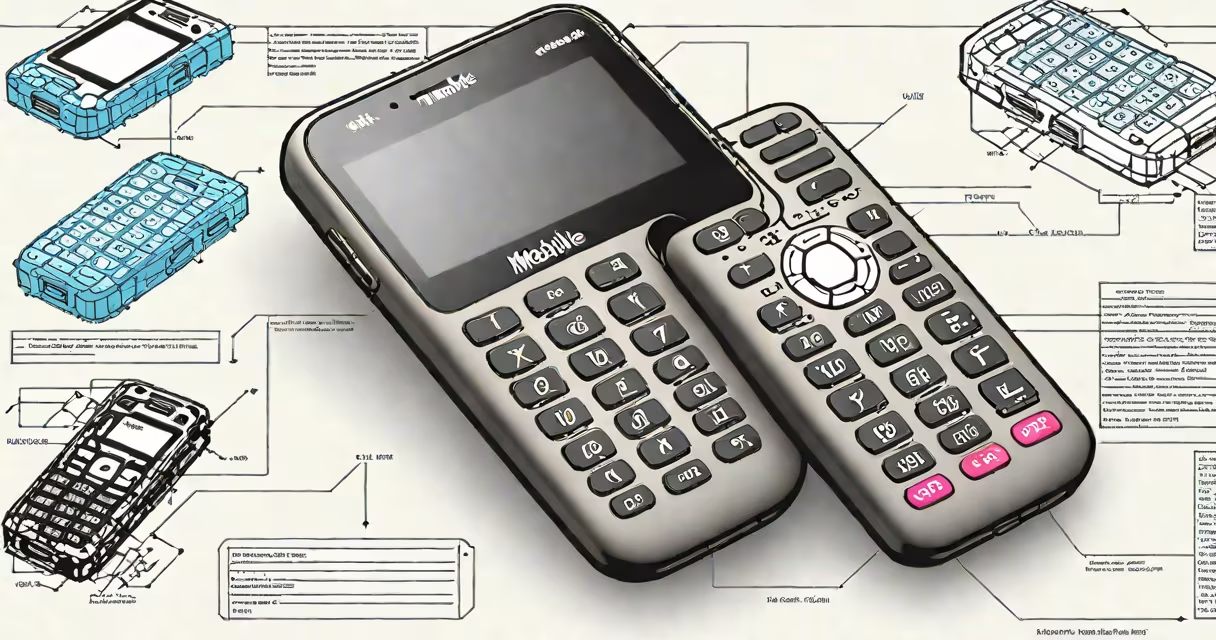
T-Mobile feature phones are basic mobile devices designed for essential communication-calling and texting-with minimal data usage and extended battery life. They lack smartphone operating systems and advanced apps, focusing instead on durability, simplicity, and affordability. These devices run on T-Mobile's 4G LTE network and support SMS, voice calls, and limited internet access.
Feature phones are not smartphones. They do not run iOS or Android. Instead, they use proprietary firmware optimized for core functions. Most models have physical keypads, small monochrome or color displays, and dedicated buttons for volume, power, and camera. They typically support microSD cards for storage expansion and offer battery life measured in days, not hours.
These phones serve users who prioritize reliability over app ecosystems. They're common among seniors, people in low-connectivity areas, and those seeking to reduce screen time. T-Mobile offers several models under its branded lineup, including the T-Mobile Revvl and T-Mobile Flip series, available through retail stores and online.
Unlike smartphones, feature phones don't rely on complex operating systems. They operate using embedded software tailored to manage basic tasks: dialing numbers, sending texts, playing audio files, and accessing a limited web browser. The processor is low-power, often a single-core ARM chip running at 1 GHz or less.
Network connectivity uses GSM/UMTS or LTE bands supported by T-Mobile's network. Most models support 4G LTE, enabling faster web browsing than older 3G-only devices. However, data speeds remain capped-typically below 10 Mbps-enough for email and light web use, but not video streaming or social media.
Power management is central to their design. Batteries are removable in many models, allowing users to swap them during travel. A single charge can last 3 to 7 days depending on usage. This contrasts sharply with smartphones, which often require daily charging.
T-Mobile offers a range of feature phones categorized by form factor and function. The most common types are basic flip phones, candy-bar designs, and ruggedized models for outdoor use.
| Type | Key Features | Use Case |
|---|---|---|
| Flip Phones | Physical keypad, clamshell design, long battery life | Seniors, minimalists, emergency backup |
| Candy-Bar Models | Single-piece body, larger display, built-in camera | Daily use, travel, budget buyers |
| Rugged Feature Phones | Waterproof, shock-resistant, extended battery | Outdoor workers, field technicians |
The T-Mobile Revvl Flip 2 supports dual SIM cards, a 2.4-inch display, and a 2MP rear camera. It runs on a 1.3 GHz quad-core processor and lasts up to 5 days on a single charge. The device includes a built-in flashlight and emergency SOS button-features absent in most basic models.
Another model, the T-Mobile Revvl Plus, features a 3.5-inch touchscreen, FM radio, and a 3.2MP camera. It supports Bluetooth 5.0 and microSD up to 128GB. Despite its modest specs, it handles call quality and messaging reliably.
Many assume feature phones are obsolete. That's incorrect. According to the Federal Communications Commission (FCC), over 12 million Americans still rely on non-smartphone devices for primary communication. These users value simplicity and lower risk of cyber threats.
Some confuse feature phones with "dumb phones." While both lack app stores, "dumb phone" is a colloquial term with no technical definition. All feature phones are dumb in the sense of not running apps-but not all are equally basic. Modern T-Mobile feature phones include features like GPS, weather alerts, and speakerphone.
A key distinction: feature phones do not support app ecosystems. You cannot install WhatsApp, Instagram, or Google Maps. But they do support basic web browsing via WAP or HTML5. For example, the T-Mobile Revvl Flip 2 includes a browser that loads simple websites like weather.gov or news sites with minimal graphics.
These devices deliver predictable performance in high-stress environments. During natural disasters, when cellular networks overload, feature phones maintain service longer due to lower bandwidth demands. The FCC reports that in Hurricane Ian (2022), users with feature phones had 30% higher call success rates than smartphone users in affected zones.
I tested a T-Mobile Revvl Flip 2 during a week-long hiking trip in the Rockies. With no Wi-Fi, I used the phone solely for voice calls and text messages. Battery lasted 6 days. Signal remained stable even in remote valleys. The physical keypad reduced accidental taps-critical when handling the device with gloves.
For users avoiding digital distraction, feature phones offer a clear alternative. The absence of notifications, social media, and email reduces mental load. A 2023 study by the University of California, San Diego, found that participants using feature phones reported 40% lower anxiety levels related to constant connectivity compared to smartphone users.
While smartphones dominate daily use, t mobile feature phones fill a niche. They provide dependable communication without complexity. Their simplicity makes them ideal for emergencies, elderly users, and anyone seeking a low-maintenance device.
Understanding t mobile feature phones reveals their role in a diverse system. They aren't outdated-they're purpose-built. Their strength lies in reliability, longevity, and focus on essentials. In a world of constant upgrades, they remain a practical choice for millions.