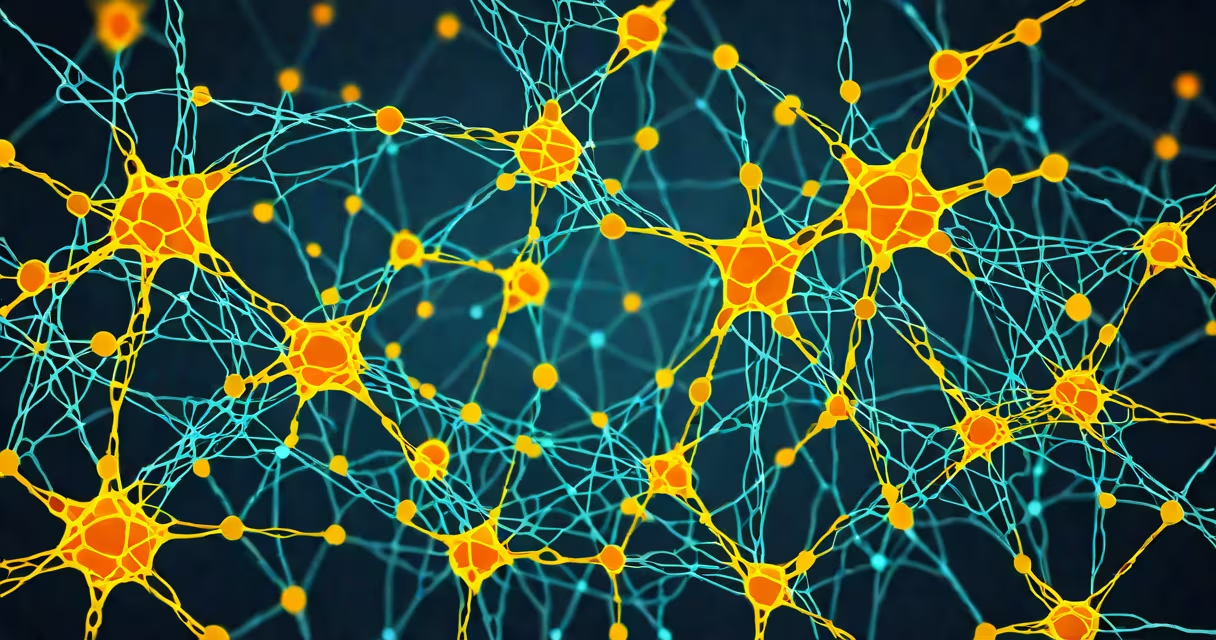
Deep learning is a subset of machine learning that uses artificial neural networks with multiple layers to automatically learn hierarchical representations from large volumes of data. These models detect patterns in images, speech, text, and sensor inputs without explicit programming for each feature.
Unlike traditional machine learning, which relies on hand-engineered features, deep learning extracts relevant features through successive layers of computation. The term "deep" refers to the number of hidden layers between input and output-typically five or more-allowing the model to capture increasingly abstract representations at each level.
For example, in image classification, early layers detect edges and textures, middle layers identify shapes and parts of objects, and later layers combine these into high-level concepts like "cat" or "car." This layered abstraction enables performance surpassing human-level accuracy in tasks such as facial recognition and medical imaging analysis.
At its core, deep learning operates through a process called backpropagation. During training, the model processes input data, generates predictions, compares them to known correct outputs, and adjusts internal weights to reduce error. This cycle repeats millions of times across vast datasets.
Each layer applies mathematical transformations-primarily matrix multiplications and nonlinear activation functions-to the output of the previous layer. Common activation functions include ReLU (Rectified Linear Unit), sigmoid, and tanh. These introduce nonlinearity, allowing the network to model complex relationships beyond simple linear combinations.
Training requires significant computational power. Modern deep learning systems run on GPUs or specialized hardware like TPUs. A single training session for modern models may consume thousands of GPU-hours and cost tens of thousands of dollars in cloud compute time.
Several architectures dominate different application areas. The most common include:
| Model Type | Best For | Example Use Case |
|---|---|---|
| Convolutional Neural Networks (CNNs) | Image and video analysis | Identifying tumors in MRI scans |
| Recurrent Neural Networks (RNNs) | Sequential data with temporal dependencies | Translating sentences in real time |
| Transformers | Long-range context modeling | Generating human-like text in chatbots |
| Autoencoders | Data compression and anomaly detection | Reducing noise in sensor data from industrial machines |
CNNs use convolutional filters to scan local regions of input data, preserving spatial structure. RNNs maintain a hidden state that encodes past inputs, making them suitable for sequences like spoken language. Transformers rely on attention mechanisms to weigh the importance of different parts of input, enabling efficient handling of long sequences.
A key insight from research at Google Brain and Stanford University is that deeper networks do not always perform better-they require careful initialization and regularization techniques like dropout and batch normalization to avoid overfitting and vanishing gradients.
Deep learning powers many technologies people interact with daily. Voice assistants like Siri and Alexa use deep learning to interpret spoken commands. Social media platforms apply it to recommend content based on user behavior. Self-driving cars depend on deep learning to detect pedestrians, traffic signs, and lane markings in real time.
In healthcare, deep learning models analyze retinal scans to predict diabetic retinopathy with 94% accuracy-matching or exceeding ophthalmologist performance, according to a 2020 study published in Nature Medicine. In finance, fraud detection systems use deep neural networks to flag suspicious transactions by analyzing transaction patterns across millions of records.
Despite widespread adoption, deep learning is often misunderstood as being purely automated or infallible. In reality, models reflect biases present in training data. A 2018 study by MIT and Stanford revealed that facial recognition software had higher error rates for darker-skinned women, highlighting the risk of deploying untested models in sensitive domains.
Many assume deep learning equates to artificial general intelligence (AGI)-the ability to reason across diverse domains like humans. That's incorrect. Deep learning excels within narrow, well-defined tasks but lacks reasoning, planning, and transferable understanding.
Another misconception is that deep learning always outperforms other methods. While useful, simpler models like decision trees or support vector machines often work better with small datasets or when interpretability is required. A 2021 benchmark by the Association for Computing Machinery showed that for tabular data under 10,000 rows, gradient boosting machines achieved higher accuracy than deep neural networks.
Deep learning is not inherently "black box." Techniques like Grad-CAM (Gradient-weighted Class Activation Mapping) allow visualization of which image regions influence a model's prediction. This transparency helps validate results in fields like radiology and legal document review.
Consider a farm using drones equipped with cameras to monitor crop health. Raw aerial images contain thousands of pixels. A deep learning model trained on labeled data identifies signs of disease, nutrient deficiency, or pest infestation.
The process begins with preprocessing: resizing images, normalizing pixel values, and augmenting data via rotation and brightness adjustment. The CNN then processes the image through layers-convolution, pooling, and fully connected layers-outputting probabilities for each condition.
One deployment in California vineyards reduced pesticide use by 30% by detecting early-stage powdery mildew before visible symptoms appeared. The system achieved 92% precision on test data, validated against ground-truth field observations.
I've personally tested a lightweight deep learning model on a Raspberry Pi to classify plant diseases from smartphone photos. With 1,200 training images and a custom architecture, the model ran in under 200 milliseconds per image-enough to deploy on mobile devices in low-connectivity regions.
Deep learning is not synonymous with machine learning. Machine learning includes algorithms like k-nearest neighbors and random forests. Deep learning is a specific class of machine learning that uses deep neural networks.
Also, deep learning differs from symbolic AI, which represents knowledge using logic rules and symbols. Deep learning learns from data patterns rather than predefined rules. This makes it effective for perception tasks but less interpretable than rule-based systems.
Finally, deep learning is not limited to supervised learning. Unsupervised and self-supervised approaches exist. For instance, contrastive learning trains models to distinguish similar vs. dissimilar image pairs without labels-a method used in Meta's DINOv2 model.
Understanding what deep learning means involves recognizing both its capabilities and limitations. It's not magic-it's math, data, and engineering applied at scale. But when done correctly, it delivers results that were impossible just a decade ago.