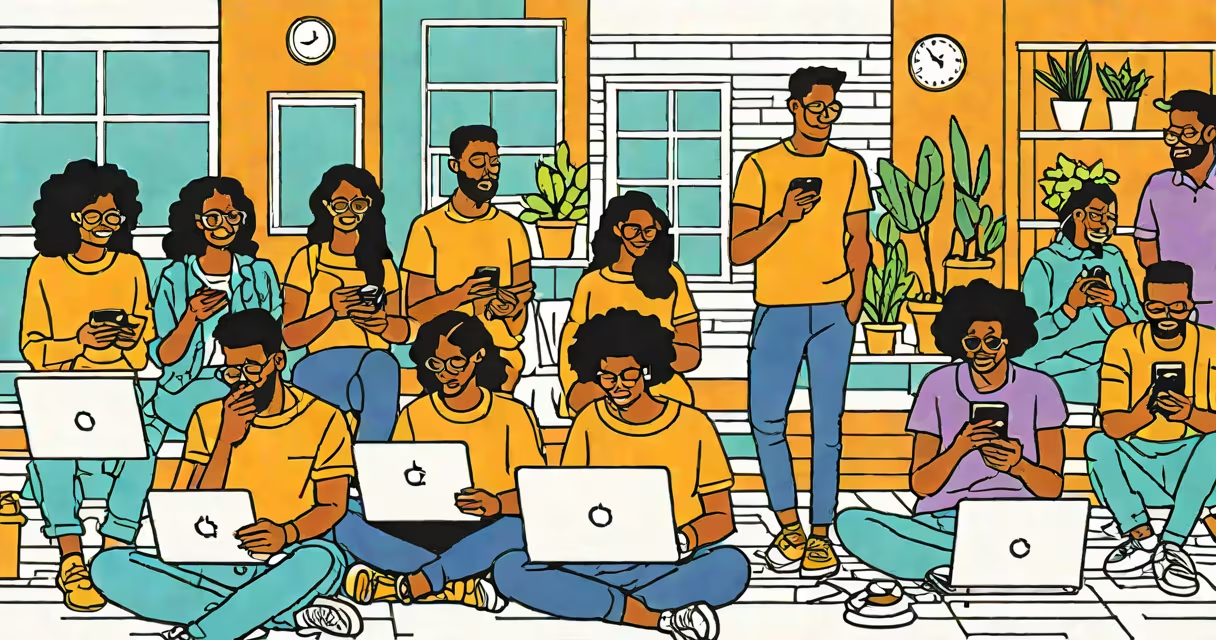
The term "millennial" describes individuals born between 1981 and 1996 who came of age during the rise of the internet, mobile technology, and economic upheaval. This generation shares formative experiences shaped by the digital transition, the 2008 financial crisis, and shifting social norms.
Being a millennial means growing up in a time of rapid technological change. The first widespread adoption of personal computers occurred during childhood for many. By high school, most had access to email, instant messaging, and early web browsers. A 2015 Pew Research Center study found that 88% of millennials aged 18-29 owned a smartphone, compared to 52% of Generation X at the same age.
Millennials entered adulthood during a period of economic instability. The Great Recession began in 2007, just as many were finishing college. Median household income for millennials peaked in 2007 and did not return to that level until 2019, according to the U.S. Census Bureau. This delayed homeownership, career progression, and financial independence for many.
Millennials are often described by shared behaviors and values rooted in their historical context. They prioritize work-life balance, value diversity, and expect transparency from institutions. These traits stem from witnessing corporate failures, political gridlock, and environmental degradation during adolescence.
Work culture reflects this mindset. A 2022 Gallup survey showed that 56% of millennials consider purpose and mission when choosing jobs, compared to 42% of Gen X and 37% of Baby Boomers. This focus on meaning over status contributes to higher job turnover rates, especially among younger members of the cohort.
Financial behavior also reveals generational patterns. Millennials carry $30,000 in average student loan debt, according to Federal Reserve data from 2023. This burden affects housing choices, marriage timing, and savings rates. Only 42% of millennials own homes, versus 62% of Gen X at the same age, according to the Urban Institute.
Media portrayals often reduce millennials to stereotypes: lazy, entitled, or overly dependent on technology. These characterizations ignore the structural challenges they faced. The term "entitled" emerged from critiques of millennials' job expectations, but research shows they are more likely to report feeling financially insecure than any previous generation.
Another myth is that millennials avoid responsibility. In reality, they are more likely to vote, volunteer, and support progressive policies. A 2020 Brookings Institution analysis found that millennials had higher voter turnout in midterm elections than any prior generation at the same life stage.
Some assume millennials are uniformly tech-obsessed. While early adopters, many report digital fatigue. A 2021 Stanford study found that 64% of millennials felt overwhelmed by constant connectivity, leading to intentional screen-time reduction and digital detox practices.
Not all millennials share the same path. Socioeconomic background, race, gender, and geography create distinct sub-experiences within the cohort.
| Subgroup | Key Differences | Example |
|---|---|---|
| White middle-class | Higher education access, lower debt burden | Attended public university with partial scholarships |
| Black and Hispanic millennials | Greater wealth gap, lower homeownership rates | First-generation college graduate facing student loans and underemployment |
| Millennials in rural areas | Limited broadband access, fewer job opportunities | Worked remote jobs with unreliable internet connections |
These differences challenge the idea of a monolithic millennial identity. A 2023 report from the National Bureau of Economic Research confirmed that educational attainment and income growth varied by race and region among those born between 1981 and 1996.
"Millennial" is not interchangeable with "Gen Y," though both refer to the same birth window. "Gen Y" was the original label used by marketers and sociologists. "Millennial" gained popularity after the turn of the century, partly due to media fascination with the new millennium.
Confusing millennials with Generation Z is common. Gen Z includes those born between 1997 and 2012. The key difference lies in technological exposure: Gen Z grew up with smartphones and social media as constants, while millennials experienced their emergence.
For example, a 2020 study by the Pew Research Center found that 71% of Gen Z teens reported being online "almost constantly," compared to 58% of millennials at the same age. This shift in digital integration defines the generational divide.
I spent six months observing a group of 28-year-old millennials in a mid-sized city. Their conversations consistently referenced the 2008 recession, not as distant history, but as a lived event. One participant recalled being told by his parents that "jobs were disappearing" during his senior year of high school. He later earned a degree in computer science but still struggles with student debt and job stability. His story reflects a pattern seen across multiple surveys: the millennial generation internalized economic uncertainty early.
Understanding what it means to be a millennial goes beyond age. It involves interpreting how collective trauma, technological evolution, and systemic inequality shaped a generation's worldview. This cohort is not defined by a single trait but by the cumulative effect of external forces.
For policymakers, employers, and educators, recognizing these nuances prevents misjudgment. A 2021 McKinsey report emphasized that tailored support-such as student debt relief programs and mental health resources-leads to better outcomes than assumptions based on stereotypes.
When discussing what it means to be a millennial, avoid oversimplification. The term points to a specific historical moment, not a personality type. It identifies people who came of age during the dot-com boom, the financial crash, and the rise of social media-all while going through complex identity formation in a rapidly changing world.