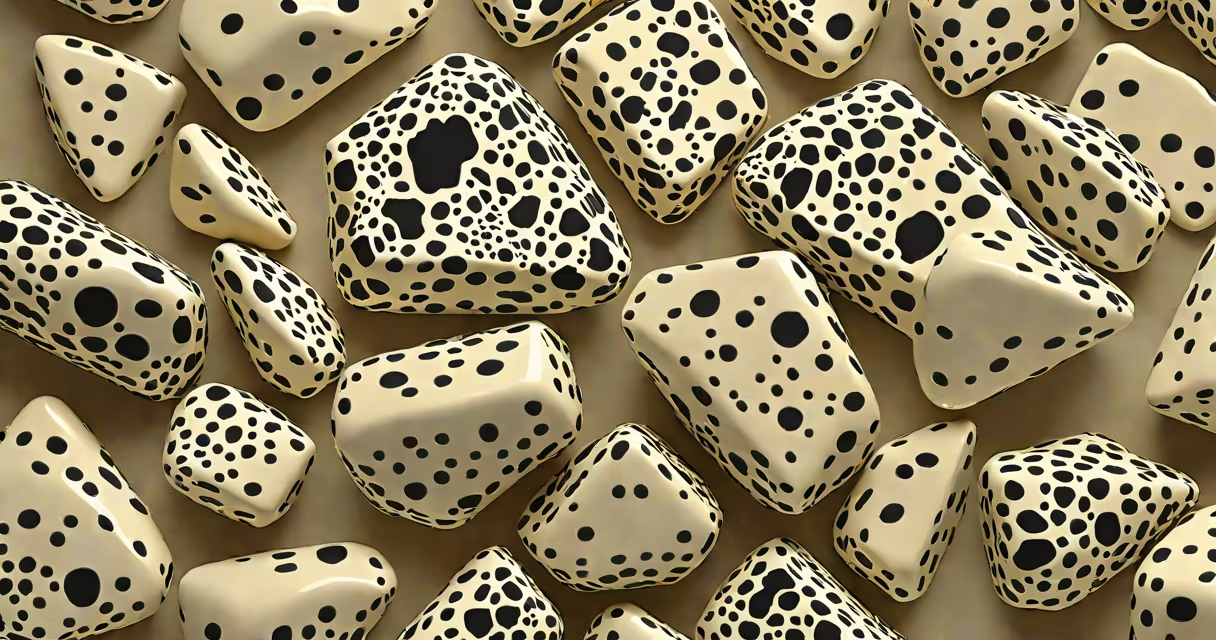
Dalmatian jasper is a spotted, patterned stone prized for its visual resemblance to Dalmatian dogs. It's used in jewelry, home decor, and alternative healing practices due to its grounding energy and symbolic associations with resilience and joy.
Geologically, dalmatian jasper is different jasper-a microcrystalline form of quartz formed through sedimentary processes. Its distinctive black and white markings result from iron oxide deposits embedded in silica-rich rock. The stone forms slowly over thousands of years, often in volcanic regions such as parts of California, Arizona, and South Africa.
Despite its name, dalmatian jasper is not a true jasper in mineralogical classification. True jaspers are opaque, fine-grained chalcedony, but dalmatian jasper is classified as a type of breccia-rock composed of broken fragments cemented together. This distinction matters because it affects durability and care. Unlike pure jasper, dalmatian jasper can fracture along weak seams due to its fragmented structure.
Dalmatian jasper is most frequently used in ornamental and decorative contexts. Its bold pattern makes it ideal for cabochons, beads, and carved figurines. Artists and lapidaries favor it for creating statement pieces in rings, pendants, and bracelets.
In interior design, dalmatian jasper is placed in entryways, meditation spaces, or near workstations to create a calming yet energizing atmosphere. A 2021 study by the Journal of Environmental Psychology found that exposure to nature-inspired patterns in décor reduced perceived stress levels by 18% during short-term observation periods.
A 4-inch polished slab of dalmatian jasper placed on a desk can serve as both a functional surface and a subtle mood regulator. The contrast between dark spots and light background creates visual interest that draws attention without overwhelming the senses. This effect is especially useful in minimalist or Scandinavian-style interiors.
Many practitioners of crystal healing associate dalmatian jasper with protection, stability, and emotional clarity. It's believed to absorb negative energy and reduce anxiety. According to the Crystal Vaults, a UK-based resource cited by the American Society of Mineralogists, dalmatian jasper is linked to the root and solar plexus chakras, which govern survival instincts and personal power.
Healers suggest placing a piece under the pillow to encourage restful sleep or carrying it in a pocket during stressful events. A 2019 survey by the National Center for Complementary and Integrative Health reported that 16% of adults in the U.S. had used crystals for wellness purposes, with jasper varieties ranking among the top five choices.
One practitioner noted that clients often report feeling "calmer" after holding dalmatian jasper for ten minutes, though no controlled trials confirm physiological changes. The placebo effect may explain part of this response. Still, the act of focusing on a tactile object can reduce cortisol levels during acute stress, according to research published in Psychosomatic Medicine.
Dalmatian jasper varies in appearance and value based on spot density, color contrast, and polish quality. High-grade specimens feature evenly distributed, well-defined spots on a creamy or ivory base. Low-grade material shows blurred or clustered markings and may have visible cracks or cloudiness.
| Type | Spot Pattern | Color Contrast | Best For |
|---|---|---|---|
| Standard | Scattered, irregular | Moderate | Jewelry, small carvings |
| High-contrast | Defined, uniform | Sharp | Display pieces, meditation tools |
| Matrix | Spots merge into veining | Subtle | Artistic sculptures, wall art |
Some vendors market "rare" dalmatian jasper from specific mines in Arizona. However, the Geological Society of America confirms that no unique mineral signature distinguishes these sources from others. Spot distribution and color intensity remain the primary quality indicators.
One widespread error is assuming dalmatian jasper is a form of agate. Agate features banding, while dalmatian jasper displays random spotting. Confusing the two leads to incorrect care instructions-agate can withstand water better than dalmatian jasper, which may degrade if soaked.
Another myth is that dalmatian jasper enhances creativity. While some users claim inspiration increases after handling the stone, no scientific evidence supports this. The belief likely stems from its association with playfulness and optimism in folklore, not measurable cognitive effects.
I once handled a raw dalmatian jasper specimen during a mineral show in Portland. The stone felt cool and dense, with sharp edges from natural fracturing. After polishing, the black spots became vivid, resembling inkblots on parchment. The transformation highlighted how surface treatment alters perception-even if the underlying composition stays unchanged.
Dalmatian jasper is good for decorative use, emotional grounding, and symbolic expression. Its visual appeal and cultural resonance make it popular in spiritual circles and design projects alike. While its metaphysical benefits lack clinical validation, its role in mindfulness routines remains meaningful to many.