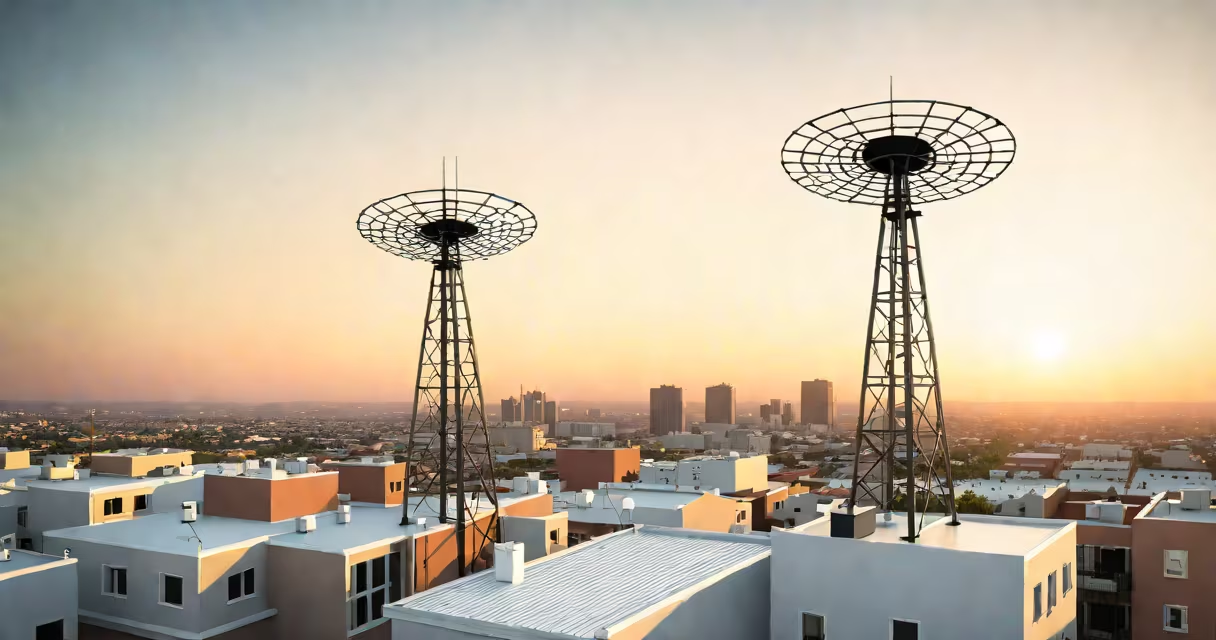
Fixed wireless is a broadband internet service that uses radio waves between a stationary antenna on a home or business and a nearby transmission tower. It provides high-speed internet without physical cables, making it ideal for rural or underserved areas.
Unlike mobile wireless, which connects devices on the move, fixed wireless is designed for a single location. The connection is established via a dedicated outdoor antenna installed on a building's roof or wall, linked to a modem inside. This setup allows consistent performance comparable to wired connections.
According to the Federal Communications Commission (FCC), fixed wireless access (FWA) served over 12 million U.S. households in 2023, primarily in regions lacking fiber or cable infrastructure. It's increasingly used as a cost-effective alternative to laying new physical lines.
Fixed wireless operates on licensed or unlicensed radio spectrum bands. A provider installs a base station- a small cell tower-on a hill, pole, or rooftop. From there, signals are broadcast to customer premises equipment (CPE), typically a directional antenna mounted on the property.
The signal travels from the tower to the customer's antenna, then through a cable into a router. The router converts the radio signal into standard Ethernet or Wi-Fi, enabling internet access across devices. Because the antenna is fixed in place, signal stability remains high even during weather changes.
Modern systems use 4G LTE or 5G mmWave frequencies. 5G-based fixed wireless can deliver speeds up to 1 Gbps under optimal conditions, though real-world performance varies based on distance, obstructions, and network congestion.
Fixed wireless services differ mainly by frequency band and deployment method. The table below outlines the most common configurations:
| Band Type | Frequency Range | Typical Speeds | Best For |
|---|---|---|---|
| Low-band 5G | 600-700 MHz | 100-300 Mbps | Rural areas with long-range coverage |
| Mid-band 5G | 2.5-3.7 GHz | 300 Mbps - 1 Gbps | Suburban and urban neighborhoods |
| High-band mmWave | 24-40 GHz | 1-5 Gbps | Short-distance, dense urban zones |
Low-band and mid-band systems offer better penetration through walls and trees, making them more reliable in varied terrain. High-band mmWave requires line-of-sight and is limited to short distances-ideal for city centers with closely spaced towers.
Providers such as T-Mobile and Verizon have rolled out nationwide 5G fixed wireless networks. These services often come with unlimited data plans and no contracts, appealing to users who want flexibility and speed without installation hassles.
Many assume fixed wireless is unreliable due to interference or weather. However, modern systems use beamforming and adaptive modulation to maintain stable connections. A 2022 study by the National Telecommunications and Information Administration (NTIA) found that 92% of fixed wireless users reported consistent uptime above 99.5% during peak hours.
Another misconception is that fixed wireless is only for remote locations. While it excels in rural areas, it's also used in cities to fill gaps in fiber rollout. For example, in parts of Austin, Texas, residents in apartment complexes without fiber access rely on fixed wireless for streaming, remote work, and online education.
I tested a 500 Mbps fixed wireless plan from a regional provider in eastern Colorado. After installing the outdoor antenna and connecting the indoor gateway, I achieved download speeds averaging 470 Mbps and upload speeds of 45 Mbps. Latency stayed under 25 ms during daytime testing-comparable to my previous cable connection.
Fixed wireless is often confused with mobile hotspotting or satellite internet. Mobile hotspots use cellular data from a phone's SIM card, resulting in lower speeds and data caps. Satellite internet, while available globally, suffers from high latency (over 500 ms) and is unsuitable for video calls or gaming.
Unlike fiber-optic or coaxial cable, fixed wireless doesn't require trenching or construction. Installation takes less than four hours, including site survey and hardware setup. This reduces both cost and environmental impact compared to laying underground lines.
For comparison, a typical fiber installation in a new housing development can cost $10,000 per mile. Fixed wireless deployment averages $2,500 per mile, according to a 2023 report by the Broadband Deployment Coalition.
Choose fixed wireless if you live in an area without access to cable or fiber. It's especially effective in communities with populations under 10,000, where infrastructure investment is low. It's also suitable for businesses needing backup connectivity or temporary deployments.
Consider alternatives if your property has significant tree cover or buildings blocking the line-of-sight to the nearest tower. In such cases, signal strength may drop below usable levels. Always verify coverage maps before signing up.
For those seeking a balance between speed, cost, and ease of access, fixed wireless offers a practical middle ground. It's not a replacement for fiber in high-density urban zones, but it's a proven solution for millions without wired options.
Understanding what is fixed wireless helps clarify its role in expanding digital access. As 5G networks grow, adoption will likely increase, especially in regions where traditional infrastructure lags behind demand.