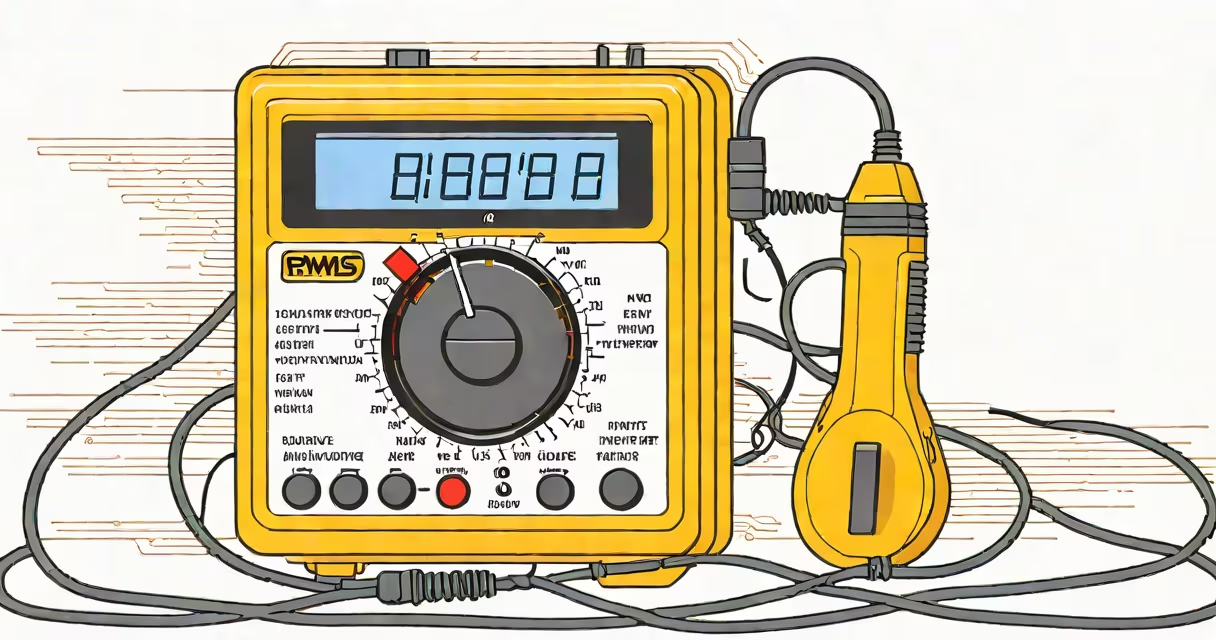
A true RMS multimeter measures the effective value of alternating current or voltage, providing accurate readings even when the waveform is non-sinusoidal. Unlike average-responding meters, it calculates root mean square values mathematically, ensuring precision across complex signals like those from variable frequency drives or dimmer circuits.
True RMS multimeters are essential for measuring real power in systems with harmonic distortion. They deliver correct results for both sine waves and irregular waveforms such as square, triangle, or chopped sine waves. This capability makes them indispensable in industrial, HVAC, and electronics troubleshooting environments where signal purity is compromised.
Standard multimeters often misread non-sinusoidal waveforms by assuming they follow a perfect sine pattern. A true RMS meter avoids this error through internal computation using analog multipliers or digital sampling algorithms. The result is a measurement that reflects actual power delivery, not just an approximation.
True RMS calculation involves squaring the instantaneous values of a waveform over time, averaging those squares, then taking the square root of the average. This process yields the effective heating value-the equivalent DC voltage or current that would produce the same thermal effect in a resistor.
For example, a 120V AC sine wave has a peak voltage of about 170V. Its RMS value is 120V because that's the DC equivalent that would generate the same heat in a load. But if the waveform is clipped or distorted-common in modern power supplies-the average-responding meter may read 105V instead of the actual 120V.
True RMS meters sample the waveform hundreds or thousands of times per cycle. They then apply the mathematical formula: √(1/T ∫₀ᵀ v²(t) dt). Modern digital multimeters perform this calculation in real time using microprocessors and high-speed ADCs (analog-to-digital converters).
Not all multimeters labeled "RMS" are true RMS. Some use average-responding circuits with a fixed scaling factor based on sine wave assumptions. These are inaccurate for non-sinusoidal signals and can mislead technicians.
| Type | Measurement Method | Accuracy on Non-Sinusoidal Signals | Use Cases |
|---|---|---|---|
| True RMS | Mathematical RMS calculation via sampling | High (within ±1% typical) | Variable frequency drives, LED lighting, solar inverters |
| Average-Responding (RMS-Calibrated) | Measures average value, scales to RMS assuming sine wave | Low (can be off by 20% or more) | Simple AC circuits with clean sine waves |
For instance, a 100V peak square wave has an RMS value of 100V. An average-responding meter calibrated for sine waves would read around 90V-underestimating the actual energy. A true RMS meter correctly reports 100V.
Industrial settings rely heavily on true RMS meters. A motor control circuit powered by a VFD (variable frequency drive) produces highly distorted waveforms. Using a standard multimeter here risks underestimating current draw, leading to incorrect breaker sizing or overheating components.
Many users assume any meter labeled "RMS" is accurate. That's false. Only meters explicitly rated as "true RMS" provide reliable measurements on non-sinusoidal signals. The label "RMS" alone does not guarantee precision.
One common mistake occurs during HVAC diagnostics. Technicians testing compressor circuits with older average-responding meters may see low current readings due to waveform distortion. This leads to false conclusions about motor health or wiring issues.
I once measured a 240V AC supply feeding a dimmer-controlled lighting system. The average-responding multimeter showed 210V. The true RMS meter read 238V-nearly 10% higher. This difference meant the lights were receiving near-full voltage, not degraded power as the old meter suggested.
According to the IEEE Standard 100-2016, "True RMS instruments shall be used when measuring currents in circuits with harmonic content exceeding 5%." This standard underscores the necessity of proper tools in real-world installations.
When selecting a true RMS multimeter, look for a crest factor rating of at least 3:1. Crest factor is the ratio of peak to RMS value. High crest factors indicate sharp peaks common in switching power supplies. A meter with poor crest factor handling will clip the signal and report falsely low values.
The Fluke 87-V multimeter is a widely used model designed for field service and maintenance. It features a true RMS measurement capability up to 1000V AC, supports frequencies up to 1 kHz, and includes a 3:1 crest factor specification. It also offers auto-ranging, overload protection, and a rugged design suitable for industrial environments.
Another key feature is bandwidth. Most true RMS meters sample at rates above 100 kHz. Higher sampling rates improve accuracy on fast-changing signals. For example, a meter sampling at 1 MHz can resolve transient spikes that slower models miss.
Always verify the manufacturer's specifications. A meter rated for 400V true RMS may only be accurate within ±1% for waveforms below 1 kHz. Beyond that, error margins increase.
For a hands-on look at a professional-grade tool, examine the Fluke 87 true RMS multimeter and its performance in live industrial applications.