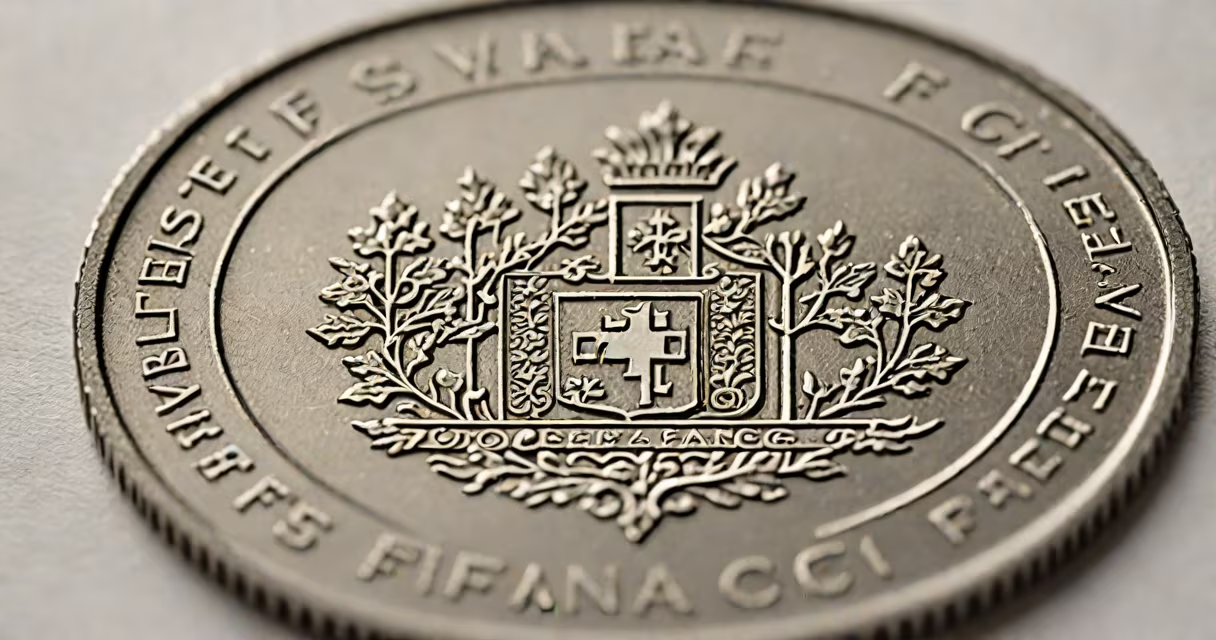
The 1 Swiss franc is a silver-colored coin issued by the Swiss Confederation, valued at 1/100th of a Swiss franc (CHF), and used daily in transactions across Switzerland and Liechtenstein.
Issued since 1968, the 1 Swiss franc coin is part of Switzerland's decimal currency system, where 100 centimes equal 1 Swiss franc. It is minted in a bi-metallic design-outer ring of nickel-plated steel, inner disc of aluminum bronze-making it both durable and distinct in feel. The coin weighs 4.4 grams and measures 23.25 mm in diameter.
Switzerland uses a mix of coins and banknotes. While 10 and 20 franc notes dominate larger purchases, the 1 Swiss franc coin handles small change, such as bus fares, coffee, or snack machines. It is accepted at all Swiss retailers, ATMs, and vending systems.
The 1 Swiss franc coin functions as legal tender within Switzerland and Liechtenstein. It is interchangeable with other denominations and recognized by automated systems, including ticket machines and payment terminals. Unlike paper money, it resists wear and tear, making it ideal for circulation.
Each coin bears a unique design on its reverse side, updated every few years to reflect Swiss culture, science, or history. For example, the 2019 version features the Swiss Federal Palace in Bern, symbolizing national unity. The obverse shows a profile of the Swiss cross and the country's name in four official languages: German, French, Italian, and Romansh.
Despite its low face value, the coin holds intrinsic metal value due to its alloy composition. The outer ring contains iron and nickel, while the inner disc includes copper and aluminum. This prevents counterfeiting and ensures long-term usability.
Since 1968, the 1 Swiss franc coin has undergone several design changes. The original 1968-1995 version was entirely silver-plated, but production shifted to cost-effective alloys in 1996 due to rising silver prices.
| Year Range | Material | Reverse Design Theme | Obverse Language |
|---|---|---|---|
| 1968-1995 | Silver-plated steel | National symbols | German, French, Italian, Romansh |
| 1996-2008 | Nickel-plated steel (ring), aluminum bronze (disc) | Swiss federal institutions | Same four languages |
| 2009-2018 | Same as above | Science and innovation | Four languages |
| 2019-present | Same | National heritage and architecture | Four languages |
Each new design cycle is selected through a public competition organized by the Swiss Federal Office of Finance. The winning theme is then engraved by the Swiss Mint in Bern.
The 1 Swiss franc coin is used in everyday commerce throughout Switzerland. It appears in cash registers, vending machines, and public transport systems. In Zurich, for example, a single ride on the tram costs 3.20 Swiss francs-requiring two 1 Swiss franc coins and two 10-cent coins.
It also serves as a unit of account in financial reporting. While not a primary denomination for large sums, it supports price stability in retail pricing. For instance, a chocolate bar priced at 2.90 Swiss francs requires three 1 Swiss franc coins plus a 10-cent coin.
Outside Switzerland, the 1 Swiss franc coin has limited acceptance. Some border towns in Germany and Italy accept it due to proximity, but most stores require local currency. ATMs in neighboring countries dispense Swiss francs, but exchange rates vary.
Many assume the 1 Swiss franc coin is made of pure silver. It is not. The original 1968-1995 versions were silver-plated, but the current version is composed of nickel-plated steel and aluminum bronze. The silver content in early versions was only 0.018 grams-worth less than 10 cents at today's market price.
Another error is confusing the 1 Swiss franc coin with the 1 Swiss franc banknote. The note is green, printed on polymer, and features a portrait of a famous Swiss figure-such as Albert Einstein in the 2008 series. The coin is smaller, lighter, and designed for frequent handling.
A lesser-known fact: the 1 Swiss franc coin is not used in all Swiss cantons equally. In Ticino, where Italian is spoken, it circulates alongside the euro due to cross-border trade. However, in German-speaking regions like Zurich, it remains the standard.
In 2022, I bought a sandwich at a train station kiosk in Basel. The price was 7.80 Swiss francs. I paid with two 5 Swiss franc notes, received 2.20 Swiss francs in change. That included two 1 Swiss franc coins and two 10-cent coins. The machine rejected a worn 1 Swiss franc coin because the edge lettering was too faint-a feature designed to detect counterfeit attempts.
This incident highlights how the 1 Swiss franc coin integrates into daily life. Its size and weight make it easy to carry. Its design ensures authenticity. And its low value keeps it useful for rounding transactions.
The 1 Swiss franc coin is more than a piece of metal-it's a functional element of Switzerland's monetary system. It supports precise pricing, enables efficient change-making, and reflects national identity through rotating designs. Understanding its role clarifies how small denominations sustain economic stability in a high-value currency environment.