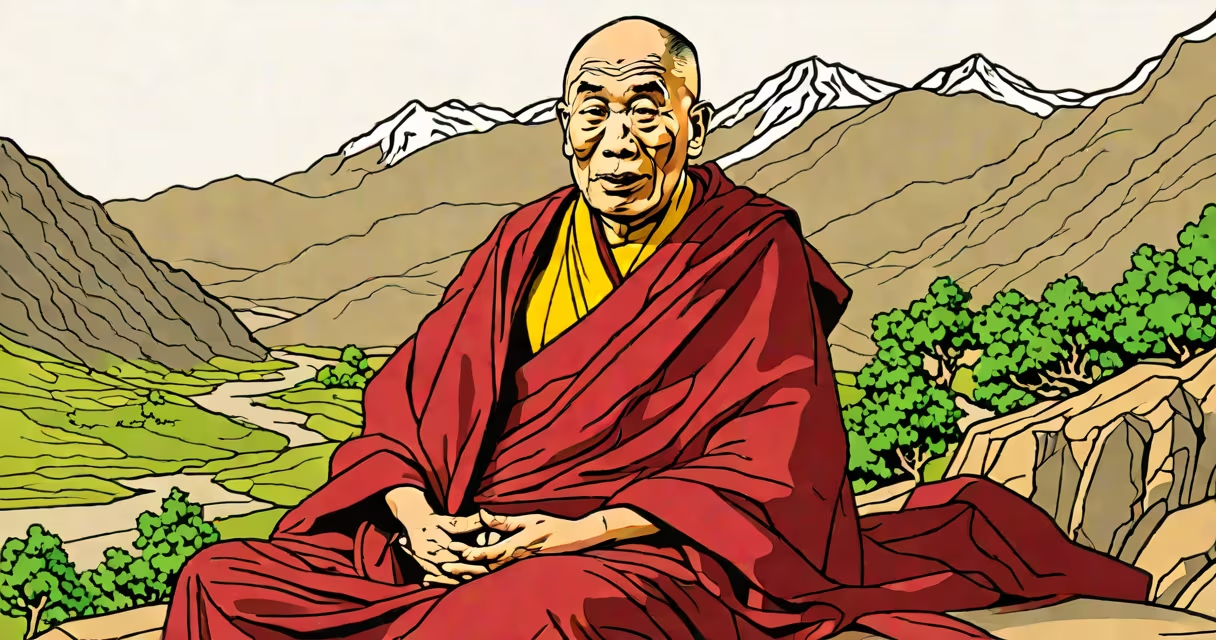
The 14th Dalai Lama is the current spiritual leader of Tibetan Buddhism, recognized by followers in Tibet and around the world as the reincarnated manifestation of Avalokiteśvara, the bodhisattva of compassion. He was born Lhamo Thondup in 1935 in northeastern Tibet and formally enthroned at age five. Since 1959, he has lived in exile in India, where he established a government-in-exile and continues to advocate for Tibetan autonomy.
He is the most recent in a lineage of Dalai Lamas that began in the 14th century. The title "Dalai Lama" was conferred in 1653 by the Qing dynasty emperor, though the tradition predates that. The 14th Dalai Lama's role is both religious and cultural-he leads rituals, teaches Buddhist philosophy, and serves as a moral authority. His teachings emphasize nonviolence, compassion, and interfaith dialogue. He has delivered public lectures in over 60 countries and authored more than 100 books.
His political stance centers on peaceful autonomy for Tibet within China's structure. He has consistently rejected calls for independence, stating that his goal is to preserve Tibetan culture, language, and religion through dialogue. This position contrasts with the Chinese government's view, which regards him as a separatist. Beijing maintains that Tibet has been an inseparable part of Chinese territory since the Yuan Dynasty (13th century).
Tibetan Buddhism uses a system of reincarnation to identify spiritual leaders. When a Dalai Lama dies, senior monks conduct divination rituals using sacred texts, dreams, and signs to locate the next incarnation. The child is then identified through a series of tests, including recognition of personal belongings from the previous Dalai Lama. The process is guided by the Nechung Oracle and the Kashag (Tibetan cabinet).
The 14th Dalai Lama was identified in 1937 after a search across eastern Tibet. He was brought to Lhasa, where he underwent formal education in Buddhist philosophy, logic, and debate. By age 18, he had completed the Geshe Lharampa degree-the highest academic qualification in Tibetan Buddhist monasticism. He served as the head of the Gelug school, one of the four major schools of Tibetan Buddhism.
A key distinction often missed is that the Dalai Lama is not a political ruler by default. While historical figures like the 5th Dalai Lama held temporal power during the 17th century, the 14th Dalai Lama's political role emerged after the 1959 uprising. He assumed leadership of the Central Tibetan Administration (CTA), based in Dharamshala, India, which functions as a de facto government for Tibetans in exile.
The 14th Dalai Lama's influence spans religious, humanitarian, and diplomatic spheres. His teachings are widely studied in universities, particularly in courses on comparative religion and ethics. Institutions such as the University of California, Berkeley, and Oxford's Faculty of Theology have hosted his lectures.
He has received numerous international honors, including the Nobel Peace Prize in 1989. The award citation praised his "non-violent struggle for the liberation of Tibet." His advocacy for human rights and environmental stewardship has drawn support from religious groups, scientists, and activists. In 2011, he formally retired from political leadership, transferring executive authority to an elected leader of the CTA-a move intended to modernize governance and ensure democratic succession.
One non-obvious fact: the Dalai Lama does not claim divine status. He repeatedly states that he is a human being who has undergone training and practice. In a 2008 interview with The New York Times, he said, "I am not a god. I am a monk who tries to live according to the principles of love and compassion." This humility is central to his public persona and distinguishes him from other religious figures who may claim supernatural authority.
Many assume the 14th Dalai Lama seeks full independence for Tibet. This is incorrect. He has publicly stated that he supports a "middle way" approach-meaning meaningful autonomy under Chinese sovereignty. In a 2011 speech at the United Nations, he said, "We do not want to break up China. We want to preserve our identity within China."
Another misconception is that he is a political leader by birthright. While the title carries historical weight, his current role is elective and subject to review. The CTA operates under a constitution adopted in 1991, and leadership positions are filled through democratic processes. The Dalai Lama himself has emphasized that "the institution is not about me-it's about service."
A third error is equating him with the Chinese government's official designation of the "14th Dalai Lama." Beijing does not recognize his legitimacy. In 2009, the Chinese Ministry of Foreign Affairs issued a statement calling him "a traitor to the motherland." The People's Republic of China administers Tibet through the Tibet Autonomous Region, governed by the Chinese Communist Party.
| Aspect | 14th Dalai Lama Position | Chinese Government View |
|---|---|---|
| Political Status | Advocates for autonomy; opposes independence | Denies any separation; considers Tibet part of China |
| Religious Authority | Recognized by Tibetan Buddhists globally | Does not acknowledge spiritual legitimacy |
| Exile Location | Dharamshala, India | Views it as illegal occupation of Chinese territory |
In 2013, I attended a public talk by the 14th Dalai Lama at the University of Michigan. He spoke for 90 minutes without notes, discussing the nature of suffering and the role of mindfulness in daily life. His delivery was calm, precise, and deeply rooted in classical Buddhist texts. Afterward, he spent 45 minutes answering questions in English, Tibetan, and French. The audience included students, professors, and members of the local Tibetan community. The atmosphere was respectful, even solemn-no applause until he finished. That moment confirmed what many scholars have noted: his presence commands attention not through charisma alone, but through intellectual rigor and emotional restraint.
The 14th Dalai Lama remains a central figure in discussions about religion, identity, and statehood. His commitment to nonviolence, cultural preservation, and interfaith understanding continues to shape global discourse. While his views are contested by the Chinese government, his influence extends beyond borders through education, humanitarian work, and ethical philosophy. For those seeking clarity on the 14th Dalai Lama, understanding his dual role-as a spiritual guide and a political advocate-is essential. His legacy rests not on power, but on principle.