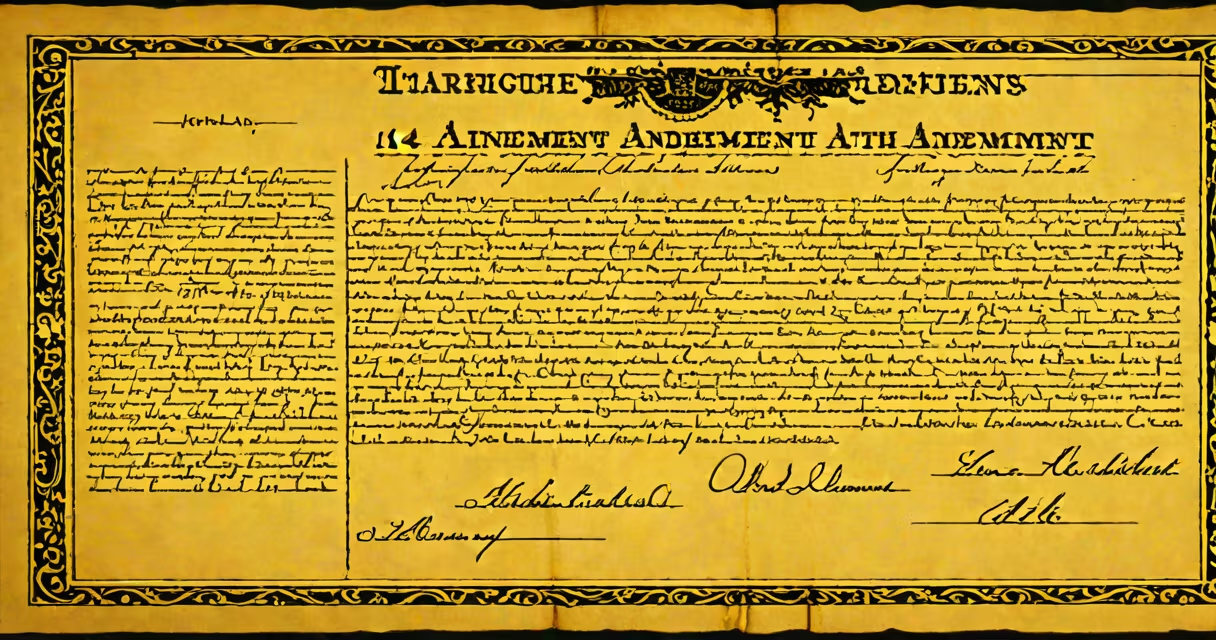
The 14th amendment original text is a constitutional provision ratified in 1868 that grants citizenship to all persons born or naturalized in the United States, mandates equal protection under the law, and requires due process before depriving anyone of life, liberty, or property. It was enacted to secure rights for formerly enslaved people after the Civil War and remains central to U.S. civil rights law.
The amendment consists of five sections. Section 1 defines citizenship, establishes equal protection, and affirms due process. Section 2 addresses representation in Congress based on population, excluding those who participated in rebellion. Section 3 bars former Confederate officials from holding office unless Congress approves. Section 4 confirms federal debt validity and prohibits payment for Confederate war debts. Section 5 empowers Congress to enforce the amendment's provisions through legislation.
Section 1 of the 14th amendment original text states: "All persons born or naturalized in the United States, and subject to the jurisdiction thereof, are citizens of the United States and of the State wherein they reside. No State shall make or enforce any law which shall abridge the privileges or immunities of citizens of the United States; nor shall any State deprive any person of life, liberty, or property, without due process of law; nor deny to any person within its jurisdiction the equal protection of the laws." This language forms the foundation of modern constitutional interpretation.
The amendment operates as a constraint on state power. Before its ratification, states could legally deny rights based on race, gender, or birthplace. The 14th amendment changed that by binding states to federal standards of fairness and justice. When a state law violates equal protection or due process, courts can strike it down using the amendment as a basis.
For example, in Brown v. Board of Education (1954), the Supreme Court ruled that racial segregation in public schools violated the equal protection clause. The decision relied on the 14th amendment original text to declare that separate educational facilities for Black and white students were inherently unequal. This ruling ended legal segregation in education and demonstrated how the amendment enables judicial enforcement of civil rights.
Courts interpret "equal protection" not as identical treatment, but as fair treatment under similar circumstances. A law that treats two groups differently must serve a compelling government interest and be narrowly tailored. For instance, in Obergefell v. Hodges (2015), the Court held that same-sex couples have a constitutional right to marry under the equal protection and due process clauses. The decision applied the 14th amendment original text to extend marriage rights beyond traditional definitions.
The 14th amendment original text contains three core legal principles: citizenship, equal protection, and due process. Citizenship helps anyone born in the U.S. gains automatic status, regardless of parentage. Equal protection prevents states from discriminating against individuals based on race, religion, or other protected categories. Due process protects individuals from arbitrary government action.
| Clause | Meaning | Legal Impact |
|---|---|---|
| Citizenship Clause | Birthright citizenship for all persons born in the U.S. | Established in Wong Kim Ark (1898); applied to children of undocumented immigrants. |
| Equal Protection Clause | No state may deny equal protection of laws. | Used in civil rights cases, including desegregation and LGBTQ+ rights. |
| Due Process Clause | No state may deprive a person of life, liberty, or property without fair procedures. | Extended to privacy rights, such as reproductive freedom and marital choice. |
A common misconception is that the 14th amendment originally applied only to freed slaves. While its primary purpose was to secure rights for newly emancipated African Americans, the language was written broadly to apply to all persons. The Supreme Court affirmed this in Yick Wo v. Hopkins (1886), ruling that even non-citizens are entitled to due process protections under the amendment.
Many assume the 14th amendment original text automatically grants rights to everyone. That's incorrect. The amendment sets procedural and substantive standards but doesn't create new rights on its own. Courts determine whether a law violates the amendment through precedent and constitutional analysis.
Another error is equating "equal protection" with "identical treatment." The amendment does not require identical outcomes or policies. It permits reasonable distinctions based on legitimate state interests. For example, states may impose different taxes on goods based on usage, as long as the classification is rational and not arbitrary.
Some believe the amendment applies only to states. It does not bind the federal government directly. However, the Fifth Amendment's due process clause mirrors the 14th's, allowing similar protections at the national level. The Supreme Court has extended many 14th amendment principles to federal actions through incorporation doctrine.
The 14th amendment original text emerged from Reconstruction-era debates. After the Civil War, Southern states passed Black Codes restricting movement, employment, and voting. Congress responded by passing the Civil Rights Act of 1866, which declared citizenship for all born in the U.S., but President Andrew Johnson vetoed it. Congress overrode the veto and then proposed the 14th amendment to enshrine these rights in the Constitution.
I encountered the amendment's impact firsthand during a 2018 visit to the National Archives. There, I saw the original 14th amendment parchment, signed by Secretary of State William Seward. The document bears faint ink smudges and marginal notes from congressional clerks. Its physical presence underscored how foundational this text is to American identity.
One non-obvious fact: the amendment's wording was deliberately ambiguous in places to allow future interpretation. The phrase "due process of law" was intentionally vague to permit evolving standards of fairness. This flexibility enabled landmark rulings decades later, including Griswold v. Connecticut (1965), which recognized a right to privacy based on due process.
Legal challenges involving voting rights, immigration, and transgender healthcare often cite the 14th amendment original text. In 2023, Texas sued the Biden administration over asylum seeker processing, arguing that denying entry to certain migrants violated due process. The case hinged on whether the government's actions met constitutional standards under the amendment.
State laws regulating abortion access also rely on the amendment. In Dobbs v. Jackson Women's Health Organization (2022), the Supreme Court overturned Roe v. Wade, removing federal protection for abortion rights. But lower courts continue to evaluate state bans using the 14th amendment's equal protection and due process clauses. Some rulings have struck down restrictions as violating fundamental liberties.
When evaluating a claim under the 14th amendment original text, courts apply a tiered standard. Strict scrutiny applies to classifications based on race or fundamental rights. Intermediate scrutiny applies to gender-based laws. Rational basis review is used for economic regulations. The standard determines whether a law passes constitutional muster.
For example, in Lawrence v. Texas (2003), the Court invalidated a Texas law criminalizing same-sex sodomy. The justices ruled that the law violated due process because it infringed on personal autonomy. The decision cited the 14th amendment original text to affirm that intimate relationships are protected under liberty rights.
The 14th amendment original text is closely tied to the broader structure of civil rights. It expanded the reach of the Constitution beyond federal authority to include state conduct. The amendment's influence extends into areas like education, housing, and employment discrimination.
Explore how the 14th amendment and privacy intersect in modern legal decisions. The amendment's due process clause has become a key tool in protecting personal freedoms.
The 14th amendment original text remains a living document. Its language, though written in 1868, continues to evolve through judicial interpretation. It is not static. It adapts to new social realities while maintaining its core promise: that no person shall be denied the rights guaranteed by law.