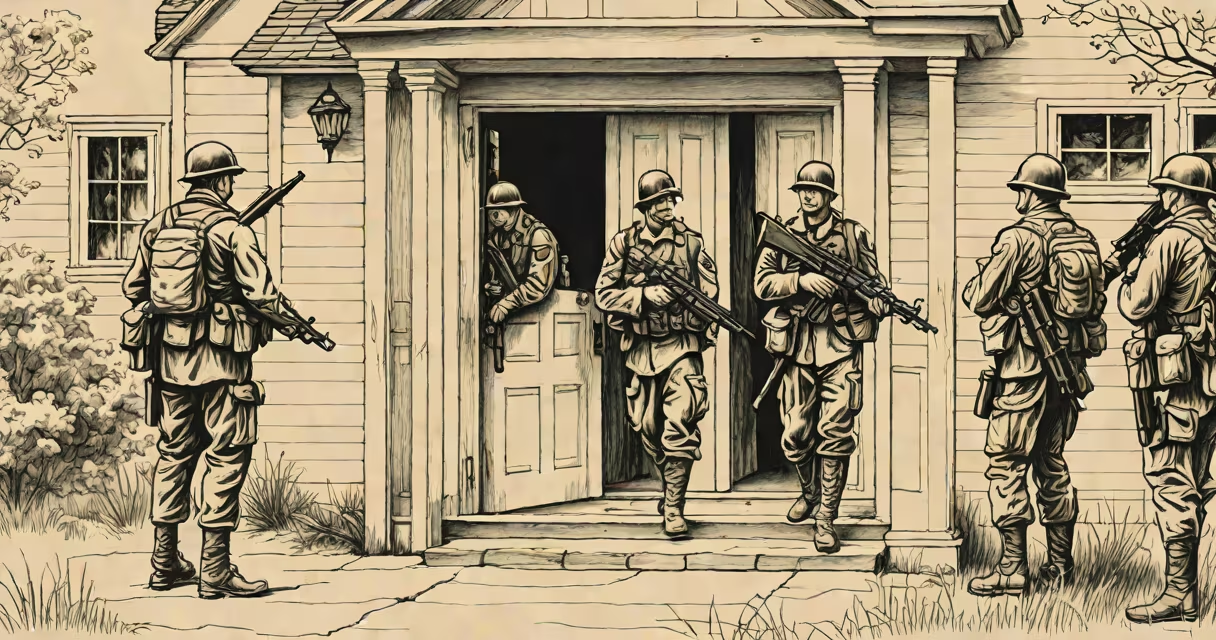
The 3rd and 4th Amendments to the U.S. Constitution prohibit the government from forcing homeowners to house soldiers during peacetime and ban unreasonable searches and seizures without a warrant.
The 3rd Amendment prevents the government from quartering troops in private homes without the owner's consent. This arose from colonial grievances against British troops being billeted in homes during the American Revolution. The 4th Amendment protects individuals from arbitrary intrusions by authorities, requiring a warrant based on probable cause for searches and seizures of property.
These amendments were ratified in 1791 as part of the Bill of Rights. They reflect foundational concerns about personal privacy and limits on state power. The 3rd Amendment is rarely invoked in court, while the 4th Amendment remains central to criminal procedure and civil liberties.
The 3rd Amendment applies only during wartime. During peacetime, no federal or state authority may compel a homeowner to allow soldiers to live in their residence. The amendment does not address military needs during war, nor does it cover temporary stops or emergency situations.
The 4th Amendment requires law enforcement to obtain a judicial warrant before searching a person's home, vehicle, or belongings. A warrant must specify the place to be searched and the items to be seized. Authorities must demonstrate probable cause-that there is a reasonable belief that evidence of a crime exists in the location.
If police conduct a search without a warrant, the evidence collected may be excluded from trial under the exclusionary rule. This rule, established in Mapp v. Ohio (1961), helps constitutional violations do not benefit prosecutors.
While both amendments are part of the Bill of Rights, they differ in application. The 3rd Amendment has never been the basis for a Supreme Court decision involving a living case. The 4th Amendment, however, is routinely applied in cases involving digital surveillance, traffic stops, and border searches.
| Amendment | Core Protection | Common Application | Legal Precedent |
|---|---|---|---|
| 3rd | No forced housing of soldiers in private homes during peacetime | None in modern jurisprudence | Engblom v. Carey (1972) - limited application to prison guards |
| 4th | Protection against unreasonable searches and seizures | Criminal investigations, digital privacy, border searches | California v. Greenwood (1988), Carpenter v. United States (2018) |
The 4th Amendment's reach extends beyond physical spaces. In Carpenter v. United States (2018), the Supreme Court ruled that accessing a person's historical cell-site location data required a warrant. This marked the first time the Court extended the 4th Amendment to digital records.
Many assume the 3rd Amendment still applies to modern military operations. It does not. The U.S. military does not quarter troops in civilian homes. The amendment's relevance lies in symbolic protection of private space from state intrusion.
Some believe the 4th Amendment allows police to search a car without a warrant if they see something illegal in plain view. That is correct-but only under strict conditions. The "plain view" doctrine permits seizure only if the officer is lawfully present and the incriminating nature of the item is immediately apparent.
A common error is thinking that a warrantless search is always unconstitutional. Courts recognize exceptions, such as exigent circumstances (e.g., imminent danger, risk of evidence destruction). However, even in emergencies, courts later review whether the intrusion was justified.
In 2014, police in Florida stopped a driver for a broken taillight. During the stop, they noticed a large amount of marijuana in plain view. They arrested the driver and searched the car, finding additional drugs and weapons. The defendant challenged the search, arguing it violated the 4th Amendment.
The Florida Supreme Court upheld the search. The court ruled that the initial stop was lawful due to the traffic violation. The discovery of the marijuana in plain view gave officers probable cause to search the entire vehicle. The evidence was admitted at trial.
This case illustrates how the 4th Amendment balances public safety and individual rights. Officers can act quickly in emergencies, but their actions remain subject to legal scrutiny.
I once observed a traffic stop in rural Georgia where an officer pulled over a vehicle for speeding. After issuing a warning, the officer asked for consent to search the car. The driver declined. The officer then cited the smell of burnt marijuana coming from the trunk.
Based on that odor, the officer obtained a warrant to search the trunk. He found a small amount of cannabis. The driver later challenged the search, claiming the initial request for consent was coercive. The court ruled that the officer had reasonable suspicion based on the smell, which justified the warrant request.
This case shows how the 4th Amendment operates in practice-not as a rigid barrier, but as a changing standard balancing law enforcement needs and individual rights.
The 3rd Amendment remains relevant as a reminder of the Founders' intent to limit government overreach into private life. Though rarely litigated, it underscores the principle that homes are sanctuaries.
The 4th Amendment is actively enforced in digital contexts. In 2022, the Supreme Court ruled in United States v. Jones that attaching a GPS tracker to a vehicle without a warrant violated the 4th Amendment. The decision affirmed that physical tracking devices constitute a search.
Both amendments form the bedrock of privacy rights in the U.S. While the 3rd Amendment serves largely as a historical safeguard, the 4th Amendment continues to evolve with technology. Its protections extend to biometric data, social media accounts, and internet browsing history.
Understanding the 3rd and 4th Amendments clarifies how constitutional rights apply in daily life. They are not relics-they are living standards that adapt to new challenges.