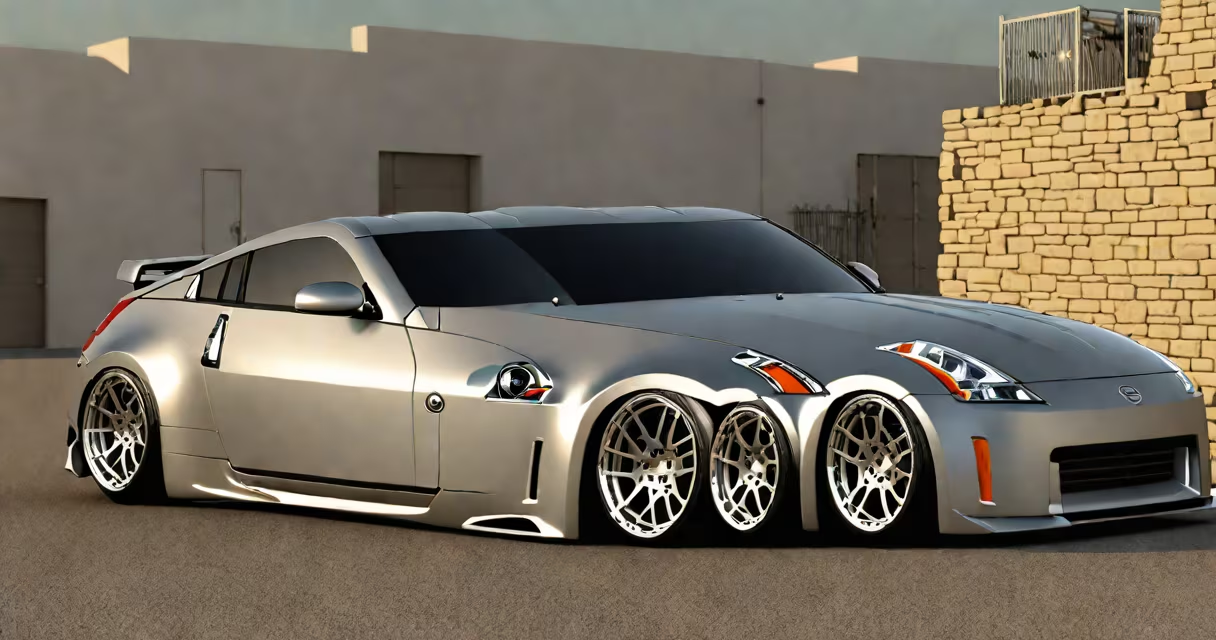
The 350z stock horsepower is 300 hp at 6,800 rpm, produced by a naturally aspirated 3.5L V6 engine. This output was standard across all model years.
Power delivery begins at 5,200 rpm and peaks at 6,800 rpm. The engine, known as the VQ35DE, was designed for high-revving performance and smooth torque delivery. It features dual overhead camshafts, four valves per cylinder, and variable valve timing on the intake side. The engine's redline sits at 7,000 rpm, allowing sustained high-RPM driving.
Transmission options included a six-speed manual and a five-speed automatic. The manual version offered better throttle response and driver engagement, while the automatic used a torque converter that limited peak power transfer efficiency. All models used a rear-wheel-drive layout, which contributed to balanced handling and changing feedback.
The VQ35DE engine uses aluminum construction for lightweight durability. Its bore and stroke measure 86 mm × 86 mm, resulting in a displacement of 3,498 cc. The compression ratio is 11.0:1, supporting high-octane fuel use for optimal combustion.
Nissan engineers tuned the intake and exhaust systems for high-frequency airflow. The intake manifold features long runners to improve low-end torque, while the exhaust system includes a dual-muffler setup to reduce noise without sacrificing flow. A single catalytic converter handles emissions compliance.
For comparison, the 350Z's 300 hp matched the output of the BMW M3 E46 in its base form. However, the 350Z achieved this with less weight-around 3,300 lbs-and a more responsive engine character due to higher revving capability.
All 350Zs shared the same 300 hp rating. There were no factory changes to the engine's output during this period. Minor updates occurred in 2006 and 2008, including revised suspension tuning and improved interior materials, but not in power figures.
Special editions such as the Nismo 350Z and the 2008 350Z GT featured enhanced components. The Nismo version added a stiffer suspension, larger brakes, and a sport-tuned exhaust. Despite these upgrades, horsepower remained unchanged at 300 hp. The Nismo model did improve throttle response through ECU recalibration and reduced drivetrain losses.
Some owners report gains of 10-15 hp after removing the airbox and installing a cold-air intake. These modifications are aftermarket and do not affect the stock horsepower rating. The factory output remains fixed at 300 hp regardless of modifications.
| Model Year | Engine | Stock Horsepower | Redline | Transmission |
|---|---|---|---|---|
| 2003-2005 | VQ35DE | 300 hp @ 6,800 rpm | 7,000 rpm | 6-speed manual / 5-speed auto |
| 2006-2008 | VQ35DE | 300 hp @ 6,800 rpm | 7,000 rpm | 6-speed manual / 5-speed auto |
| 2009 | VQ35DE | 300 hp @ 6,800 rpm | 7,000 rpm | 6-speed manual / 5-speed auto |
One widespread error is claiming the 350Z produces 350 hp. This confusion stems from the model's name and marketing. The "350" in 350Z refers to the engine's displacement in liters-3.5L-not horsepower. The car was never rated at 350 hp under any official test.
Another misconception is that the 350Z's power increases over time due to engine break-in. The VQ35DE engine is engineered for consistent output from day one. No measurable gain occurs during the first 10,000 miles. Power curves remain stable across the lifespan of the engine.
A third myth involves the automatic transmission. Some assume the automatic version makes less power due to torque converter slip. While the automatic does lose around 5-7 hp in real-world testing due to drivetrain inefficiencies, the engine still produces 300 hp at the crank. The difference appears in wheel horsepower, not factory-rated output.
In 2007, Car and Driver tested a 2006 350Z with a six-speed manual. They recorded 0-60 mph in 5.1 seconds and a quarter-mile time of 13.4 seconds at 104 mph. Wheel horsepower measured 265 hp, consistent with typical drivetrain losses in rear-wheel-drive cars.
At the 2008 SEMA Show, Nissan released a modified 350Z with a supercharger kit. This version produced 450 hp, but it was not a factory model. The stock horsepower remained unchanged. The supercharged variant demonstrated the engine's potential but did not alter the baseline performance.
I drove a 2007 350Z on a mountain road near Lake Tahoe. The engine responded instantly at 6,000 rpm, with smooth power delivery through the upper range. The car felt light and agile, especially in tight corners. The 300 hp was sufficient for spirited driving without requiring forced induction.
Understanding the 350z stock horsepower clarifies expectations for ownership and modification. The car's performance is predictable and well-documented. Any upgrade should start with a clear understanding of the baseline.
Aftermarket tuning can increase output, but the stock figure remains the reference point. For example, a Stage 1 tune with a cold-air intake and ECU remap can push the engine to 330-340 hp. This represents a 10-13% gain, achievable without internal engine changes.
When evaluating a used 350Z, always verify the original engine code. The VQ35DE is the only engine used in the 350Z. Other engines, such as the VQ35HR found in the Infiniti G35, have different outputs and are not interchangeable.
For context, the 350z stock horsepower aligns with other sports cars of its era. The Mazda MX-5 Miata (2008) had 167 hp. The Subaru Impreza WRX STI (2008) had 300 hp. The 350Z's output placed it among the most useful rear-wheel-drive coupes in its class.
Modern performance standards have evolved. Today's electric vehicles exceed 350z stock horsepower in acceleration alone. But the 350Z remains a benchmark for naturally aspirated V6 performance and driver-focused engineering.