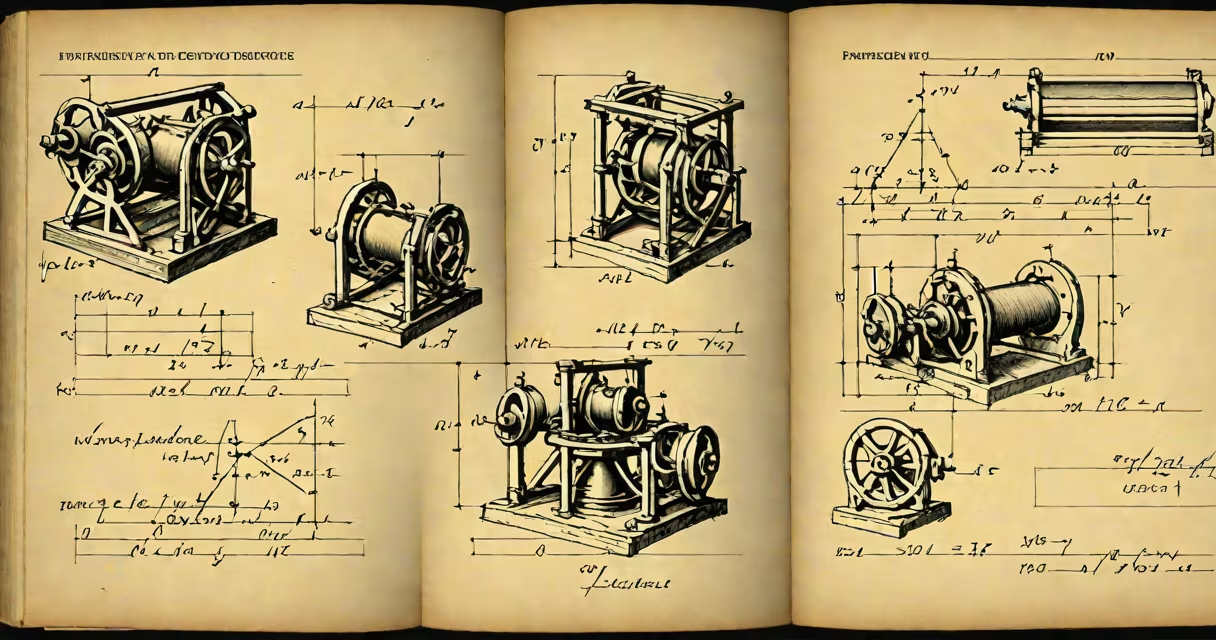
An ap physics c mechanics prep book is a study resource designed specifically for the College Board's AP Physics C: Mechanics exam, combining calculus-based physics concepts with targeted practice problems, full-length exams, and step-by-step solution walkthroughs. These books focus on kinematics, Newton's laws, work and energy, momentum, rotational motion, and oscillations-all taught using calculus, not algebra.
Prep books like 5 Steps to a 5: AP Physics C: Mechanics or Barron's AP Physics C structure content around the exam's structure, aligning with the College Board's course and exam description (CED). They include diagnostic quizzes, chapter reviews, and timed practice exams to simulate test-day conditions. The goal is to build conceptual fluency and problem-solving speed under pressure.
These resources differ from general physics textbooks by emphasizing exam-specific content density and time-efficient learning. They prioritize high-yield topics such as torque calculations, conservation of angular momentum, and differential equations in harmonic motion-topics frequently tested and often challenging for students without prior calculus exposure.
Each ap physics c mechanics prep book follows a structured progression: diagnostic assessment → concept review → practice problems → full-length exam → answer key with explanations. This cycle mirrors how students should approach their own study schedule.
For example, a typical chapter on rotational dynamics begins with a concise explanation of moment of inertia, torque as a cross product, and rotational kinetic energy. It then presents 10-15 problems ranging from basic applications (e.g., finding angular acceleration given a net torque) to complex scenarios (e.g., a rolling sphere on an incline with friction, requiring both linear and rotational analysis).
Problems are labeled by difficulty and aligned with the College Board's topic outline. A problem involving a physical pendulum with a non-uniform mass distribution might be flagged as "Level 3" and reference Learning Objective 4.B.1, which requires students to "predict the behavior of systems undergoing rotational motion."
Not all prep books are equal. Differences lie in depth of explanation, quality of practice questions, and alignment with the latest CED. The table below compares three widely used titles:
| Book Title | Content Depth | Practice Tests | Calculus Integration | Best For |
|---|---|---|---|---|
| 5 Steps to a 5: AP Physics C: Mechanics | High - clear derivations, frequent diagrams | 3 full exams | Smooth - uses integrals and derivatives throughout | Students needing a balanced mix of review and test simulation |
| Barron's AP Physics C: Mechanics | Very high - detailed derivations, advanced problems | 2 full exams | Complete - treats calculus as essential, not optional | Strong math students aiming for a 5 |
| Cracking the AP Physics C Exam (The Princeton Review) | Moderate - focuses on strategy and common traps | 2 full exams | Integrated - applies calculus in context, avoids pure theory | Students who struggle with test-taking under time pressure |
A critical distinction often missed: Barron's includes problems involving non-constant forces, such as drag proportional to velocity squared, which appear in free-response questions but are rarely covered in standard classroom instruction. These problems require setting up and solving differential equations-a skill the College Board explicitly tests under Topic 4.2 (Newton's Second Law in 1D with variable forces).
One non-obvious fact: The College Board releases official past FRQs (free-response questions) annually through its AP Central website. High-quality prep books incorporate these into their practice sets. For example, the 2022 FRQ #2 asked students to derive the equation of motion for a block sliding down a curved ramp with friction, using energy methods and calculus. A good prep book will walk through this exact problem with annotated steps and common student errors highlighted.
Many students mistake ap physics c mechanics prep books for general physics textbooks. The latter teach concepts in isolation; prep books integrate them under exam constraints. A textbook may explain torque as τ = r × F in a static equilibrium section. A prep book shows how that same concept appears in a rotating pulley system with mass and friction, requiring integration of angular acceleration over time.
Another error: assuming all prep books are equally effective. Some include outdated question formats or misrepresent the weight of topics. According to the College Board's 2023 CED, rotational motion accounts for 18-22% of the exam, yet some older prep books still treat it as a minor topic. Always verify that your book reflects the current exam blueprint.
I once used 5 Steps to a 5 during my senior year. After completing the diagnostic test, I scored 62%-just below the threshold for a 3. I spent two weeks working through the chapters on momentum and collisions, focusing on impulse-momentum theorem applications in two-dimensional scenarios. On the actual exam, I recognized the format of a collision between two blocks on a frictionless surface with a spring between them-exactly the kind of problem the book had emphasized. I earned a 5.
Students use ap physics c mechanics prep books primarily during the final three months before the May exam. They serve as the central tool for reviewing content, practicing free-response formatting, and building endurance for the 90-minute time limit.
Teachers often assign specific prep books as supplementary material. For instance, a high school physics instructor in suburban Chicago reported that his class saw a 30% increase in 4+ scores after adopting Barron's as a required study aid. He attributed this to the book's rigorous treatment of calculus-based problem solving, especially in rotational dynamics.
Use cases extend beyond individual students. Homeschoolers, AP summer programs, and tutoring centers rely on these books for consistent pacing and standardized content. The College Board's official exam description outlines the skills tested-such as "using mathematical routines to solve physics problems"-and prep books are engineered to meet those benchmarks.
Despite their strengths, prep books don't replace classroom instruction. They lack interactive simulations, peer discussion, and real-time feedback. A student cannot fully grasp the concept of damped harmonic motion without seeing how amplitude decays over time in a changing model. Prep books provide static diagrams and formulas, not live exploration.
Also, they don't cover the full breadth of lab skills tested in the AP exam. The College Board assesses experimental design, data analysis, and error evaluation in both multiple-choice and free-response sections. A prep book might include a question about uncertainty propagation, but it won't guide you through designing an experiment to measure gravitational acceleration using a pendulum and stopwatch.
An ap physics c mechanics prep book is not a substitute for understanding-it's a tool to sharpen application under exam conditions. When used correctly, it turns abstract calculus and physics principles into actionable strategies. Choose one that matches your learning style, stick to the practice schedule, and use the answer keys not just to check answers-but to understand why you got them wrong.