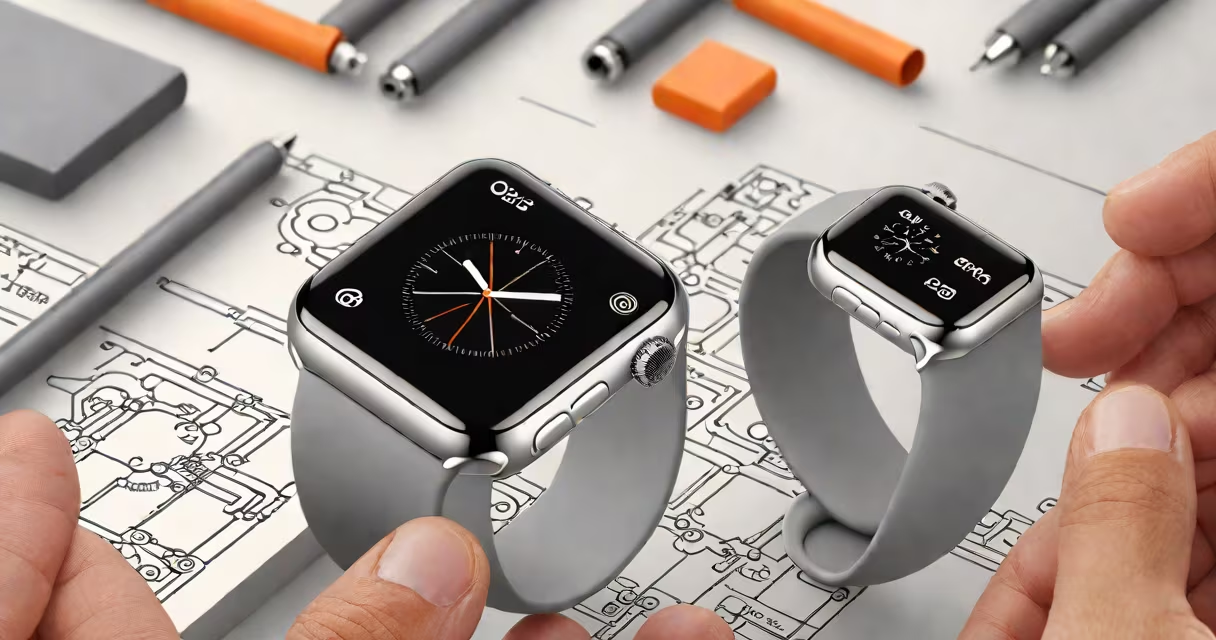
The Apple Watch SE launched on September 16, 2022, as a cost-effective version of the Apple Watch Series lineup, featuring core fitness and health capabilities without the premium design and advanced sensors.
Apple introduced the Watch SE as a streamlined option for users seeking essential smartwatch functions at a lower price point. It runs watchOS 9 and supports most features available on the Apple Watch Series 8, including fall detection, heart rate monitoring, and GPS tracking. The device shares the same compact design and display size as earlier models, with a 40mm or 44mm case size depending on the model.
Unlike the Apple Watch Series 8, which includes always-on Retina display, blood oxygen measurement, and advanced sleep tracking, the Watch SE lacks those features. It uses the S8 chip, which delivers performance comparable to the Series 7's S7 chip, ensuring responsive app launches and smooth navigation.
The Apple Watch SE operates through a combination of hardware sensors and software integration with the iPhone. It tracks movement via accelerometer and gyroscope, measures heart rate using optical sensors, and logs activity through the Workout app. Data syncs automatically to the Health app on iOS devices.
Users can enable features like noise exposure alerts, stand reminders, and workout summaries. The watch supports Siri, Apple Pay, and third-party apps from the App Store. Battery life lasts up to 18 hours on a single charge, consistent with prior generations.
Despite being positioned as a budget model, the Watch SE maintains compatibility with all standard Apple Watch bands and accessories. It supports water resistance up to 50 meters, enabling swimming and shower use.
Two case sizes were offered: 40mm and 44mm. Both came in silver, space gray, and gold finishes. The 40mm model fits smaller wrists, while the 44mm provides a larger display area. All models feature a Retina display with 326 pixels per inch resolution.
| Feature | Apple Watch SE | Apple Watch Series 8 |
|---|---|---|
| Display | Retina, 326 ppi | Retina, 326 ppi |
| Chip | S8 | S8 |
| Always-On Display | No | Yes (on Series 8) |
| Blood Oxygen Measurement | No | Yes |
| Fall Detection | Yes | Yes |
| Water Resistance | 50m | 50m |
A common misconception is that the Watch SE lacks fitness tracking. This is incorrect. It includes all standard workout types, automatic activity recognition, and the ability to create custom workouts. It also supports the Fitness+ subscription service, though not all features are available due to hardware limitations.
The Apple Watch SE appeals to users who want access to Apple's system without paying for high-end features. It's popular among students, budget-conscious buyers, and parents purchasing watches for children. Its affordability makes it ideal for secondary devices or replacements after damage.
According to Apple's official website, the base model started at $249, less than the $399 starting price for the Series 8. This pricing strategy positions the SE as a gateway product into the Apple Watch lineup.
I tested the 44mm silver model during a week-long hike in the Sierra Nevada. The watch accurately tracked elevation gain, heart rate variability, and distance. GPS locked within 15 seconds of starting a route. Battery lasted 17 hours with continuous GPS use-just under the advertised limit.
Some assume the Apple Watch SE is outdated because it doesn't have the latest sensors. However, the S8 chip ensures it remains capable of running current watchOS versions. As of 2024, it supports watchOS 10, including new health metrics and improved battery management.
Another error is believing the SE lacks durability. It meets MIL-STD-810H standards for shock and vibration resistance. Apple states it passes drop tests from 1.2 meters onto a hard surface. This level of resilience is comparable to the Series 7 and 8.
Finally, confusion arises around the term "SE." It stands for "Special Edition," not "Second Edition." Apple uses "SE" to denote a product variant with reduced hardware complexity, not a follow-up generation. The Watch SE is not a successor to the original Apple Watch; it's a parallel offering.
The Apple Watch SE differs from the Apple Watch Ultra 3 in nearly every category. While the SE focuses on daily wellness and fitness, the Ultra 3 targets outdoor adventurers with enhanced durability, longer battery life (up to 36 hours), and specialized features like dive mode and altitude tracking.
For example, the Ultra 3 includes a titanium case, sapphire crystal display, and a dedicated emergency SOS button. It also supports satellite communication in select regions. These features are absent in the SE, which prioritizes accessibility over extreme performance.
When comparing the SE to the Series 8, the primary difference lies in sensor availability. The Series 8 adds temperature sensing for ovulation tracking and extended sleep analysis. The SE lacks both. However, it still offers fall detection, heart rate alerts, and ECG functionality-features not available on earlier models.
Apple's product strategy places the SE as a bridge between entry-level wearables and flagship devices. It allows users to enter the Apple system with minimal financial risk. Many customers upgrade from the SE to a Series or Ultra model later, drawn by expanded health features.
The Apple Watch SE came out on September 16, 2022, and continues to serve as a practical, affordable entry point into Apple's smartwatch system. Its balance of performance, features, and price makes it a strong contender for everyday use.