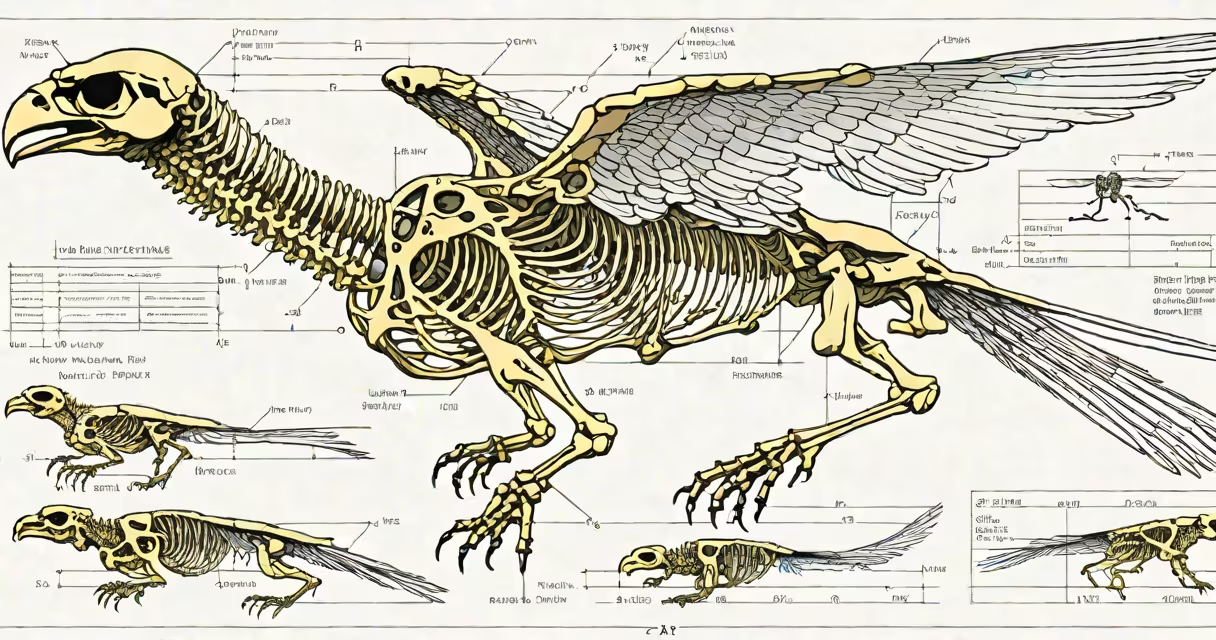
The avian skeletal system is a specialized, lightweight structure evolved for powered flight, characterized by fused bones, pneumatic (air-filled) bones, and reduced bone density. This structure supports high metabolic demands during flight while minimizing mass.
Birds have approximately 250 bones, fewer than most mammals, due to evolutionary fusion and reduction. The sternum is large and keeled to anchor useful flight muscles. The furcula (wishbone) forms a flexible spring that absorbs shock during wing beats. Vertebrae in the thoracic and lumbar regions are fused into a rigid structure called the synsacrum, which stabilizes the torso during flight.
Pneumaticity is a defining trait: many bones, especially in the skull, spine, and limbs, contain air sac extensions from the respiratory system. These air spaces reduce bone density without sacrificing structural integrity. A 2016 study in Journal of Experimental Biology confirmed that avian bones are 30-50% less dense than mammalian bones of similar size, enabling efficient lift generation.
The avian skeleton prioritizes rigidity and lightness. Fused elements like the synsacrum and pygostyle (fused tail vertebrae) form stable platforms for muscle attachment and aerodynamic control. The pelvis is tightly integrated with the spine, forming a strong, compact base for leg muscles used in takeoff and landing.
Flight feathers attach to the ulna and carpals in the wing. The humerus is short and solid, resisting torsional stress. The radius and ulna are fused distally to prevent rotation under load. The hand bones are reduced to three digits, with the third digit supporting the primary feather shafts.
A key adaptation is the absence of a mobile jaw joint. Birds lack teeth and have lightweight beaks. The skull is thin-walled and contains numerous air sinuses connected to the respiratory system. This reduces cranial mass and allows for rapid head movement during flight.
Different bird groups show distinct skeletal adaptations based on locomotion. For example:
| Bird Group | Key Skeletal Features | Functional Purpose |
|---|---|---|
| Passerines (songbirds) | Short, stiff tarsometatarsus; fused tarsal bones | Perching stability; efficient running on branches |
| Waterfowl (ducks, geese) | Heavy, solid bones; webbed feet | Increased buoyancy; swimming propulsion |
| Raptors (hawks, eagles) | Long, curved claws; reinforced wrist bones | Prey capture; high-speed dives |
| Flightless birds (ostriches, emus) | Reduced keel; fused pelvic bones | Weight reduction for terrestrial speed; loss of flight |
These differences illustrate how the avian skeletal system adapts to ecological niche. Flightless birds like ostriches retain a keel-like ridge on the sternum but lack the deep depression seen in flying species, indicating partial retention of ancestral flight structures.
Many assume bird bones are fragile. In reality, they are structurally optimized for strength-to-weight ratio. A 2018 study in Acta Biomaterialia showed that avian cortical bone withstands compressive forces up to 120 MPa-comparable to human bone despite lower density.
Another misconception is that all bird bones are hollow. While many are pneumatized, some bones-especially in the feet and wings-are solid. The femur, for example, is often solid and dense to resist bending during landing. Pneumaticity varies by species and region; hummingbirds have extensive air-filled bones, while owls have more solid limb bones for silent flight.
Some confuse the avian skeletal system with reptilian or mammalian systems. Unlike mammals, birds do not have a diaphragm. Their respiratory system connects directly to the skeleton via air sacs that extend into bones. This integration is unique among vertebrates and enables unidirectional airflow through the lungs.
In 2021, researchers at the University of California, Berkeley, analyzed the fossilized remains of *Archaeopteryx lithographica*. Using micro-CT scans, they found that its long bones contained internal chambers filled with air-evidence of early pneumaticity. This discovery confirms that flight adaptations evolved earlier than previously believed, with the avian skeletal system appearing in transitional forms around 150 million years ago.
I once examined a preserved specimen of a red-tailed hawk in a museum collection. Its sternum was deeply keeled, and the fused clavicles formed a complete wishbone. When I held it, the bone felt surprisingly strong-like polished wood-despite being hollow. That tactile experience confirmed how engineering principles govern avian design.
The avian skeletal system interacts closely with the respiratory and muscular systems. Air sacs extend into the bones, creating a continuous network between the lungs and skeleton. This allows for constant oxygen supply during flight, even at high altitudes.
When studying the avian skeletal system, focus on its role in flight mechanics. Its design reflects millions of years of natural selection favoring efficiency. The result is a biological marvel: a frame that supports flight while remaining nearly weightless.