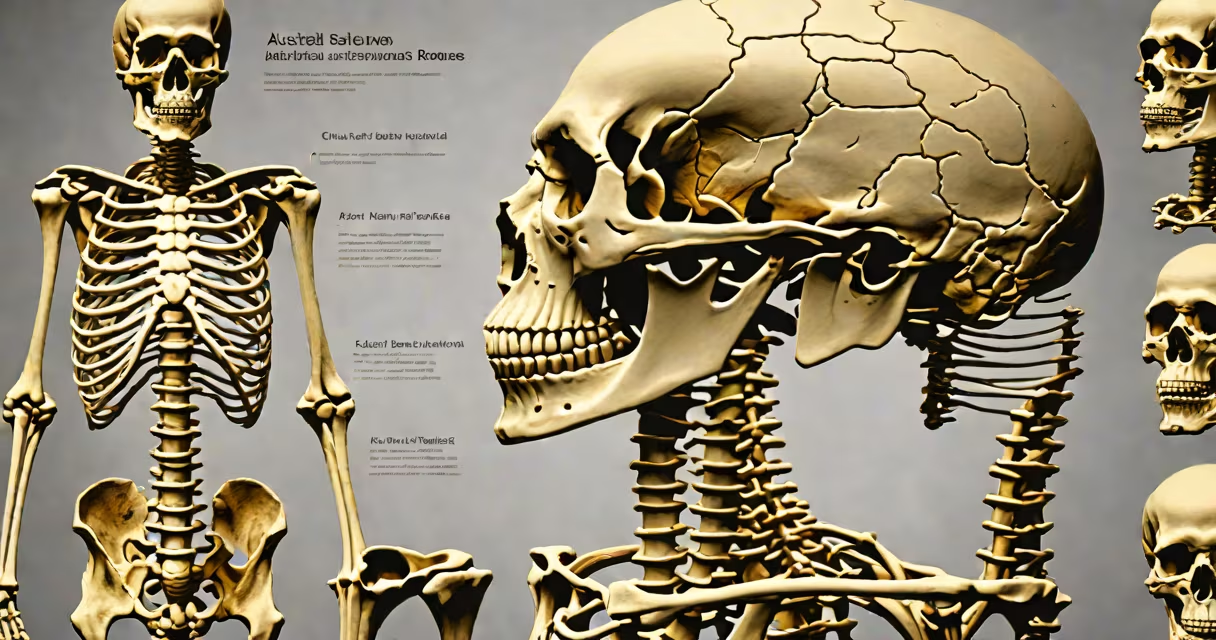
The axial skeleton bones list comprises 80 bones that form the central axis of the human body, including the skull, vertebral column, and rib cage. These bones provide structural support, protect the brain and spinal cord, and anchor muscles involved in breathing and posture.
This system makes up about 80% of the skeleton's total bone count. The axial skeleton differs from the appendicular skeleton, which includes limbs and girdles. Together, both systems maintain balance, allow motion, and shield internal organs.
Understanding the axial skeleton bones list begins with recognizing its three primary components: cranial bones, vertebral column, and thoracic cage. Each serves distinct roles in protection, stability, and biomechanics.
The axial skeleton functions as a rigid structure that supports the head, neck, and trunk. It stabilizes the body during upright movement and absorbs shock from walking or jumping. The spine acts as a load-bearing column, transferring weight from the skull through the pelvis.
Bone density and joint articulation allow controlled motion. For example, the atlanto-occipital joint between the skull and first cervical vertebra permits nodding ("yes") movements. The intervertebral discs between vertebrae act as cushions, reducing friction and distributing pressure.
Internal organs such as the brain, spinal cord, heart, and lungs are protected by bony enclosures. The cranium encases the brain, while the vertebral column surrounds the spinal cord. The rib cage shields the heart and lungs, preventing injury during impact.
The axial skeleton consists of three major groups: cranial bones, vertebral column, and thoracic cage. Below is a breakdown of each group and their constituent bones.
| Group | Bone Type | Number of Bones | Key Functions |
|---|---|---|---|
| Cranial Bones | Skull bones | 22 | Protect brain, house sensory organs, form facial structure |
| Vertebral Column | Spinal vertebrae | 26 | Support spine, protect spinal cord, enable flexible motion |
| Thoracic Cage | Ribs, sternum | 25 | Shield heart and lungs, assist in respiration |
Among the 22 cranial bones, 8 are cranial vault bones: frontal, occipital, two parietal, two temporal, and sphenoid. The remaining 14 include facial bones such as the maxilla, mandible, nasal, and zygomatic bones. These contribute to facial expression, mastication, and airway passage.
The vertebral column contains seven cervical, twelve thoracic, five lumbar, five fused sacral, and four coccygeal vertebrae. The sacrum forms a single bone after fusion, contributing to pelvic stability. The coccyx, though small, aids in sitting balance and muscle attachment.
The thoracic cage includes 12 pairs of ribs (24 total), the sternum (1 bone), and costal cartilages. True ribs (1-7) attach directly to the sternum via cartilage. False ribs (8-10) connect indirectly. Floating ribs (11-12) have no anterior attachment.
The axial skeleton enables essential daily functions. It maintains upright posture, allowing humans to stand and walk efficiently. Without this structure, coordinated movement would be impossible due to lack of stability and use.
Respiration relies heavily on the thoracic cage. During inhalation, the diaphragm contracts and the rib cage expands. This increases chest volume, drawing air into the lungs. The sternum moves upward and outward, driven by intercostal muscles attached to the ribs.
Neurological protection is critical. The cranium's thickness averages 5 mm in adults, providing resistance to trauma. The vertebral canal houses the spinal cord, which transmits signals between the brain and peripheral nerves. Damage to this region can result in paralysis or loss of sensation.
A clinical example: a patient with a fractured T12 vertebra may experience lower limb weakness due to compression of spinal nerve roots. Imaging confirms displacement, and surgical stabilization prevents further neurological decline. This highlights the functional necessity of spinal integrity.
Many assume the axial skeleton includes the pelvis. It does not. The pelvis belongs to the appendicular skeleton, formed by the hip bones (ilium, ischium, pubis) and sacrum. While the sacrum is part of the axial skeleton, the rest of the pelvis is not.
Another error is equating "skull" with "cranial bones." The skull includes both cranial and facial bones. The term "cranium" refers only to the bones enclosing the brain. Facial bones like the mandible and maxilla are separate structures involved in chewing and speech.
A lesser-known fact: the hyoid bone is part of the axial skeleton but is not connected to any other bone. It sits beneath the mandible and supports the tongue and larynx. Its unique suspension allows for precise control during swallowing and vocalization.
I once observed a cadaver dissection where a student mislabeled the hyoid as a cervical vertebra. The instructor corrected it, emphasizing that although the hyoid lies in the neck, it lacks a bony connection to the spine and is not a vertebra.
The axial skeleton contrasts sharply with the appendicular skeleton in function and composition. While the axial system focuses on protection and central support, the appendicular system enables locomotion and manipulation.
For example, the humerus (upper arm bone) is part of the appendicular skeleton. It connects to the scapula and clavicle, forming the shoulder girdle. This arrangement allows many motion, unlike the limited mobility of the spinal column.
When comparing bone counts, the axial skeleton contributes 80 bones out of the adult human body's total of 206. The remaining 126 bones belong to the appendicular system: 64 in the upper limbs, 62 in the lower limbs.
Understanding the axial skeleton bones list clarifies how anatomy integrates structure and function. It's not just a collection of bones-it's a changing system enabling survival, movement, and interaction with the environment.