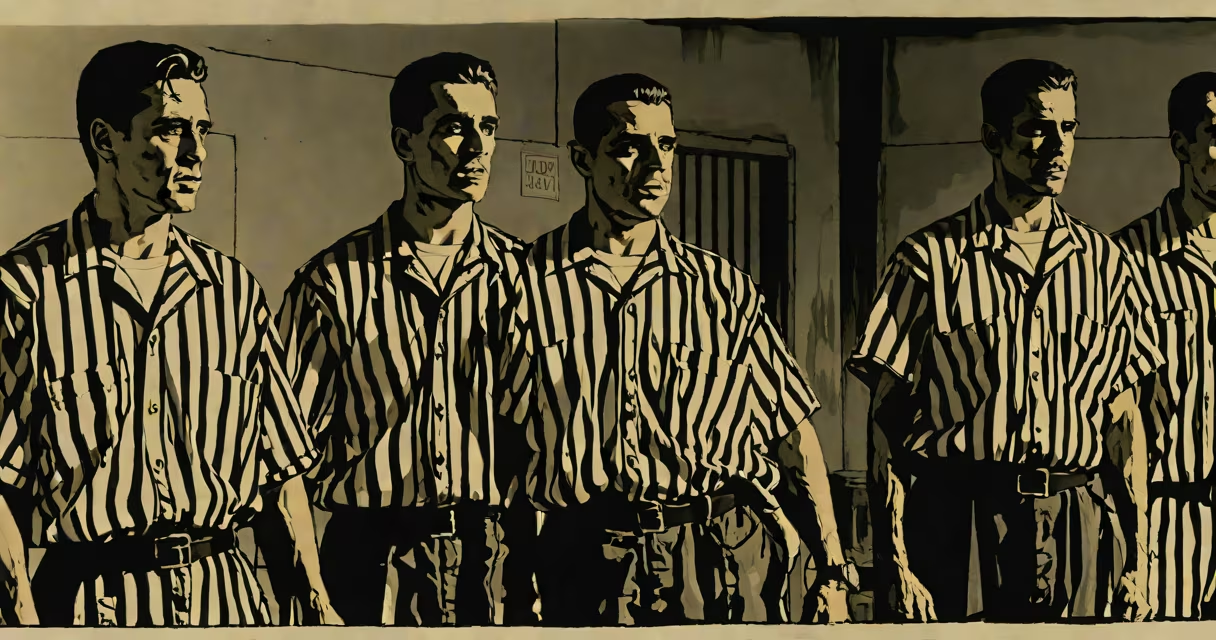
"Blood in Blood Out" (1993) is a dramatic crime film directed by Mario Van Peebles that follows three Chicano cousins across three decades, tracing their lives through gang affiliations, military service, imprisonment, and personal betrayal. The story unfolds against a backdrop of systemic racism, cultural identity struggles, and the brutal realities of urban survival.
The film centers on the Valdez family-Lucy, Trevino, and Ray-three cousins raised in East Los Angeles. Their lives diverge after Lucy joins the Mexican Mafia, Trevino becomes a Marine, and Ray enters prison for murder. Over 30 years, they go through shifting alliances, racial violence, and the emotional toll of choosing between family and ideology. The narrative spans locations from LA streets to Vietnam battlefields and California prisons, emphasizing how environment shapes destiny.
Van Peebles wrote and directed the film with a distinct visual language-handheld camerawork, natural lighting, and long takes that immerse viewers in the characters' lived experience. The score blends traditional Mexican music with jazz and hip-hop, reinforcing the cultural duality the characters embody. The film's title references the phrase "blood in, blood out," a rule in many gangs requiring members to kill outsiders to join and never betray the group.
"Blood in Blood Out" uses a nonlinear timeline anchored by key events: Lucy's initiation into the Mexican Mafia, Trevino's deployment to Vietnam, Ray's incarceration, and the eventual confrontation between the cousins. Flashbacks and voiceovers connect past decisions to present outcomes, revealing how trauma accumulates across generations.
Themes include racial identity, institutional failure, and the cost of loyalty. The film critiques both law enforcement and gang culture as systems that trap marginalized youth. A key scene shows Ray being beaten by police during a raid, then later arrested for a crime he didn't commit-a moment reflecting real incidents of police brutality documented by the American Civil Liberties Union (ACLU).
Unlike many Hollywood films of the early 1990s, which portrayed Latino communities through stereotypes, "Blood in Blood Out" presents complex, multidimensional characters. Trevino's arc-from idealistic enlistment to disillusionment in combat-mirrors real experiences of veterans returning from war, as noted in research by the U.S. Department of Veterans Affairs.
The film belongs to the urban crime drama subgenre, blending elements of prison narratives, war films, and family sagas. It stands apart from similar works due to its focus on Chicano identity and multigenerational storytelling.
| Genre Type | Key Features | Examples |
|---|---|---|
| Urban Crime Drama | Set in inner-city neighborhoods, explores systemic inequality and gang life | "Boyz n the Hood" (1991), "Menace II Society" (1993) |
| Prison Film | Focuses on incarceration, rehabilitation, or prison politics | "The Shawshank Redemption" (1994), "Orange Is the New Black" (2013) |
| War Drama | Depicts military conflict and psychological aftermath | "Platoon" (1986), "Born on the Fourth of July" (1989) |
What sets "Blood in Blood Out" apart is its integration of all three genres into a single narrative. The film doesn't treat prison, war, or gang life as isolated experiences-they intersect. For example, Trevino's time in Vietnam directly impacts his behavior upon return, leading to domestic violence and alienation from his family.
A lesser-known fact: Van Peebles cast real-life former gang members in minor roles. This choice grounded the performances in lived reality. During filming, one actor who had served time in San Quentin shared that the prison scenes felt "too accurate" to be fictional.
The film premiered at the Toronto International Film Festival in 1993 and received mixed reviews initially. Critics praised its direction and performances but questioned its pacing and graphic violence. Over time, it gained recognition as a landmark in African American and Latino cinema.
It was one of the few major studio films of the 1990s directed by a Black filmmaker with a predominantly Latino cast. Van Peebles, son of pioneering director Melvin Van Peebles, broke barriers by centering Chicano experiences without exoticizing them. His decision to shoot in Spanish and English with subtitles preserved linguistic authenticity.
Today, "Blood in Blood Out" is taught in university courses on race, gender, and media. It appears in curricula at institutions like UCLA's School of Theater, Film, and Television and the University of Texas at Austin's Department of Radio-Television-Film. Its influence extends beyond entertainment-it's cited in academic papers on identity formation among second-generation immigrants.
Many assume the film is a straightforward gang epic. It is not. While gang life is central, the story interrogates the idea of loyalty itself. The film asks whether loyalty to family or to a code is more destructive.
Another misconception: that the film glorifies violence. On the contrary, it portrays violence as cyclical and self-perpetuating. A scene where Ray kills a rival in cold blood ends with him vomiting afterward-showing the psychological toll, not the triumph.
Some confuse "Blood in Blood Out" with "American Me" (1992), another gang-focused film. Both explore Chicano identity, but "American Me" focuses on the rise of the Mexican Mafia from within prison walls. "Blood in Blood Out" spans wider timelines and includes military and civilian life.
One non-obvious distinction: the film's ending is ambiguous. After years of conflict, the cousins meet in a bar. They don't reconcile. They don't fight. They sit in silence. This quiet moment underscores the film's core message: healing is not guaranteed, and peace is not always achievable.
Consider the moment when Ray is released from prison after serving 15 years. He returns to East LA, walks into a diner, and sees his cousin Lucy-now a high-ranking member of the Mexican Mafia. Lucy offers him a job. Ray refuses. He says, "I'm not your man." Lucy responds, "Then you're nothing."
This exchange reveals the film's central tension: identity tied to allegiance. Ray chooses freedom over belonging. But the cost is isolation. He walks away, not toward resolution, but into uncertainty. The camera lingers on his face-tired, wary, unmoored. No music. No dialogue. Just silence.
This scene exemplifies how the film avoids easy answers. It doesn't reward or punish choices. It simply shows consequences. That restraint is rare in mainstream cinema of the era.