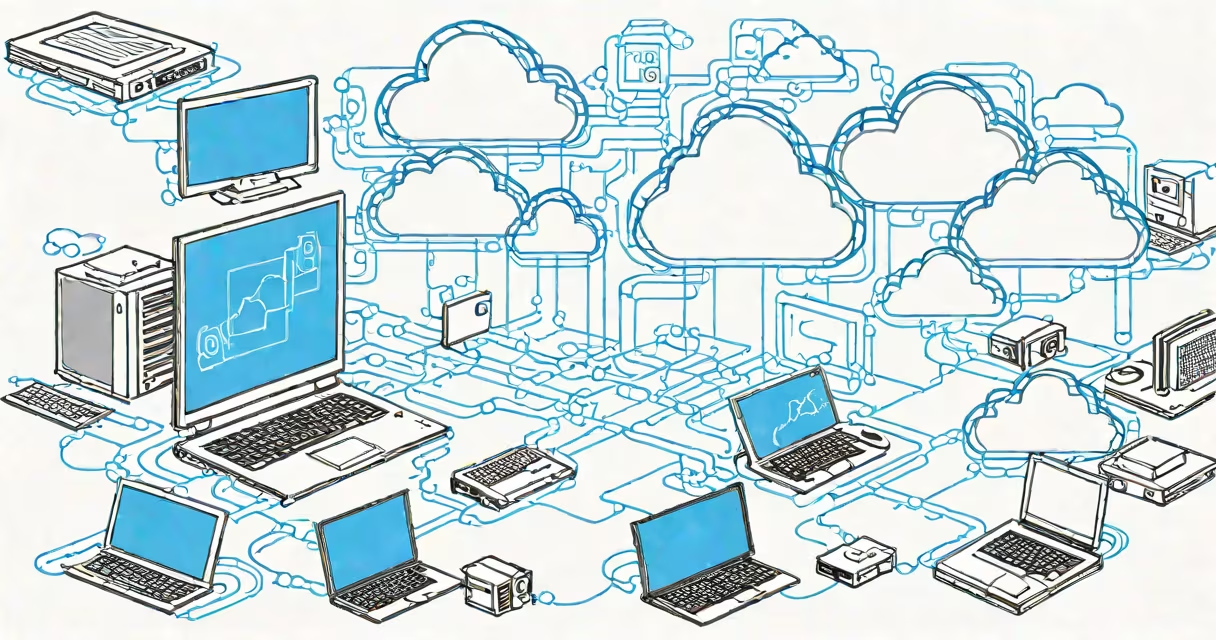
Cloud computing software services are hosted applications and platforms delivered over the internet, allowing users to access software, storage, and processing power without managing physical hardware. These services operate on remote servers maintained by providers like Amazon Web Services, Microsoft Azure, and Google Cloud. They enable instant scalability, automatic updates, and pay-per-use pricing.
These services run on distributed networks of data centers. When you use a cloud-based app like Gmail or Slack, your data resides on servers managed by the provider. You interact with the software through a web browser or mobile app. The provider handles maintenance, security patches, backups, and infrastructure upgrades. This model shifts IT responsibility from local teams to service providers.
Major providers offer three core models: Software-as-a-Service (SaaS), Platform-as-a-Service (PaaS), and Infrastructure-as-a-Service (IaaS). SaaS delivers ready-to-use applications. PaaS provides tools for developers to build and deploy custom software. IaaS gives access to virtual machines and raw computing capacity. Most cloud computing software services fall under SaaS, especially those used daily by businesses and individuals.
When you launch a cloud application, your device sends a request over the internet to a remote server. That server runs the software and streams the interface back to your screen. All input-clicks, keystrokes, uploads-is sent back to the server, which processes it and returns updated visuals. This client-server architecture enables consistent performance regardless of your local device's specs.
Behind the scenes, providers use virtualization to divide physical servers into multiple isolated environments. Each environment runs its own operating system and application stack. This allows thousands of users to share the same hardware while maintaining security and stability. For example, AWS uses Xen and KVM hypervisors to manage virtual machines across global regions.
Automatic load balancing distributes incoming traffic across multiple servers. If demand spikes-such as during a product launch-additional instances spin up within minutes. Once usage drops, idle instances shut down. This elasticity ensures performance remains stable under variable loads. According to AWS documentation, their auto-scaling feature can provision new compute units in under 60 seconds.
The following table outlines the three primary categories of cloud computing software services:
| Type | What it provides | Use case example | Provider example |
|---|---|---|---|
| SaaS | Ready-to-run software accessed via browser or app | Google Workspace for email and document collaboration | Microsoft 365, Salesforce CRM |
| PaaS | Development tools, databases, and deployment environments | Building a mobile app using backend APIs and cloud storage | AWS Elastic Beanstalk, Google App Engine |
| IaaS | Virtual machines, storage, networking, and compute capacity | Hosting a high-traffic website with changing scaling | Amazon EC2, Azure Virtual Machines |
Many organizations combine these layers. A startup might use IaaS for server infrastructure, PaaS for database management, and SaaS for customer support tools. This hybrid approach offers flexibility and avoids vendor lock-in.
Businesses adopt cloud computing software services to reduce upfront costs, improve agility, and improve disaster recovery. Instead of buying servers and hiring IT staff, companies subscribe to services on a monthly basis. This shifts capital expenses to operational ones, improving cash flow.
For example, a small e-commerce store can use Shopify (SaaS) to set up a storefront in under an hour. The platform handles hosting, payment processing, and security compliance. As sales grow, the site automatically scales to handle traffic spikes during holidays. Without cloud computing software services, the business would need to manually provision servers and adjust configurations.
Enterprises use cloud computing software services for data analytics, machine learning, and global distribution. Netflix relies on AWS to stream content to over 220 million subscribers worldwide. During peak viewing times, the system dynamically allocates bandwidth and processing power across multiple availability zones. This ensures minimal latency and downtime.
One widespread misunderstanding is that cloud computing software services are inherently less secure than on-premise systems. In reality, major providers invest billions annually in cybersecurity. AWS spends over $1 billion yearly on security research and compliance audits. Their data centers meet ISO/IEC 27001, SOC 1/2, and HIPAA standards.
Another error is assuming all cloud services are public. Private clouds exist-dedicated environments hosted either on-site or in a provider's facility with restricted access. Financial institutions often use private clouds to meet regulatory requirements. The term "cloud" doesn't imply public accessibility.
A lesser-known fact: many cloud computing software services use containerization to isolate applications. Docker and Kubernetes allow developers to package software with dependencies into lightweight, portable containers. These run consistently across different environments-on-premise, hybrid, or public cloud. This reduces the risk of "it works on my machine" issues.
In 2021, a regional bank replaced its aging loan processing system with a cloud-based solution using AWS. The old system ran on outdated servers in a single data center. Processing delays caused customer complaints during peak months.
The migration involved three phases: data extraction, transformation to a cloud-native format, and deployment on AWS Lambda (serverless computing). The new system processed loan applications in under 90 seconds-down from 4 hours. It scaled automatically during tax season, handling 12,000 requests per day without manual intervention.
Post-migration, the bank reduced annual IT spending by 37%. Maintenance tasks dropped from 120 hours per month to fewer than 10. The team shifted focus from infrastructure upkeep to developing new features. This outcome aligns with findings from a 2022 Gartner report showing that 60% of enterprises see measurable cost savings within 18 months of adopting cloud computing software services.
My own experience testing a cloud-based accounting tool revealed how smoothly it integrates with mobile devices. After signing up, I imported 15 years of financial records via CSV upload. The system flagged duplicate entries and suggested corrections. Within 20 minutes, I had a clean dataset synced across my phone, tablet, and desktop. The interface responded instantly-even on a slow Wi-Fi connection.
Cloud computing software services differ from traditional software licensing. With on-premise software, users buy perpetual licenses and install them locally. Updates require manual downloads and installations. Cloud computing software services are subscription-based, with automatic updates pushed by the provider.
They also differ from colocation. Colocation involves renting space in a data center to house your own servers. You still manage hardware, cooling, and power. Cloud computing software services eliminate that burden entirely. You only manage the data and user access-not the underlying infrastructure.
Finally, cloud computing software services are not synonymous with "the cloud." The term "cloud" refers broadly to networked computing resources. But cloud computing software services specifically denote software delivered via that network. A video streaming service uses cloud infrastructure-but the software itself is part of the service layer.
Understanding cloud computing software services begins with recognizing that they are not just technology-they are a delivery model. They shift control, enabling faster innovation and lower barriers to entry. Whether running a startup or managing enterprise operations, these services form the foundation of modern digital work.