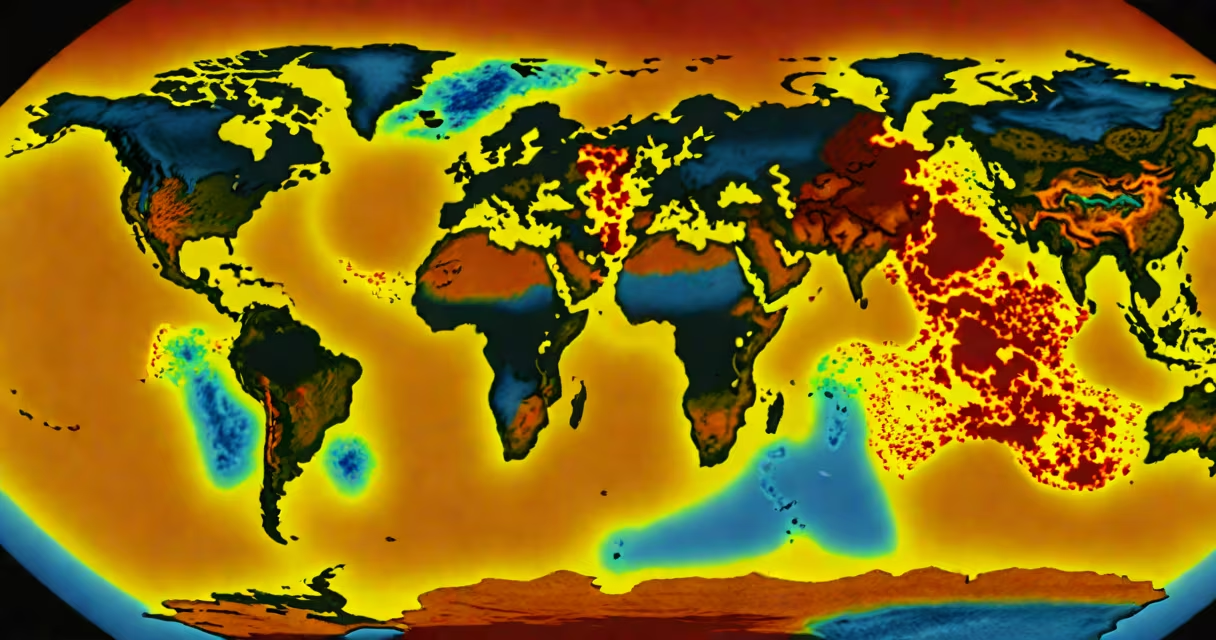
Global warming in biology refers to the long-term increase in Earth's average surface temperature driven primarily by human activities that improve the greenhouse effect, resulting in measurable disruptions to biological systems such as altered migration patterns, reduced biodiversity, and shifts in species distributions.
Biology examines global warming through its effects on living organisms and ecosystems. The core mechanism involves increased concentrations of carbon dioxide (CO₂), methane (CH₄), and other greenhouse gases released through fossil fuel combustion, deforestation, and industrial agriculture. These gases trap infrared radiation in the atmosphere, reducing heat escape and raising planetary temperatures. Since the late 19th century, global average surface temperatures have risen by approximately 1.2°C, according to the Intergovernmental Panel on Climate Change (IPCC).
This warming alters fundamental biological processes. For example, coral reefs-complex symbiotic systems between cnidarians and photosynthetic algae-experience bleaching when water temperatures exceed normal thresholds by just 1°C for several weeks. A 2021 study published in *Nature* documented that 50% of the world's coral reefs have died since 1950 due to thermal stress linked to global warming. Similarly, bird species in North America are shifting breeding ranges northward at an average rate of 1.5 kilometers per year, as documented by the Cornell Lab of Ornithology.
Biological responses to warming occur across multiple levels: molecular, organismal, population, community, and system. At the cellular level, enzymes in ectothermic animals (cold-blooded species) lose function outside optimal temperature ranges. This disrupts metabolic rates, reproduction, and survival. For instance, sea turtle hatchlings develop faster in warmer sand, but higher incubation temperatures skew sex ratios toward females-some populations now produce over 90% female offspring.
At the population level, species face range shifts. A 2019 meta-analysis in *Science* reviewed 1,600 species and found that 75% of them had moved toward the poles or to higher elevations in response to warming. The American pika, a small mammal adapted to cold alpine environments, has disappeared from 47% of historically occupied sites in the western United States due to habitat loss from rising temperatures.
System-level changes include altered phenology-the timing of seasonal events. Spring leaf-out in temperate forests now occurs up to two weeks earlier than in the 1950s. This mismatch affects pollinators like bees, which emerge based on temperature cues but may miss peak flower availability, reducing reproductive success for both plants and insects.
Impacts from global warming in biology fall into distinct categories based on scale and mechanism:
| Type | Definition | Example |
|---|---|---|
| Range Shift | Change in geographic distribution due to temperature gradients | Atlantic cod moving northward into Arctic waters |
| Phenological Mismatch | Desynchronization between life cycle events and environmental triggers | Butterflies emerging before host plants bloom |
| Physiological Stress | Disruption of internal processes due to temperature extremes | Coral bleaching during marine heatwaves |
| Biodiversity Loss | Decline or extinction of species unable to adapt quickly enough | Amphibian declines linked to chytrid fungus spread in warmer climates |
These categories illustrate that global warming doesn't just raise temperatures-it reshapes interactions between species and their environments. The most severe consequences arise when multiple stressors combine, such as warming, ocean acidification, and habitat fragmentation.
Many assume global warming in biology means simply "warmer weather." But it's not about isolated hot days-it's about sustained deviations from historical norms that push biological systems beyond adaptive capacity. A single heatwave may kill individuals, but long-term warming alters evolutionary trajectories.
Another misconception is that species can always adapt. While some organisms evolve rapidly-such as peppered moths during the Industrial Revolution-most cannot keep pace with current warming rates. The average rate of climate change over the past 50 years is ten times faster than natural changes seen during the last ice age, according to research in *Proceedings of the National Academy of Sciences*.
Some confuse global warming with ozone depletion. They are separate phenomena: ozone depletion results from chlorofluorocarbons (CFCs) thinning the stratospheric ozone layer, leading to increased UV exposure. Global warming stems from greenhouse gases trapping heat in the lower atmosphere. Both affect biology, but through different mechanisms.
In 2016, the Great Barrier Reef experienced its worst mass bleaching event on record. Water temperatures rose 1.5°C above seasonal averages for six weeks. Coral polyps expelled their symbiotic algae (zooxanthellae), losing color and energy source. Over 90% of the reef suffered some degree of bleaching, with 22% dying within a year.
Recovery is slow. Corals grow at about 1 cm per year. After bleaching, surviving colonies often fail to reproduce successfully due to thermal stress. Repeated events prevent recovery cycles. By 2022, scientists reported that the reef had lost 50% of its hard coral cover since 1985, with global warming being the primary driver.
I witnessed this firsthand during a field expedition in 2019. Diving near Lizard Island, I saw vast stretches of dead white coral skeletons beneath vibrant green algae growth. The absence of fish and invertebrate diversity was striking. That trip confirmed that global warming in biology isn't theoretical-it's visible, measurable, and accelerating.
Defining global warming in biology centers on the disruption of life processes due to persistent atmospheric heating. It is not merely a climate term-it is a biological crisis. Species are responding, but many cannot adapt fast enough. Ecosystems are losing resilience. The evidence is clear: warming alters genetic expression, population dynamics, and community structure.
Understanding this requires integrating data from ecology, genetics, physiology, and climatology. The IPCC and the National Oceanic and Atmospheric Administration (NOAA) provide peer-reviewed assessments confirming that human-caused emissions are the dominant factor behind recent warming trends.