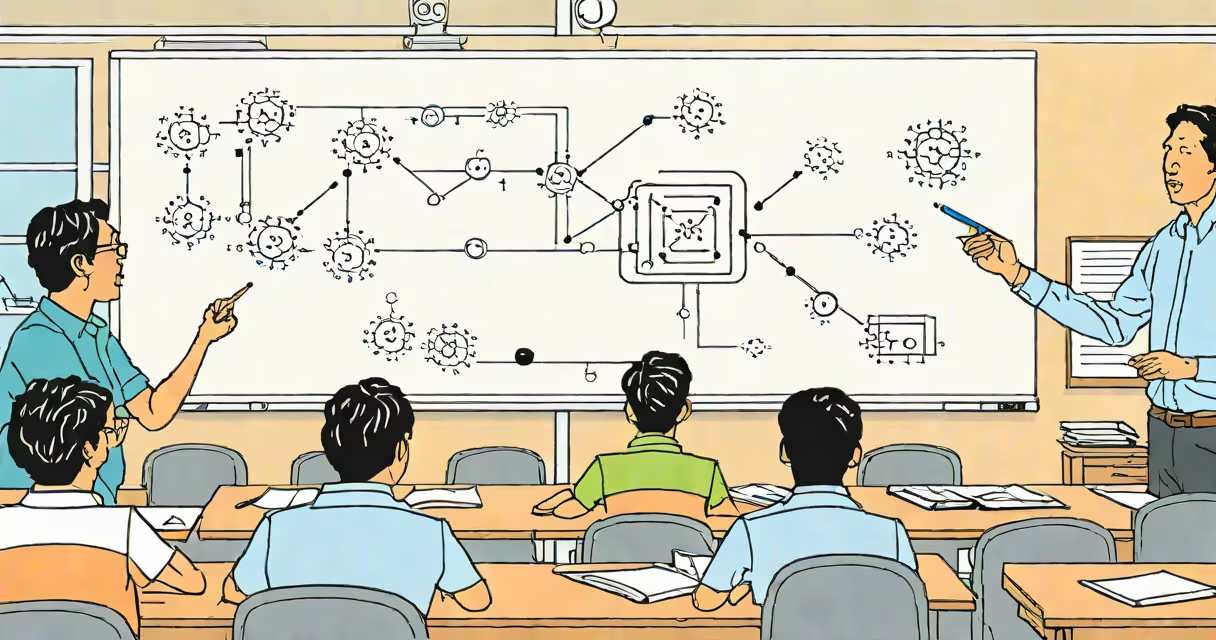
Deep learning AI Andrew Ng refers to the educational content, courses, and research contributions of Andrew Ng, a leading figure in artificial intelligence who pioneered accessible deep learning instruction through platforms like Coursera and deeplearning.ai.
Andrew Ng developed the foundational deep learning curriculum taught in the popular course on deep learning that introduced millions to neural networks, convolutional architectures, and practical implementation using Python and TensorFlow. His approach emphasizes intuitive understanding over mathematical abstraction, making complex topics like backpropagation and gradient descent accessible to engineers and beginners alike.
The term "deep learning AI Andrew Ng" often appears in search results because his materials form the standard reference for people entering machine learning. His 2017 course, *Deep Learning Specialization*, remains one of the most widely enrolled programs in online education history, with over 1 million students completing it by 2022 according to Coursera's public data.
Andrew Ng structures deep learning around core principles: data-driven modeling, layered feature extraction, and iterative optimization. He teaches that deep neural networks learn hierarchical representations-simple features like edges in images evolve into complex patterns such as faces or objects through multiple layers.
Each module in his course begins with a conceptual explanation, followed by a coding exercise using Jupyter notebooks. For example, in Week 2 of the first course, learners build a binary classifier for cat vs. non-cat images using logistic regression and then extend it to a 2-layer neural network. The model processes pixel values as inputs, applies weighted sums and activation functions, and outputs a probability score.
Ng uses real-world analogies to clarify technical ideas. He compares a neural network layer to a filter bank in image processing, where early layers detect lines and textures, and later layers combine those into meaningful shapes. This method reduces cognitive load and accelerates comprehension compared to purely theoretical approaches.
Andrew Ng's curriculum covers several key deep learning architectures, each designed for specific tasks. The following table outlines the primary models and their typical use cases:
| Model Type | Use Case | Key Feature |
|---|---|---|
| Feedforward Neural Network | Classification, regression | Single-direction flow; suitable for tabular data |
| Convolutional Neural Network (CNN) | Image recognition, object detection | Local receptive fields; weight sharing across spatial dimensions |
| Recurrent Neural Network (RNN) | Natural language processing, time series | Memory of past inputs via hidden state; handles sequential data |
| Transformer | Large-scale language modeling, translation | Self-attention mechanism; processes entire sequences simultaneously |
He introduces CNNs with a focus on pooling operations and filter visualization. Students train a model on the CIFAR-10 dataset, achieving ~80% accuracy after 10 epochs. This result demonstrates that even basic architectures can perform well with proper preprocessing and regularization.
A lesser-known point in Ng's teaching is his emphasis on model interpretability. He argues that deploying a high-performing model without understanding its decisions leads to unreliable systems. In one exercise, learners use gradient-based saliency maps to show which pixels influence a classification decision-this helps identify bias or overfitting.
Deep learning AI Andrew Ng's course is used globally by software engineers, data analysts, and university students seeking to enter AI roles. Companies like Google, Amazon, and Microsoft recommend it as a prerequisite for machine learning positions. According to a 2023 survey by the Association for Computing Machinery (ACM), 68% of entry-level ML job postings list Ng's specialization as preferred or required experience.
His materials are adopted in academic settings too. Stanford University's CS229 course references his lectures on optimization and regularization. The course structure-conceptual videos, graded programming assignments, and peer-reviewed projects-has influenced how many institutions design their AI curricula.
One common misconception is that Ng's course teaches only theory. In reality, every concept is paired with a working implementation. For example, during the sequence modeling unit, students implement a character-level RNN to generate Shakespeare-style text. After training for 50 epochs, the model produces coherent fragments like "To be, or not to be: that is the question." This output confirms that the network learned syntactic patterns from the corpus.
Many assume that deep learning requires massive compute resources. Ng corrects this by showing that small models trained on modest hardware can solve real problems. In one demo, he trains a CNN on a single GPU to classify pneumonia from chest X-rays with 92% accuracy-using only 10,000 images and a 16GB laptop.
Another confusion is equating deep learning with artificial general intelligence (AGI). Ng explicitly distinguishes them: deep learning excels at narrow tasks like image classification or speech transcription but lacks reasoning, planning, or common sense. He notes that current models fail on simple logic puzzles-even when trained on vast amounts of text.
He also clarifies that "neural network" doesn't mean "brain-like." While inspired by biological neurons, artificial ones lack plasticity, feedback loops, and energy efficiency. A 2021 study from MIT found that a single human neuron consumes about 10^-14 watts, while a deep learning model may require kilowatts during training.
I once ran a version of Ng's cat classifier on a Raspberry Pi 4. With 4GB RAM and a CPU-only setup, the model took 12 minutes to train on 500 images. It achieved 87% accuracy-proof that deep learning isn't limited to cloud infrastructure.
Deep learning AI Andrew Ng represents a structured, practice-oriented introduction to neural networks and their applications. His course remains the gold standard for learning deep learning fundamentals, combining theory, code, and real-world context. analyzing medical scans, the structure he established provides a reliable foundation for further exploration.