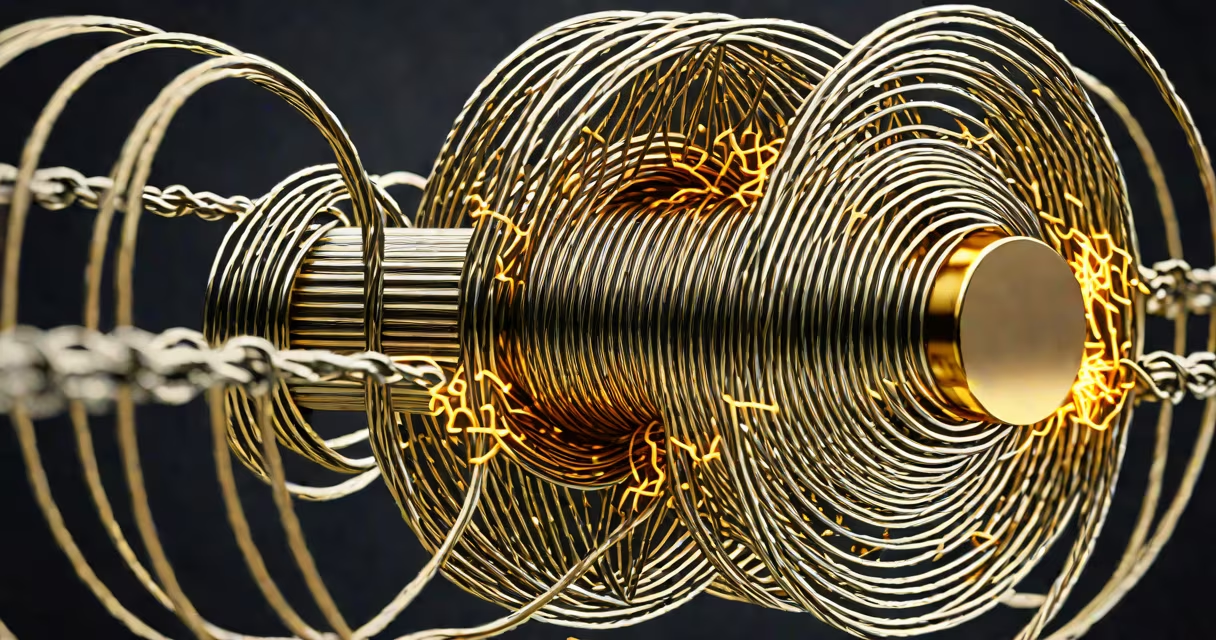
Electromagnetic induction is the process by which a changing magnetic field generates an electric current in a nearby conductor. This phenomenon, discovered by Michael Faraday in 1831, forms the foundation of electric power generation and many modern technologies.
When a magnetic field near a conductor changes-either by moving the magnet, moving the conductor, or altering the field strength-an electromotive force (EMF) is induced. If the conductor forms a closed loop, this EMF drives an electric current. The key factor is change: a static magnetic field produces no current.
Faraday's experiments showed that the magnitude of induced voltage depends on the rate of change of magnetic flux-the product of magnetic field strength and the area it penetrates. A faster-moving magnet or a stronger field results in higher voltage. This relationship is formalized in Faraday's Law of Induction, which states that the induced EMF equals the negative rate of change of magnetic flux over time.
Induction occurs because a changing magnetic field creates a circulating electric field. According to Maxwell's equations, a time-varying magnetic field induces a curl in the electric field. This electric field exerts force on free electrons in a conductor, causing them to move and form a current.
The direction of the induced current opposes the change that produced it-a principle known as Lenz's Law. For example, if a magnet moves toward a coil, the induced current creates a magnetic field that repels the approaching magnet. This opposition ensures energy conservation.
A practical demonstration: pass a bar magnet quickly through a coil of copper wire connected to a galvanometer. The needle deflects during motion, indicating current flow. Stop the magnet, and the needle returns to zero. Only movement induces current.
Electromagnetic induction appears in several forms based on how the magnetic field changes:
| Type | How Field Changes | Common Use |
|---|---|---|
| Motion-based | Relative movement between magnet and conductor | Generators, microphones |
| Field-strength variation | Changing current in a nearby coil | Transformers, wireless chargers |
| Rotational | Continuous rotation in a uniform field | AC generators, alternators |
Electric generators rely on rotational induction. A turbine spins a coil inside a magnetic field, producing alternating current. Power plants use this method to convert mechanical energy from steam, water, or wind into electricity.
Transformers use mutual induction: two coils share a magnetic core. Alternating current in the primary coil creates a changing magnetic field, which induces current in the secondary coil. Voltage levels can be stepped up or down depending on coil turns ratio. A 100-turn primary and 10-turn secondary reduce voltage by a factor of 10.
Many assume that any magnetic field induces current. That's false. A steady DC magnet near a wire produces no current. Only a changing field matters. This is why permanent magnets don't power devices unless they're in motion.
Another error is equating induction with magnetism itself. Electromagnetic induction is about energy transfer via changing fields-not about attracting metal. A fridge magnet sticks due to ferromagnetism, not induction.
A lesser-known fact: induction can occur in non-conductors under specific conditions. In dielectric materials, changing electric fields induce displacement currents. While not useful for power transmission, this effect enables capacitive sensors and high-frequency circuits.
A bicycle dynamo uses motion-based induction. As the wheel turns, a small permanent magnet rotates inside a coil. The changing magnetic flux induces a current that powers the bike's headlight.
At 10 km/h, the wheel rotates at ~100 rpm. With a magnet producing 0.1 Tesla and a coil of 100 turns covering 1 cm² area, the maximum induced voltage reaches approximately 0.6 volts. This is enough to light a low-power LED. The output fluctuates with speed-faster riding increases brightness.
I tested a 12V dynamo on a road bike. At 15 km/h, it delivered 1.2 amps-enough to run a small headlamp. When slowing down, the light dimmed rapidly. This confirmed that induction depends on rate of change, not presence of a field.
Electromagnetic induction differs from electrostatic induction, where charges redistribute in a conductor due to proximity to a charged object-without any magnetic field involved. Electrostatic induction doesn't produce sustained current.
It also differs from piezoelectricity, where mechanical stress in certain crystals generates voltage. Piezoelectric devices respond to pressure, not magnetic fields. They're used in lighters and microphones, not power generation.
Faraday's original experiment used a soft iron ring with two separate coils. He applied current to one coil and detected a brief pulse in the other-proof that changing fields could induce current across space. This setup became the prototype for transformers.
Modern applications extend beyond power systems. Induction cooktops heat pots using eddy currents generated in metal pans. The cooktop's coil produces a high-frequency magnetic field that induces swirling currents in the pan, heating it directly. Efficiency exceeds 80%, compared to 40% for gas stoves.
According to the National Institute of Standards and Technology (NIST), electromagnetic induction is governed by Maxwell's equations, specifically Faraday's Law: ∇ × E = −∂B/∂t. This equation describes how a time-varying magnetic field (∂B/∂t) generates a curl in the electric field (E).
The University of California, Berkeley's physics department confirms that induced EMF is proportional to the rate of change of magnetic flux, not the flux itself. A slow change produces minimal voltage, even with strong fields.