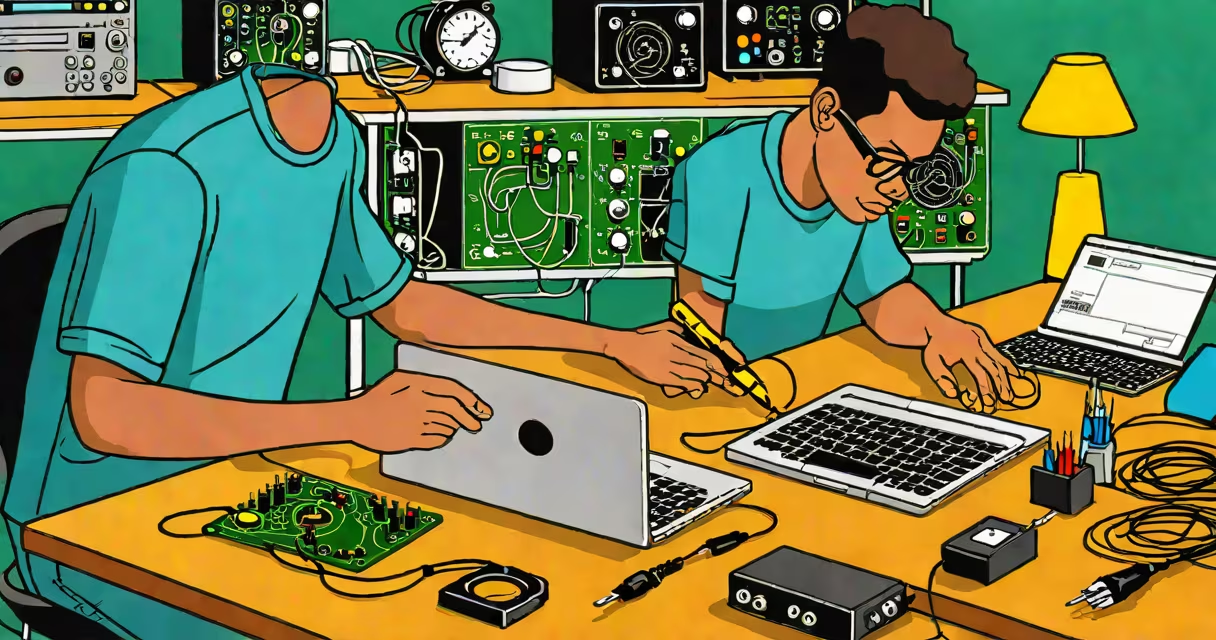
An electrical technology degree online is a college-level credential that teaches the principles and applications of electrical systems, circuits, power distribution, and control technologies through remote coursework. These programs are designed for working professionals, career changers, and students seeking flexibility without sacrificing technical rigor.
Students complete courses in analog and digital electronics, electrical safety standards, programmable logic controllers (PLCs), motor controls, renewable energy integration, and power systems analysis. Most programs require 60-90 credit hours and take 2-4 years to complete, depending on enrollment status and transfer credits.
Accredited programs are typically offered by regionally accredited institutions and may lead to certifications recognized by the National Fire Protection Association (NFPA) or the Institute of Electrical and Electronics Engineers (IEEE). Graduates qualify for roles such as industrial electrician, maintenance technician, automation specialist, or power systems analyst.
Electrical technology degree online programs deliver curriculum via learning management systems like Canvas or Blackboard. Students access video lectures, interactive simulations, virtual labs, and live webinars. Assignments are submitted digitally, and exams are often proctored remotely using AI or human supervision.
Virtual lab components use software such as Multisim, MATLAB, or LabVIEW to simulate circuit behavior, troubleshoot faults, and design control systems. Some programs partner with local technical schools or community colleges to provide hands-on lab experiences at approved sites.
For example, a student in Phoenix enrolled in an online electrical technology degree from a university in Texas completes a course on motor control systems through recorded demonstrations, then uses a simulation tool to test a PLC-controlled conveyor belt system. The student submits a report analyzing fault conditions and proposes solutions based on real-world electrical codes.
Programs vary by focus area, level, and delivery model. Below is a comparison of common formats:
| Type | Duration | Credit Hours | Focus Areas | Common Entry Requirements |
|---|---|---|---|---|
| Associate Degree | 2 years | 60 | Basic circuits, wiring, safety, HVAC systems | High school diploma or GED |
| Bachelor's Degree | 4 years | 120 | Power systems, automation, renewable energy, project management | High school transcript, SAT/ACT (some schools waive) |
| Post-Baccalaureate Certificate | 6-12 months | 15-18 | Advanced PLC programming, industrial networking, SCADA systems | Bachelor's degree in engineering or related field |
Some programs offer accelerated tracks with 8-week terms, allowing students to progress faster. Others integrate industry certifications like CompTIA A+, NFPA 70E, or NETA Level II into the curriculum, reducing time to job readiness.
Electrical technology degree online programs serve industries requiring skilled technicians and engineers in manufacturing, utilities, construction, transportation, and renewable energy. For example, a wind farm operator in Iowa hires technicians with online electrical technology credentials to maintain turbine control systems and grid interconnection hardware.
These programs address workforce shortages in critical infrastructure. According to the U.S. Bureau of Labor Statistics, employment for electrical and electronics installers and repairers is projected to grow 7% -faster than average. Online education enables displaced workers, veterans, and rural residents to enter high-demand fields without relocating.
A key advantage is cost efficiency. The average annual tuition for an online associate degree in electrical technology ranges from $5,000 to $12,000, compared to $15,000-$25,000 for on-campus equivalents at similar institutions. Financial aid, employer reimbursement, and state grants further reduce out-of-pocket costs.
Many assume online electrical technology degrees lack practical training. This is incorrect. Reputable programs include mandatory lab components, even if delivered virtually. For instance, the University of Colorado's online electrical technology program requires students to complete a capstone project involving real-time monitoring of a solar-powered microgrid using cloud-based sensors and data analytics tools.
Another misconception is that these degrees do not lead to licensure. While most states don't license electrical technologists directly, many employers require certification from bodies like the National Institute for Certification in Engineering Technologies (NICET). Programs aligned with NICET standards prepare students for certification exams during their final year.
An electrical technology degree is not equivalent to a bachelor's in electrical engineering (EE). EE programs emphasize theoretical math and physics, including differential equations and electromagnetics. Electrical technology focuses on applied skills-installing, maintaining, and troubleshooting systems in real environments. The former leads to roles like circuit designer or research engineer; the latter prepares for fieldwork in industrial settings.
I once observed a student in a virtual lab session fail to detect a ground loop in a simulated control panel. After reviewing the oscilloscope waveform and applying NEC Article 250 guidelines, they corrected the wiring error. That moment highlighted how online labs teach not just theory, but decision-making under pressure-critical for field technicians.
Those drawn to healthcare systems can explore health information technology programs, which focus on medical device integration, electronic health records, and HIPAA-compliant network security. While distinct from electrical technology, both fields share foundational concepts in system reliability and compliance.
Graduates of electrical technology degree online programs often advance to roles such as senior technician, site supervisor, or systems integrator. Median annual pay for industrial electricians exceeds $60,000, according to BLS data from 2023. With experience and additional certifications, earnings can surpass $90,000.
Electrical technology degree online programs offer a direct pathway to technical careers in changing, high-need sectors. They combine academic rigor with real-world application, supported by accredited curricula and industry-aligned training. As demand grows for smart grids, automated factories, and clean energy infrastructure, these programs remain important for building a skilled electrical workforce.