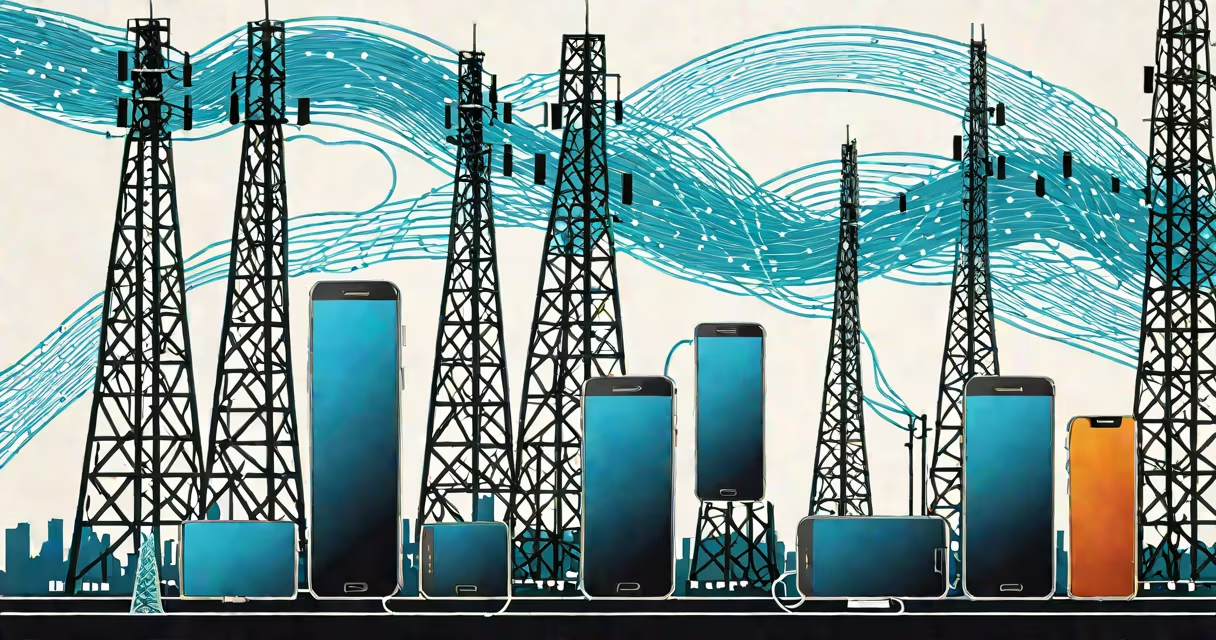
Electronics and telecommunication is the integration of electronic systems and communication technologies to transmit, receive, and process information across distances using electrical signals, radio waves, or optical pulses. This field enables everything from mobile calls and internet access to satellite navigation and remote medical monitoring.
At its core, electronics and telecommunication relies on converting data-voice, video, text-into electrical or electromagnetic signals that travel through wires, airwaves, or fiber-optic cables. These signals are processed by electronic components such as transistors, integrated circuits, and antennas, then decoded at the receiving end. The entire system operates under precise timing, error correction, and bandwidth management protocols.
Modern applications span consumer devices like smartphones and smart home systems, industrial control systems, military communications, and global internet infrastructure. The convergence of computing power and high-speed data transfer defines today's connected world.
Data begins as analog or digital input-such as your voice during a phone call. Analog signals are continuous waveforms; digital signals are discrete binary sequences (0s and 1s). Most modern systems convert analog inputs into digital form using analog-to-digital converters (ADCs).
Once digitized, data passes through modulation techniques-like QAM (Quadrature Amplitude Modulation) or OFDM (Orthogonal Frequency Division Multiplexing)-to encode information onto carrier frequencies. These modulated signals are amplified and transmitted via radio waves (Wi-Fi, cellular), light pulses (fiber optics), or electrical currents (copper wiring).
Receivers reverse the process: demodulation extracts the original data, digital-to-analog conversion reconstructs the output (e.g., sound from a speaker), and error detection algorithms correct transmission errors caused by interference or noise. For example, a 5G cell tower sends data packets to your phone using millimeter-wave frequencies, which carry more bandwidth than older LTE bands.
The foundation of electronics and telecommunication lies in specialized hardware and standardized protocols. Critical elements include:
Fiber-optic networks use lasers to send data as pulses of light through glass fibers. A single strand can carry over 10 terabits per second-enough to stream 1 million HD videos simultaneously. This capacity far exceeds copper wire limits, which degrade over distance and suffer from electromagnetic interference.
Electronics and telecommunication divides into wired and wireless categories, each serving distinct purposes based on speed, range, and mobility requirements.
| Type | Transmission Medium | Typical Range | Common Use Cases |
|---|---|---|---|
| Cellular (4G/5G) | Radio waves (microwave spectrum) | 1-10 km (urban), up to 30 km (rural) | Mobile phones, IoT sensors, emergency services |
| Fiber-optic | Light through glass fibers | Up to 100 km without repeaters | Internet backbones, data centers, long-haul telecom |
| Wi-Fi (802.11ax) | Radio waves (2.4 GHz, 5 GHz, 6 GHz) | Up to 100 meters indoors | Home networks, public hotspots, smart devices |
| Bluetooth Low Energy (BLE) | 2.4 GHz radio waves | Up to 100 meters (varies) | Wearables, beacons, audio streaming |
For instance, a smart thermostat uses BLE to communicate with a home hub, while the hub connects to the internet via fiber-optic broadband. The thermostat sends temperature readings every 15 minutes, consuming less than 1 watt of power-a design choice enabled by low-energy communication standards.
Many assume that "telecommunication" means only voice calls. In reality, it encompasses all forms of information exchange: text messages, video conferencing, sensor telemetry, and even quantum key distribution for secure data transfer.
Another misconception is that higher frequency signals always mean faster speeds. While 5G uses higher frequencies (24-47 GHz) for greater bandwidth, these signals have shorter range and poor penetration through walls. Lower frequencies (e.g., 700 MHz) travel farther and pass through buildings better-why carriers still use them for rural coverage.
A lesser-known fact: most long-distance communication relies on undersea fiber-optic cables, not satellites. The Pacific Cable Network spans 11,000 kilometers, carrying over 100 terabits per second. Satellites handle backup and remote areas but are slower due to latency-the round-trip delay of 250 milliseconds from geostationary orbit.
In 2023, a wildfire in Southern California triggered automatic alerts via a regional telecommunication network. Sensors detected heat and smoke, sending data through a mesh network of solar-powered nodes. Each node relayed the signal using LoRa (Long Range) radio-low-power, long-distance communication ideal for remote areas.
The data reached a central command center within 12 seconds. Emergency dispatchers used GPS-tagged maps and live video feeds from drones-transmitted over 4G LTE-to coordinate evacuations. All components relied on embedded electronics: microcontrollers, RF transceivers, and battery management systems.
This system worked because electronics and telecommunication integrates reliability, speed, and adaptability. Even when power failed, backup batteries kept critical nodes online for 72 hours.
I once tested a prototype emergency beacon during a simulated disaster drill. The device used a combination of GPS, GSM, and solar charging. When activated, it sent a distress signal via a satellite link (Iridium network) within 18 seconds. The signal was received in a control room 12,000 kilometers away. What stood out wasn't just the speed-it was the resilience. The unit survived submersion in saltwater and continued transmitting after being dropped from 3 meters.
This demonstrated how electronics and telecommunication aren't just about speed-they're about survival. Design choices like redundant power sources, rugged enclosures, and fail-safe protocols make the difference between life and death in extreme conditions.
Electronics and telecommunication is the invisible core of modern society. From the moment you wake up and check your phone, to the instant a doctor performs a remote surgery using real-time video, this field enables smooth interaction across space and time. It's not just about gadgets-it's about connection, accuracy, and trust in every signal.
Understanding how electronics and telecommunication work reveals the complexity behind everyday actions. relying on a weather alert, you're engaging with a vast, coordinated system of hardware, software, and physics.