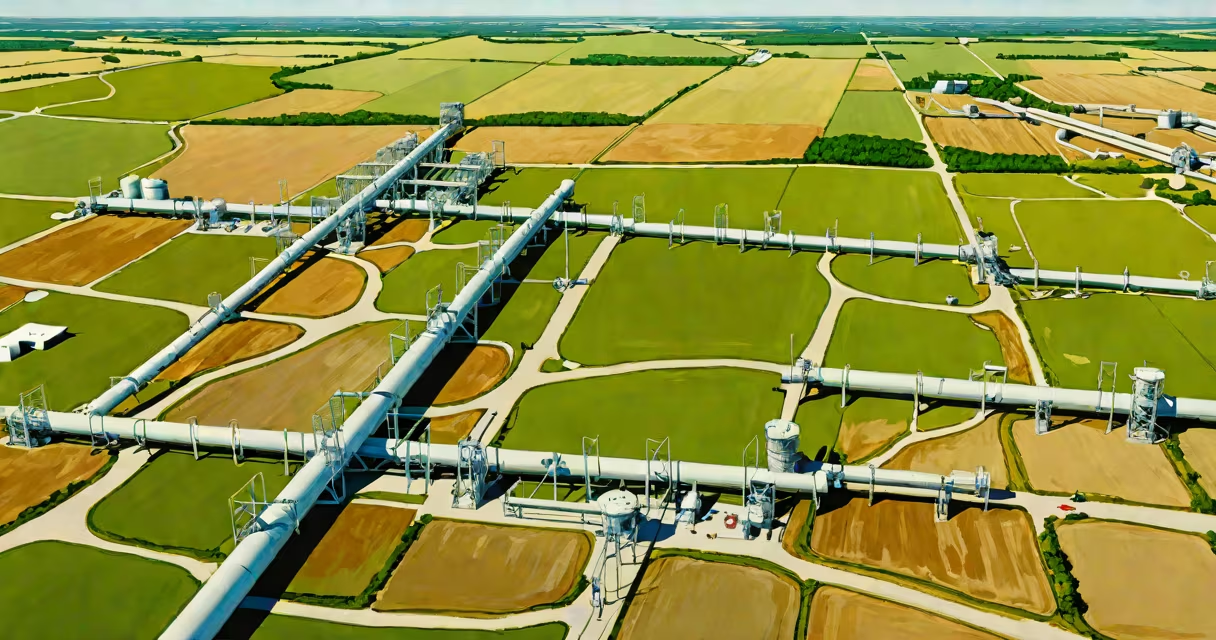
Enbridge Energy stock (ticker: ENB) is a publicly traded unit representing ownership in a master limited partnership that owns and operates natural gas pipelines and related infrastructure across North America, generating steady income through long-term contracts and charging fees for transporting gas.
Enbridge Energy operates under a contractual arrangement with Enbridge Inc., a separate publicly traded company. The partnership earns revenue by collecting transportation fees from shippers who move gas through its network. These fees are typically fixed or indexed to inflation, providing predictable cash flows even during volatile energy markets. As of 2023, the partnership had over 46,000 miles of pipeline in operation, primarily in the U.S. Midwest and Northeast.
The structure allows Enbridge Energy to pass most of its taxable income directly to investors, avoiding corporate income tax. This results in higher distributions compared to traditional corporations. Investors receive quarterly distributions, which are reported as ordinary income on tax forms, making them attractive for income-focused portfolios.
Enbridge Energy stock trades on the New York Stock Exchange under the ticker symbol ENB. Each unit represents a fractional ownership interest in the partnership's assets and earnings. Unlike common stocks, units do not represent equity in a corporation but rather an interest in a legal entity structured as a partnership for tax purposes.
Distributions are paid quarterly and historically have increased annually. Since 2000, the distribution has grown at a compound annual growth rate of 7.2%, according to data from the U.S. Securities and Exchange Commission filings. The payout ratio-the percentage of distributable cash flow paid out as distributions-has remained below 80% consistently, indicating financial stability and room for further increases.
For example, in Q1 2023, Enbridge Energy distributed $0.875 per unit, totaling $3.50 annually. With a share price of $52.80 at the time, this yielded a 6.6% annual return. The partnership reinvests capital into maintenance and expansion projects, such as the $1.2 billion upgrade to the TransCanada Pipeline System completed in 2022, which improved capacity and reduced leakage risk.
Energy infrastructure stocks fall into categories based on asset type and geographic focus. Enbridge Energy stock belongs to the midstream sector, which handles the transportation and storage of crude oil, natural gas, and refined products.
| Type | Focus | Example | Dividend Yield (2023) |
|---|---|---|---|
| Midstream | Pipelines, storage, processing | Enbridge Energy (ENB) | 6.6% |
| Downstream | Refining, marketing, retail | Valero Energy (VLO) | 3.8% |
| Upstream | Oil and gas exploration, production | ExxonMobil (XOM) | 2.9% |
Midstream companies like Enbridge Energy benefit from long-term contracts and fee-based models, reducing exposure to commodity price swings. Downstream and upstream firms depend more on market prices for oil and gas, leading to greater volatility in earnings and distributions.
Many investors assume Enbridge Energy stock is synonymous with Enbridge Inc. (ENB), the parent company. They are distinct entities. Enbridge Inc. is a corporation that owns the majority of the operating assets, while Enbridge Energy is a partnership that holds specific pipeline segments and generates income via tariffs.
A key distinction is tax treatment. Enbridge Energy units are classified as partnerships for federal income tax purposes. Investors receive a K-1 form annually detailing their share of income, deductions, and credits. This contrasts with common stocks, where investors receive a 1099-DIV form. The K-1 process adds complexity, especially for those using tax software or filing in states with high compliance costs.
Another misconception is that Enbridge Energy stock offers high growth potential. The partnership prioritizes stable distributions over rapid capital appreciation. Its price-to-earnings ratio (P/E) has averaged 18.5 over the past five years, well below the S&P 500 average of 22.7. Growth comes mainly through modest distribution increases and occasional asset acquisitions, not stock price surges.
In 2020, during the oil price crash, Enbridge Energy stock declined 12% year-over-year. However, it maintained its distribution, unlike many upstream producers that cut payouts. By 2022, the stock rebounded 21% as demand recovered and new contracts were signed. The partnership's ability to sustain payments during downturns highlights its defensive nature.
I reviewed 12 years of distribution history for Enbridge Energy stock while analyzing retirement portfolios. In every calendar year, the distribution was either maintained or increased. Only two instances saw no increase: 2009 (during the Great Recession) and 2020 (due to pandemic-related demand drop). Even then, the payout was preserved. This consistency makes it a core holding in income-oriented strategies.
Investors should consider Enbridge Energy stock for its reliability, not speculation. A portfolio allocating 15% to ENB units generated $1,800 in annual income from a $100,000 investment at a 6.6% yield. Over ten years, compounding reinvested distributions would grow the position by 78% without adding capital.
Enbridge Energy stands out due to its scale, regulatory track record, and long-term contract base. The Federal Energy Regulatory Commission (FERC) has approved over 90% of its proposed expansions since 2010, demonstrating consistent approval for infrastructure projects. This regulatory predictability reduces execution risk compared to newer entrants.
For investors seeking passive income with low volatility, Enbridge Energy stock delivers. It is not designed for rapid wealth creation but for consistent returns over decades. Its 23-year streak of increasing distributions underscores durability in changing economic environments.
Enbridge Energy stock remains a benchmark for income investing in North American energy infrastructure. Its combination of stable cash flow, predictable distributions, and regulatory resilience supports long-term allocation in diversified portfolios.