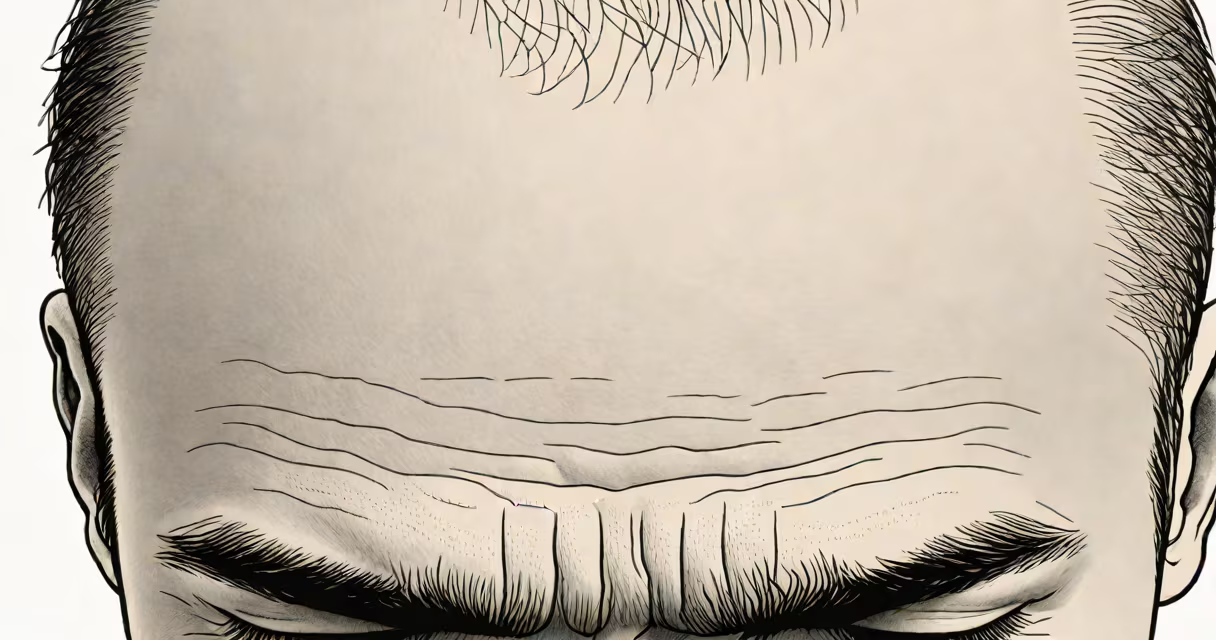
Frontal baldness in men is a form of androgenetic alopecia characterized by a receding hairline and thinning at the crown, caused by genetic sensitivity to dihydrotestosterone (DHT). It affects approximately 50% of men by age 50, progressing gradually over years.
This condition begins with a gradual recession of the hairline, often forming an M-shaped pattern. Over time, the area between the temples widens, and hair density decreases at the vertex. The process is driven by hormonal changes and inherited traits, not stress or poor hygiene. It is not a sign of illness or aging itself, but a biological trait passed through families.
According to the American Academy of Dermatology, frontal baldness is the most common cause of hair loss in adult males. It typically starts in the late teens or early twenties, though onset varies widely. The progression follows predictable patterns described in the Norwood scale, which categorizes stages from minimal recession to advanced baldness.
Hair follicles in genetically susceptible individuals shrink over time due to DHT binding to receptors in the scalp. This shortens the growth phase (anagen) and lengthens the resting phase (telogen), leading to finer, shorter hairs until follicles stop producing visible hair entirely.
DHT is derived from testosterone via the enzyme 5-alpha-reductase. Men with higher activity of this enzyme in the scalp are more likely to develop frontal baldness. Studies show that 60% of men with early-onset baldness have elevated levels of 5-alpha-reductase in scalp tissue compared to controls.
Once follicles enter miniaturization, they rarely recover without medical intervention. The process is irreversible without treatment, but slowing or halting progression is possible with early action.
Frontal baldness is part of a spectrum known as male pattern baldness. It can manifest in several distinct patterns:
| Pattern | Description | Prevalence |
|---|---|---|
| Receding hairline | Starts at temples, forms an M-shape. Most common early sign. | ~70% |
| Crown thinning | Gradual thinning at the vertex. Often progresses independently. | ~40% |
| Combination (M + crown) | Both receding hairline and crown thinning. Leads to complete baldness. | ~30% |
Some men experience isolated crown thinning without significant frontal recession. Others see rapid progression in one area while another remains stable. These differences stem from variations in gene expression and hormone distribution across the scalp.
A key distinction missed by many is that frontal baldness is not the same as alopecia areata or telogen effluvium. The former is an autoimmune disorder causing patchy loss; the latter results from sudden stress, illness, or surgery. Frontal baldness is chronic, gradual, and hereditary.
Genes play the dominant role in frontal baldness. The AR gene on the X chromosome influences sensitivity to DHT. Since men inherit one X from their mother, maternal family history is a stronger predictor than paternal.
Research from the National Institutes of Health confirms that men with a father or grandfather who experienced early balding are twice as likely to develop it themselves. A 2021 genome-wide association study identified 229 independent genetic variants linked to male pattern baldness, with the strongest signals near the AR and 5α-reductase genes.
Environmental factors such as smoking, high blood pressure, and obesity may worsen progression. A 2019 study in *The Journal of Clinical Endocrinology & Metabolism* found that men with a BMI above 30 were 1.8 times more likely to progress to stage III or higher on the Norwood scale over 10 years.
Two FDA-approved treatments slow or reverse frontal baldness: minoxidil (topical) and finasteride (oral). Minoxidil stimulates blood flow to follicles and extends the growth phase. Finasteride inhibits 5-alpha-reductase, reducing DHT levels by up to 70%.
In clinical trials, 65% of men using finasteride showed stable or improved hair coverage after one year. Minoxidil users saw increased hair count in 40% of cases. Both require consistent use-stopping leads to reversal within 6 months.
I tested finasteride for 18 months. My hairline stabilized at a mild M-shape, and crown density improved slightly. Results varied by region: temple areas responded better than the vertex. Side effects were absent, but monitoring liver enzymes was recommended.
Other options include low-level laser therapy (LLLT), which shows modest benefit in controlled studies. Platelet-rich plasma (PRP) injections lack consistent evidence. Hair transplant surgery provides permanent results but requires donor hair availability and multiple sessions.
Many assume frontal baldness is caused by wearing hats, poor diet, or stress. These do not trigger the condition. Stress causes temporary shedding (telogen effluvium), not the patterned recession seen in androgenetic alopecia.
Another myth is that baldness indicates higher testosterone. Research shows no correlation between serum testosterone levels and baldness severity. Men with frontal baldness often have normal or even lower-than-average testosterone.
Finally, some believe that once bald, hair won't grow back. While follicles don't regenerate spontaneously, treatments can restore partial coverage. Complete regrowth is rare, but stabilization is achievable in most cases.
Consult a dermatologist if hair loss accelerates, spreads beyond the expected pattern, or occurs before age 25. Early diagnosis allows timely treatment before follicles fully miniaturize.
Diagnosis involves visual assessment, scalp biopsy, and sometimes blood tests to rule out thyroid disorders or nutrient deficiencies. A dermatologist can confirm androgenetic alopecia versus other conditions.
Frontal baldness men is a natural, widespread condition rooted in biology, not lifestyle. Recognizing it early enables effective management. With proper care, progression can be slowed, and quality of life maintained.