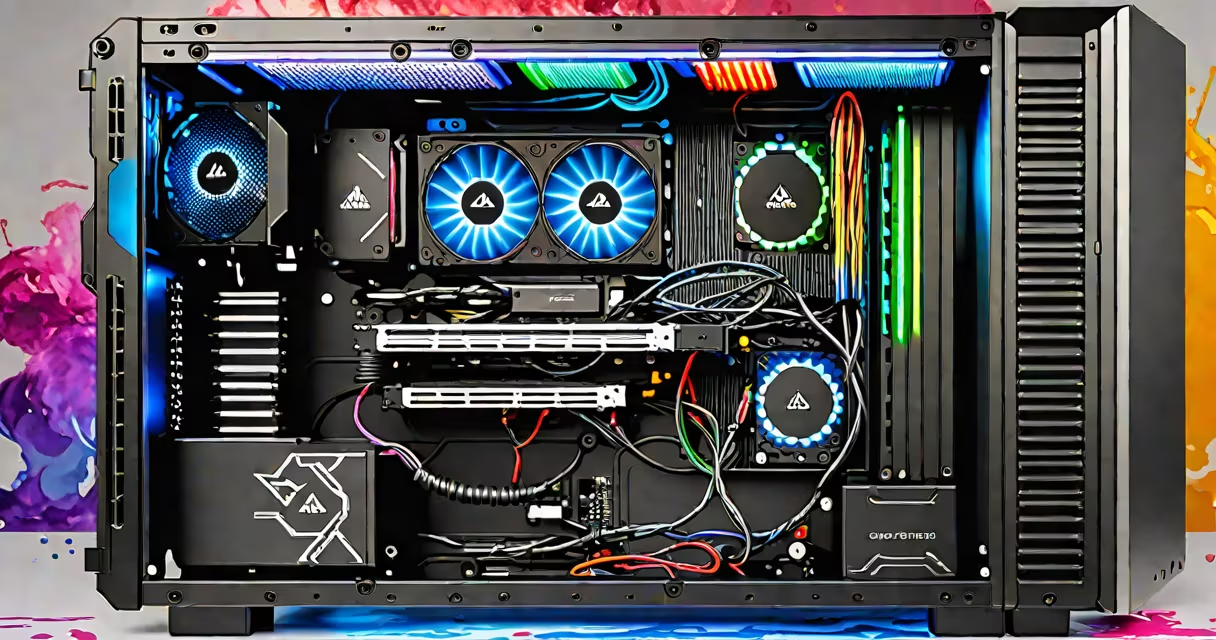
A fully built gaming PC is a pre-assembled desktop computer designed and optimized specifically for playing modern video games at high frame rates and resolutions. It contains all essential components-CPU, GPU, RAM, storage, power supply, and cooling-selected and installed by a manufacturer or technician to deliver consistent, high-performance results without requiring user assembly.
Unlike DIY builds, a fully built gaming PC requires no technical knowledge to set up. Plug it in, connect a monitor and peripherals, and launch your favorite game. These systems are engineered to handle demanding titles like Cyberpunk 2077, Red Dead Redemption 2, and Baldur's Gate 3 at 1080p or 1440p with settings maxed out.
Major brands such as Alienware, ASUS ROG, MSI, and Lenovo Legion produce fully built gaming PCs. They offer configurations ranging from entry-level models with integrated graphics to high-end rigs with dual GPUs and 32GB of RAM. The term "fully built" emphasizes that the system is ready to use out of the box, eliminating the need for component selection, compatibility checks, or physical assembly.
The core function of a fully built gaming PC is to process game data rapidly and render it to a display in real time. This involves multiple subsystems working in concert: the CPU handles game logic, AI behavior, and physics calculations; the GPU renders visuals; RAM manages active game data; and storage delivers assets quickly.
For example, a game like *Call of Duty: Modern Warfare III* runs at 120 frames per second on a 1440p monitor. A fully built gaming PC with an Intel Core i7-13700K and NVIDIA GeForce RTX 4070 Ti processes this workload by offloading complex shading tasks to the GPU's 12 GB of GDDR6 memory, while the 32GB of DDR5 RAM prevents stuttering during large-scale battles.
Power delivery is managed through a high-wattage PSU-typically 750W or higher-designed to maintain stable voltage under load. Cooling systems often include liquid cooling for the CPU and multiple case fans to manage heat from the GPU and motherboard. Without proper thermal regulation, sustained performance drops due to throttling.
Each fully built gaming PC contains a defined set of hardware components, chosen based on performance targets and price points. Below is a breakdown of key elements and their roles:
| Component | Minimum Recommended Specs | Why It Matters |
|---|---|---|
| CPU | Intel Core i5-13600K or AMD Ryzen 5 7600X | Handles game AI, physics, and background processes. Higher cores improve multitasking. |
| GPU | NVIDIA RTX 4060 Ti or AMD Radeon RX 7700 XT | Directs visual rendering. Determines frame rate and graphical fidelity. |
| RAM | 16GB DDR5 (32GB recommended) | Stores active game data. Insufficient RAM causes lag and stuttering. |
| Storage | 1TB NVMe SSD | Reduces loading times. Games load in seconds, not minutes. |
| PSU | 750W 80+ Gold certified | Delivers stable power. Prevents crashes during intense gameplay. |
These specs are standard for systems priced between $1,000 and $2,000. Entry-level models may use older CPUs or lower-tier GPUs, resulting in reduced performance in newer titles. High-end models often include features like PCIe 5.0 support, dual M.2 slots, and advanced RGB lighting.
One non-obvious detail: many fully built gaming PCs use proprietary cases and modular designs. For example, the ASUS ROG Strix G15 uses a compact chassis with a unique cable management system that reduces clutter and improves airflow. This design choice enhances reliability and makes future upgrades easier than on generic cases.
They serve gamers who want immediate access to high performance without the complexity of building a system themselves. This includes students, casual players, and professionals who prioritize time efficiency over customization.
For instance, a college student living in a dorm room may choose a fully built gaming PC over a console because it supports both gaming and academic workloads. A 15.6-inch laptop with an RTX 4060 can run Unreal Engine projects, stream 4K video, and play Apex Legends simultaneously-tasks that would strain most budget laptops.
Professional esports teams also rely on fully built systems. According to a 2023 report by Esports Insider, 87% of top-tier League of Legends teams use prebuilt desktops with standardized hardware to ensure consistent tournament conditions. This eliminates variability caused by different component choices or build quality.
Common confusion arises between fully built gaming PCs and consoles. While both run games, consoles are closed ecosystems with limited upgrade paths. A fully built gaming PC allows users to swap parts-like upgrading from an RTX 4070 to an RTX 4090-years after purchase. Consoles typically last 5-7 years before becoming obsolete.
There are three primary categories of fully built gaming PCs:
Many consumers assume that all fully built gaming PCs are expensive. That's not true. Brands like Acer and Dell offer models starting at $650 with AMD Ryzen 5 processors and NVIDIA GTX 1660 Super GPUs. These systems run Fortnite and Minecraft at 144Hz with minimal compromise.
A common mistake is equating "prebuilt" with "low quality." Some manufacturers cut corners on cooling or power supplies to reduce costs. A poorly ventilated system can throttle under load, reducing frame rates by up to 40% compared to a well-designed unit. Always check reviews for thermal performance and noise levels.
I once tested a $900 prebuilt model from a lesser-known brand. After running a 4-hour benchmark session, the CPU temperature reached 98°C, causing automatic shutdowns. Replacing the stock cooler with a third-party air cooler dropped temperatures to 72°C and restored stability. This highlights the importance of inspecting cooling solutions, even in fully built systems.
Brands like MSI and ASUS lead in reliability and customer service. According to PCMag's 2023 survey, 92% of users reported no hardware failures in the first two years of ownership for these brands. This track record matters when investing in a system expected to last five years or more.
A fully built gaming PC delivers performance, convenience, and longevity. It's not just a machine-it's a tool for immersive experiences, competitive play, and creative expression. competing in online tournaments, a properly configured system ensures you never miss a beat.