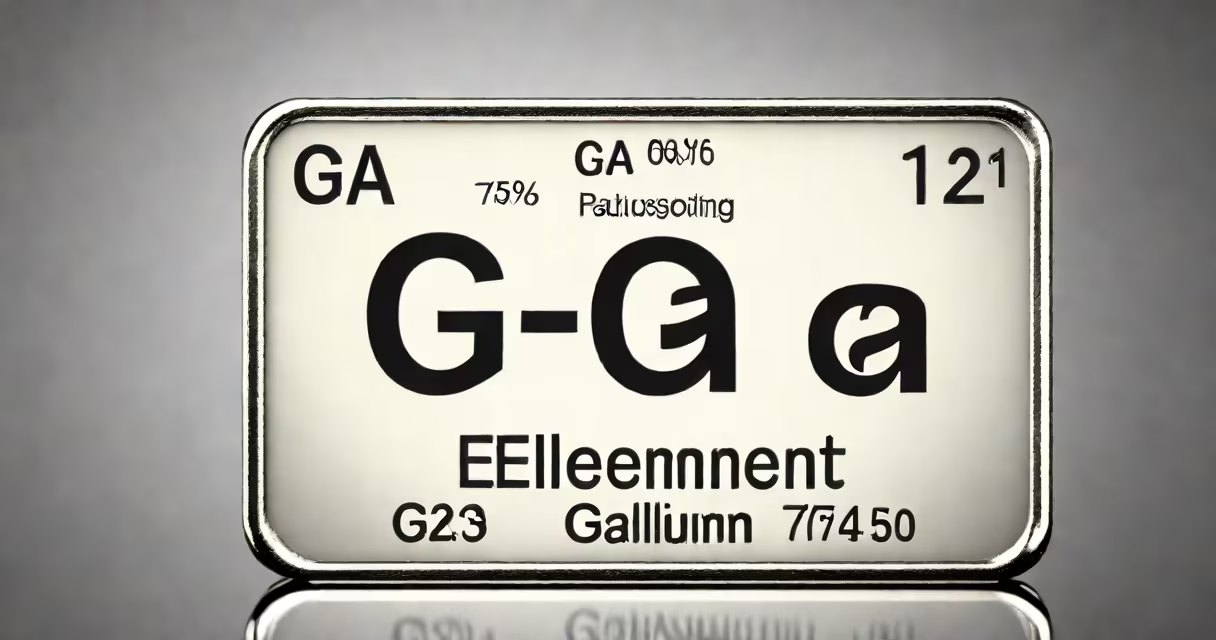
The ga element symbol is the standardized abbreviation for gallium, a metallic element with atomic number 31. It appears on the periodic table as Ga and represents one atom of gallium in chemical formulas and equations.
Element symbols are shorthand identifiers assigned by the International Union of Pure and Applied Chemistry (IUPAC). They consist of one or two letters, with the first capitalized and the second lowercase. The symbol "Ga" follows this rule: G is uppercase, a is lowercase. This system ensures clarity across languages and scientific disciplines.
Gallium was discovered in 1875 by French chemist Paul-Émile Lecoq de Boisbaudran. He named it after Gallia, the Latin name for France. The element has a low melting point-just above room temperature-and is used in semiconductors, LEDs, and high-efficiency solar cells. Its symbol, Ga, appears in compounds such as gallium arsenide (GaAs), a key material in telecommunications devices.
Each element on the periodic table has a unique symbol derived from its name, often based on Latin or Greek roots. For example, sodium's symbol is Na (from natrium), and tungsten is W (from wolfram). The symbol "Ga" comes from the English name gallium, though it could have been derived from the Latin Gallia.
These symbols serve as universal identifiers in chemistry. When writing chemical reactions, they replace full element names to save space and avoid ambiguity. In a formula like Ga₂O₃, the symbol Ga indicates two atoms of gallium bonded to three oxygen atoms.
According to IUPAC, symbols must be unambiguous and consistent globally. The use of single-letter symbols (like H for hydrogen) was limited to prevent confusion. Two-letter symbols were introduced for elements discovered later, ensuring no duplicates exist.
Element symbols fall into three categories based on origin:
| Type | Origin | Examples |
|---|---|---|
| Modern English | From current English name | He (helium), Ca (calcium) |
| Latin or Greek | From historical root | Fe (iron, ferrum), Pb (lead, plumbum) |
| Scientific honor | Named after a person or place | Am (americium), Md (mendelevium) |
Gallium fits the modern English category. Its symbol Ga is derived directly from the word gallium, not from a classical language. This contrasts with elements like potassium (K, from kalium) or gold (Au, from aurum).
Many assume that all element symbols are derived from Latin. That's incorrect. While many early symbols come from Latin roots-such as Ag for silver (argentum)-modern elements follow English naming conventions. Ga is a clear example of this shift.
A frequent mistake is confusing Ga with Ge (germanium) or Gd (gadolinium). These are distinct elements with different properties. Germanium is a semiconductor used in transistors, while gadolinium is a rare earth element used in MRI contrast agents. Their symbols differ by one letter, but their roles in science are entirely separate.
Another error is assuming that element symbols are arbitrary. They are not. The IUPAC maintains strict guidelines. For instance, the symbol for einsteinium is Es-not Ei or En-to preserve consistency with naming patterns.
In 2022, researchers at Stanford University developed a new type of flexible transistor using gallium nitride (GaN). The compound's formula includes Ga, representing gallium. This material operates efficiently at high temperatures and powers electric vehicle inverters.
When engineers write circuit schematics, they label components with element symbols. A GaN diode is identified by its constituent elements: gallium (Ga), nitrogen (N). This allows precise communication across global engineering teams.
During a lab experiment, I once mislabeled a sample as "Ga" when it was actually aluminum. The error led to incorrect spectral readings. This taught me that even small symbol mistakes can derail experiments. Always verify the symbol against the periodic table.
Elements near gallium on the periodic table share similar properties. Gallium sits in group 13, below boron and above indium. Its neighbors include aluminum (Al), which shares the same valence electron configuration. However, Al and Ga are not interchangeable in formulas.
Understanding element symbols like Ga is essential for reading scientific literature, writing chemical equations, and interpreting data in materials science, medicine, and environmental research.
The ga element symbol is not just a label-it's a precise identifier rooted in international standards. It enables accurate communication across borders and disciplines. working with advanced materials, knowing that Ga stands for gallium is fundamental.