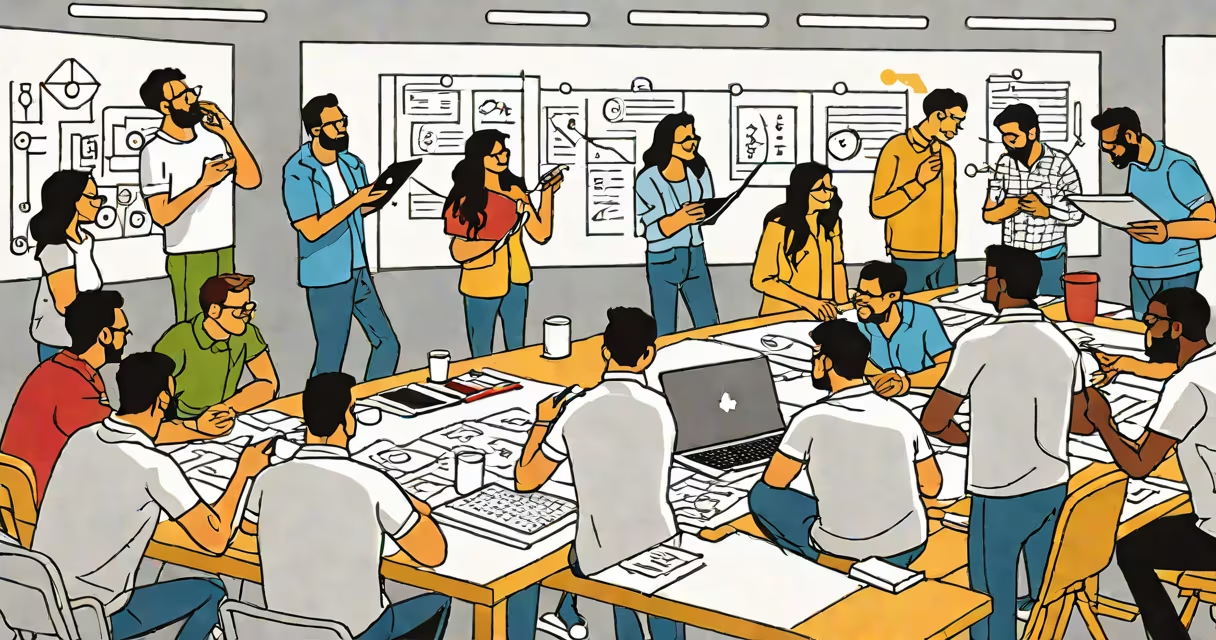
Google Design Sprint is a structured five-day process for rapidly testing ideas, validating solutions, and making high-stakes decisions using design thinking, prototyping, and user feedback. It was developed by Jake Knapp at Google Ventures and later adopted by teams across startups, enterprises, and government agencies.
The method begins with defining a specific challenge-such as improving a product feature or launching a new service-and ends with a prototype tested with real users. Each day focuses on a distinct phase: understanding the problem, sketching solutions, deciding on a direction, building a prototype, and testing it with users. The entire cycle runs in just five days, compressing months of development into a single sprint.
Unlike traditional project planning, which may take weeks to gather input and build consensus, Google Design Sprint forces clarity under time pressure. Teams work in cross-functional roles-designers, engineers, product managers, and business leads-ensuring diverse perspectives are heard early. This structure prevents endless debate and keeps focus on outcomes, not just activity.
Day one centers on mapping the problem. The team identifies the core challenge, defines success metrics, and clarifies user needs. A shared understanding is essential-without it, solutions drift off track. For example, a healthcare app team might define the goal as "reduce patient appointment no-shows by 30% within six months."
On day two, individuals generate ideas independently. Each person sketches potential solutions on paper. No discussion occurs yet-this prevents groupthink and encourages creativity. After sharing, the team evaluates options using a voting system. The most promising idea moves forward.
Day three involves refining the selected concept. The team turns the sketch into a detailed plan. They decide on the flow, features, and interactions. This step ensures everyone agrees on how the solution will work-even if it's not fully built yet.
Day four is dedicated to building a realistic prototype. The prototype doesn't need to be functional code-it must look and behave like the real product. Using tools like Figma, Adobe XD, or even physical mockups, the team creates something users can interact with. The goal is believability, not perfection.
On day five, the team tests the prototype with five real users. These are people who match the target audience profile. Observations are recorded in real time. Feedback reveals whether the solution solves the intended problem-or misses the mark entirely. Results often lead to immediate pivots or go/no-go decisions.
While the original Google Design Sprint follows a strict five-day format, teams have adapted it for different needs. The core structure remains consistent, but timing and focus vary based on context.
| Type | Duration | Use Case | Key Difference |
|---|---|---|---|
| Full Sprint | 5 days | High-risk decisions, new product launches | Includes all phases; full user testing |
| Mini Sprint | 2-3 days | Quick fixes, internal tool improvements | Skips full user testing; focuses on internal validation |
| Remote Sprint | 5 days | Distributed teams, global collaboration | Uses video conferencing and shared digital whiteboards |
| Design Sprint Lite | 1 day | Brainstorming sessions, idea triage | Only includes ideation and decision-making |
Each variant maintains the principle of rapid iteration but adjusts scope and effort. For instance, a remote sprint requires careful facilitation to prevent digital fatigue and ensure equal participation. Tools like Miro, FigJam, and Zoom are standard in remote settings.
Many assume Google Design Sprint is a software development process. It is not. It's a decision-making structure, not a build cycle. The prototype created is not meant to be shipped-it's a test vehicle for learning.
Another misconception is that the sprint guarantees success. It doesn't. The goal is not to produce a working product, but to reduce uncertainty. In one case, a fintech startup used a sprint to test a new loan application flow. User testing revealed confusion at the identity verification step. The team revised the interface and saved three months of development time by catching the flaw early.
A less obvious point: the sprint is not about consensus. It's about making a decision. The facilitator guides the team toward a clear choice-often by eliminating options through voting. This avoids the "paralysis by analysis" common in large organizations. As Jake Knapp writes in Make Time: How to Focus on What Matters Every Day, "The goal isn't to agree. It's to learn."
In 2016, the U.S. Department of Veterans Affairs used a Google Design Sprint to improve access to mental health services. The team identified a key barrier: veterans were hesitant to seek help due to stigma and long wait times. Over five days, they sketched solutions including anonymous chat bots, peer support networks, and AI-driven triage systems.
They built a clickable prototype of a mobile app that offered a private chat interface with trained peers. On day five, they tested it with 12 veterans. Six reported feeling more comfortable reaching out than through existing channels. Based on the results, the VA launched a pilot program with 1,500 participants and saw a 40% increase in initial engagement.
This example shows how the sprint reduces risk. Without testing, the team might have invested in a full-scale chatbot system that failed to address emotional barriers. The sprint exposed the need for human connection early, saving resources and improving outcomes.
Google Design Sprint works because it combines psychological safety with structured constraints. Time limits create urgency. Role assignments prevent dominance by loud voices. The process forces teams to act, not just discuss.
Research from Stanford's d.school confirms that structured ideation improves solution quality. A 2021 study found teams using design sprints generated 3.7x more viable concepts than those relying on standard brainstorming. The method also increases team alignment-89% of participants reported clearer understanding of goals post-sprint, according to a survey by Google Ventures.
I've facilitated a sprint for a nonprofit aiming to redesign their donor portal. We had 48 hours to define the problem, sketch solutions, and test a prototype. The team was skeptical at first-"We don't have time for this," one said. By day three, we had a working mockup. On day five, we tested it with three donors. One said, "I didn't realize I could set up recurring gifts in three clicks." That insight led to a redesign that increased recurring donations by 22% in the following quarter.
Google Design Sprint is not magic. It's discipline. It demands focus, honesty, and a willingness to fail quickly. But when applied correctly, it delivers actionable insights faster than traditional methods.
For teams seeking to validate ideas before committing resources, the Google Design Sprint offers a proven path. It's not about perfect execution-it's about learning fast.