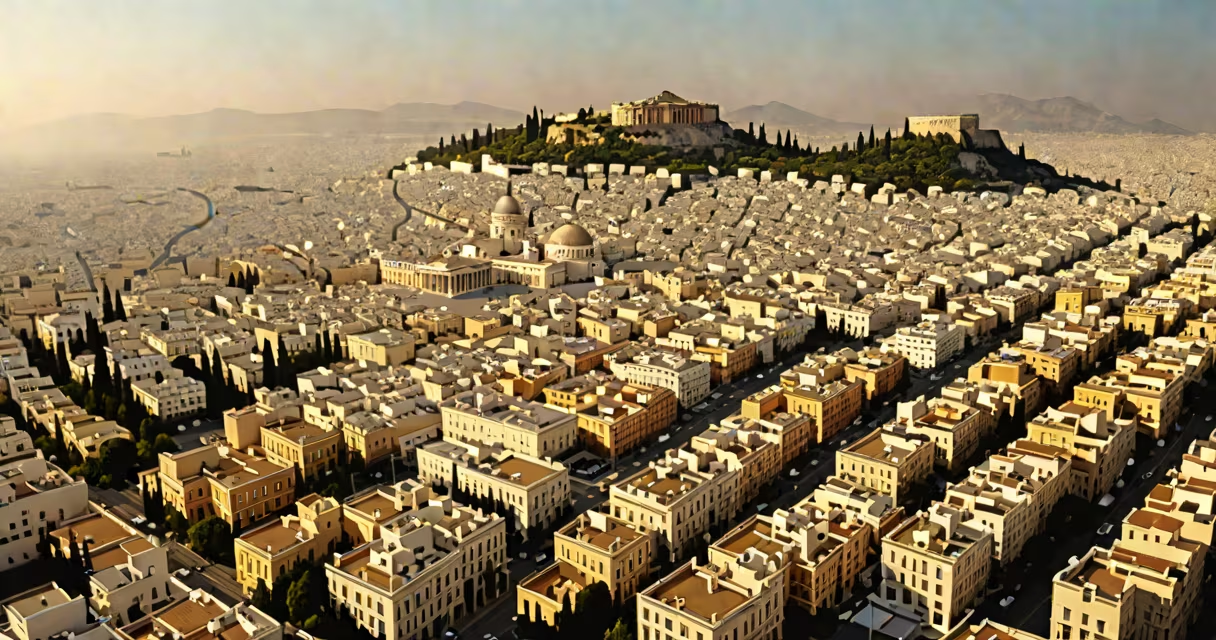
Athens is the capital city of Greece, situated on the Attica Peninsula in southeastern Europe. It has served as the country's administrative, cultural, and historical heart since ancient times.
Athens sits at the intersection of mountainous terrain and the Aegean Sea, with elevations ranging from sea level to over 200 meters above sea level. The city lies within the larger region of Attica, which includes the surrounding suburbs and towns. Its location has shaped its development for over 2,500 years, from the classical city-state of antiquity to the modern metropolis of today.
The city's urban core spans approximately 39 square kilometers, with a metropolitan population exceeding 3.5 million people. This makes it the largest city in Greece and one of the most populous in the European Union. Despite its size, Athens retains strong archaeological presence-over 100 ancient sites are documented within the city limits, including the Acropolis, the Ancient Agora, and the Temple of Olympian Zeus.
Athens hosts the Greek government, including the President's office, Parliament, and major ministries. The Hellenic Parliament occupies the historic building known as the Old Royal Palace, located near Syntagma Square-the central hub of civic life. Protests, ceremonies, and public gatherings regularly occur here, reflecting the city's role in national identity.
The city's economy relies heavily on services, tourism, education, and finance. Over 15 million international visitors arrive annually, drawn by historical landmarks such as the Parthenon and the National Archaeological Museum. The museum holds over 11,000 artifacts from ancient Greece, including the famous Antikythera mechanism-an ancient analog computer discovered in a shipwreck off the coast of Kythera.
Transportation in Athens centers around the metro system, which extends 68 kilometers and connects the city center with suburban neighborhoods. The Athens Metro Line 1 runs beneath the Ancient Agora and past the Roman Forum, blending modern infrastructure with ancient ruins. The city also operates a network of buses, trams, and the suburban railway (Proastiakos), linking Athens with nearby cities like Piraeus and Elefsina.
Athens is divided into distinct zones based on function and historical development:
| Zone Type | Characteristics | Examples |
|---|---|---|
| Historic Core | Centers around ancient and Byzantine structures; high heritage value | Acropolis, Plaka neighborhood, Syntagma Square |
| Administrative Districts | Government buildings, embassies, public institutions | Metaxourgeio, Kallithea, Palaio Faliro |
| Residential Suburbs | High-density housing, mixed-use developments | Nea Filadelfeia, Maroussi, Chalandri |
| Commercial & Industrial Areas | Shopping centers, ports, manufacturing zones | Piraeus port, Attiki Odos motorway corridor |
Each zone reflects different phases of urban growth-from the grid-based planning of the 19th century to the unregulated expansion of the 20th century. The city's zoning laws now emphasize sustainability, with new projects required to meet energy efficiency standards set by the European Commission.
Many assume that Athens is a single, compact city. In reality, it is a sprawling metropolitan area spread across multiple municipalities. The official city boundaries cover only about 39 km², while the greater Athens urban area spans over 400 km² and includes 37 municipalities.
Another misconception is that the Acropolis is the entire city. While the Acropolis hill contains the most iconic monuments, it represents just one site among hundreds. The ancient city of Athens extended across the plains of Attica, with temples, theaters, and agora spaces scattered throughout the region.
A lesser-known fact: Athens was briefly the capital of the newly formed Kingdom of Greece in 1834, replacing Nafplion. The decision was influenced by the desire to connect the modern state with its classical roots. The city's layout was redesigned by German architect Leo von Klenze, who introduced neoclassical architecture to reflect ancient ideals. His plan included wide boulevards, symmetry, and public squares-elements still visible today.
Athens hosted the 2004 Summer Olympics, becoming the first European city to host the Games twice-after 1896. The event prompted extensive infrastructure upgrades. The Olympic Stadium, located in Marousi, was rebuilt with a capacity of 75,000 spectators. The city expanded its metro lines, added new roads, and improved accessibility for disabled athletes.
Post-Games, many venues were repurposed. The Olympic Aquatic Centre became a public swimming facility. The velodrome was converted into a community sports complex. The Olympic Village in the suburb of Nea Filadelfeia was transformed into affordable housing for low-income families. These changes illustrate how large-scale events can reshape urban environments long-term.
I visited Athens during the 2004 Games and witnessed the transformation firsthand. The city center was bustling with construction crews, security personnel, and tourists. The sight of the Olympic flame being lit atop the Acropolis was unforgettable-a symbolic fusion of ancient and modern Greece.
Athens differs from other European capitals in several ways. Unlike Paris or Berlin, it lacks a centralized palace district. Instead, power is dispersed across government buildings, universities, and civic halls. The city's elevation creates microclimates-summer temperatures often exceed 35°C, while winter rainfall averages 500 mm annually.
Compared to smaller capitals like Reykjavik or Luxembourg City, Athens has a much higher population density. The average residential unit in central Athens covers 60 square meters, compared to 80 in Vienna and 100 in Stockholm. This affects housing affordability, with median rent prices reaching €1,800 per month in the city center.
For context, the capital city of the USA is Washington, D.C., a planned federal district separate from any state. In contrast, Athens is both the capital of Greece and the seat of Attica Region. South Sudan's capital city, Juba, lies in a conflict-affected region with limited infrastructure. Athens, by comparison, has a well-established legal structure, public transportation, and emergency services.
Understanding the term "greece capital city" requires recognizing that Athens is not just a political center-it is a living archive of human history, a modern urban system, and a global cultural landmark.
Athens remains the definitive greece capital city. Its blend of ancient legacy and contemporary function sets it apart among world capitals. From the Parthenon's columns to the electronic fare cards on the metro, the city continues to evolve while preserving its identity.