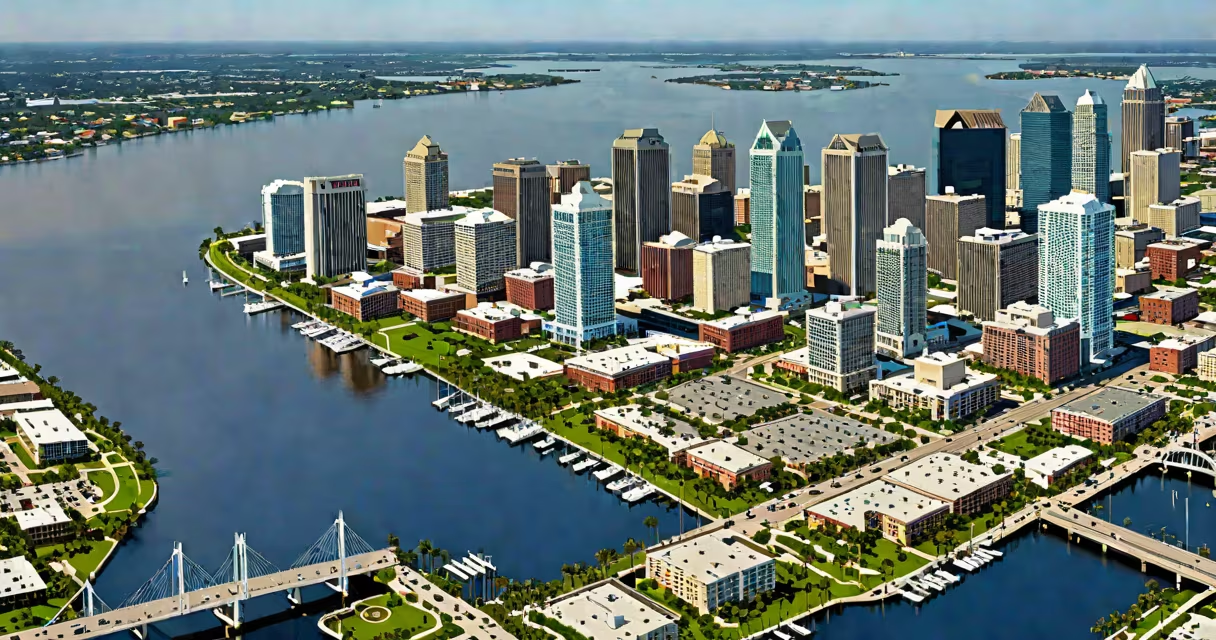
The greater Tampa Bay area is a metropolitan region in west-central Florida encompassing Hillsborough, Pinellas, and Pasco counties. It includes major cities such as Tampa, St. Petersburg, Clearwater, Largo, and Brandon. The region covers approximately 3,600 square miles and had a population of 4.7 million in 2023, according to the U.S. Census Bureau.
Defined by the U.S. Office of Management and Budget, the greater Tampa Bay area is part of the larger Tampa-St. Petersburg-Clearwater Metropolitan Statistical Area (MSA). This designation reflects economic integration, shared infrastructure, and labor market coordination across the three counties. The region serves as a center for logistics, healthcare, education, and technology in Florida's Gulf Coast.
Transportation networks tie the area together. The Selmon Expressway connects Tampa to the north, while the Veterans Expressway links to the south. Major ports in Tampa and St. Petersburg handle cargo and cruise traffic. The Tampa International Airport (TPA) serves over 20 million passengers annually and is a key gateway for domestic and international travel.
Despite being divided among three counties, the greater Tampa Bay area functions as a single economic and social unit. Residents frequently cross county lines for work, shopping, and recreation. Commuting patterns show that 42% of workers in Hillsborough County live in neighboring Pasco or Pinellas counties, according to the 2022 American Community Survey.
Shared services and institutions reinforce cohesion. The University of South Florida (USF) in Tampa has campuses in both St. Petersburg and Sarasota. The Tampa Bay Buccaneers play their home games at Raymond James Stadium in Tampa, but their fan base extends across all three counties. The Tampa Bay Lightning hockey team draws fans from the entire region.
Regional planning agencies coordinate development. The Tampa Bay Area Council, a nonprofit organization, brings together local governments, businesses, and nonprofits to address transportation, housing, and environmental issues. Its work includes regional transportation plans and climate resilience strategies.
The greater Tampa Bay area is shaped by geography, economy, and culture. The region sits along the Gulf of Mexico, with access to beaches, estuaries, and wetlands. The Tampa Bay estuary covers 400 square miles and supports commercial fishing, boating, and marine research.
Economically, the region ranks among the top 25 U.S. metropolitan areas by GDP. In 2022, the region's gross metropolitan product was $248 billion, according to the U.S. Bureau of Economic Analysis. Key sectors include healthcare (with hospitals like Tampa General and Johns Hopkins All Children's), defense (Naval Station Norfolk's support operations), and information technology (with growing tech hubs in Downtown Tampa and St. Petersburg).
Culture and lifestyle contribute to the region's identity. The annual Gasparilla Festival in Tampa features a pirate invasion and parade. St. Petersburg hosts the Salvador Dalí Museum, which attracts over 100,000 visitors annually. The region also has a strong arts scene, with venues like the Straz Center for the Performing Arts and the Museum of Fine Arts, St. Petersburg.
| County | Population (2023) | Largest City | Key Economic Sector |
|---|---|---|---|
| Hillsborough | 1.5 million | Tampa | Healthcare, Education, Logistics |
| Pinellas | 970,000 | St. Petersburg | Tourism, Healthcare, Real Estate |
| Pasco | 570,000 | Port Richey | Agriculture, Manufacturing, Tech |
Businesses use the term "greater Tampa Bay area" to define their service zones. For example, insurance companies list coverage areas by county, but advertise services across the entire region. A 2023 report from the Tampa Bay Partnership noted that 68% of new business investments in Florida were located in the greater Tampa Bay area.
Real estate markets operate under the same umbrella. Home prices in the region averaged $430,000 in 2023, with significant variation between cities. In St. Petersburg, median home values reached $540,000, while in Brandon, they were $390,000. Buyers often compare neighborhoods across county lines due to proximity and commuting time.
Emergency response systems span the region. The Florida Department of Health uses a unified reporting system for disease surveillance across all three counties. During Hurricane Ian in 2022, coordinated evacuation routes and shelter assignments were managed through a joint command center based in Hillsborough County.
Many assume the greater Tampa Bay area includes Miami or Orlando. It does not. The region is distinct from other Florida metro areas. Miami lies in South Florida, and Orlando is in Central Florida. The greater Tampa Bay area is geographically centered on the Gulf Coast, roughly 100 miles west of Orlando and 300 miles south of Jacksonville.
Another misconception is that the region is synonymous with "Tampa." While Tampa is the largest city and administrative center, the area includes multiple urban centers. St. Petersburg is the second-largest city and a major cultural and economic hub. Clearwater ranks among the top 20 most livable cities in the U.S. by U.S. News & World Report.
A lesser-known fact: the greater Tampa Bay area is home to the largest concentration of NASA-affiliated research in Florida outside of Cape Canaveral. The Kennedy Space Center's engineering teams collaborate with USF and the Florida Institute of Technology on aerospace projects. This network supports over 12,000 jobs in STEM fields across the region.
In 2021, I attended a regional innovation summit in downtown Tampa hosted by the Greater Tampa Bay Chamber of Commerce. Over 800 attendees from all three counties discussed workforce development and clean energy initiatives. The event highlighted how cross-county collaboration drives growth-companies from Pasco County partnered with universities in Hillsborough County on AI research grants.
The greater Tampa Bay area is a changing, interconnected region defined by shared infrastructure, economic activity, and civic engagement. It is not a single city but a network of communities bound by geography, economy, and purpose. Understanding this distinction helps clarify how regional planning, business strategy, and daily life function across Hillsborough, Pinellas, and Pasco counties.