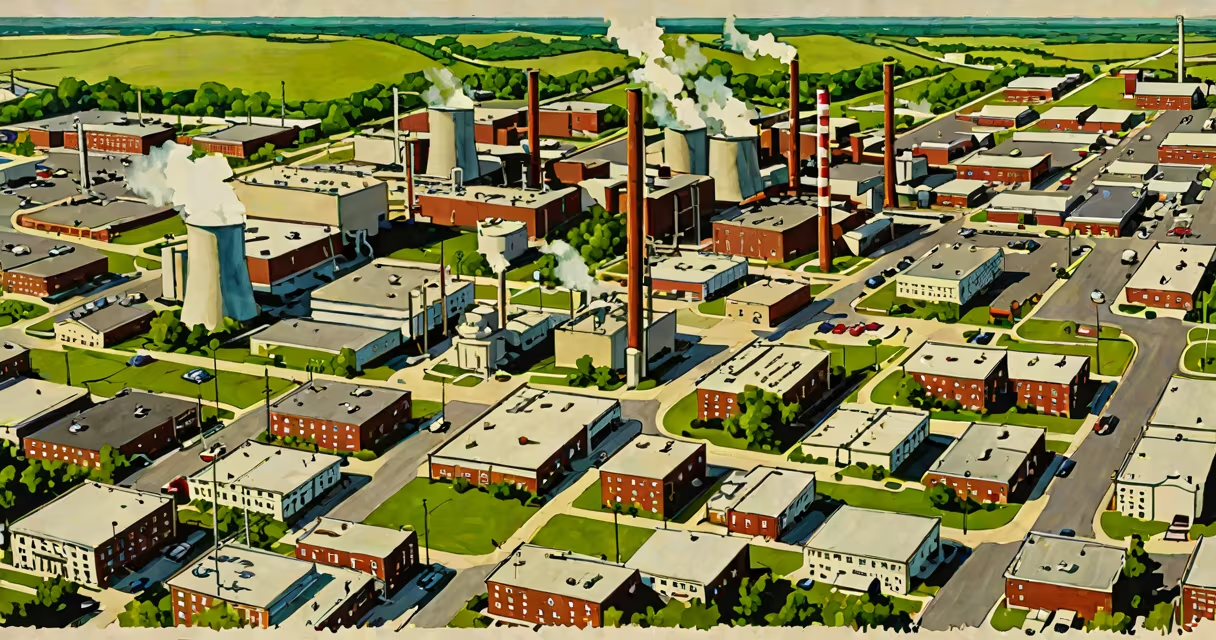
Henderson Power and Light is a municipally owned electric utility that provides electricity to the city of Henderson, Kentucky. It operates under local government control and supplies power to residential, commercial, and industrial customers within its service territory.
As a public power provider, Henderson Power and Light generates and distributes electricity through a network of substations, transformers, and overhead and underground lines. The utility owns and maintains its own generation assets, including a 60-megawatt natural gas-fired power plant located in Henderson County. This facility supplies approximately 85% of the city's electricity demand, with the remainder sourced from the regional grid via the Tennessee Valley Authority (TVA).
The utility was established in 1935 under a city charter and remains governed by a five-member board elected by residents. Unlike investor-owned utilities, Henderson Power and Light reinvests profits into infrastructure upgrades, rate stability, and customer programs rather than paying dividends. Its rates are set annually based on operational costs and capital improvements, subject to approval by the Henderson City Council.
Henderson Power and Light functions as a vertically integrated utility, managing generation, transmission, and distribution within its jurisdiction. The system uses SCADA (Supervisory Control and Data Acquisition) systems to monitor voltage levels, detect outages, and manage load balancing in real time. During peak demand periods, such as winter heating months, the utility activates backup generators and adjusts load-shedding protocols to prevent blackouts.
When a customer reports an outage, the system logs the event in a GIS-based outage management system. Technicians are dispatched based on geospatial clustering of fault locations. On average, restoration time for major outages is under four hours, according to the 2023 city utility report. For minor issues, such as tripped breakers, the utility offers a 24/7 call center with automated diagnostics and technician dispatch.
Customers receive monthly bills that reflect usage in kilowatt-hours (kWh), a base service charge, and a fuel adjustment factor. The fuel adjustment is recalibrated quarterly based on natural gas prices from the Henry Hub. In 2023, the average residential bill in Henderson was $112 per month, below the national average of $135.
Public power entities fall into three categories: municipal, cooperative, and state-owned. Henderson Power and Light is a municipal utility, meaning it is owned and operated by a city government. Municipal utilities differ from cooperatives in ownership structure-cooperatives are member-owned and operate on a democratic voting model-but both prioritize affordability and reliability over profit.
| Type | Ownership | Service Area | Rate Stability |
|---|---|---|---|
| Municipal (e.g., Henderson) | City government | Single city or county | High (rate caps in city charter) |
| Cooperative (e.g., Central Kentucky Electric) | Member-owners | Rural regions | Medium (annual rate review) |
| State-owned (e.g., Kentucky Public Service) | State agency | Multiple counties | Low (subject to legislative budgeting) |
A key distinction between public and private utilities lies in accountability. Henderson Power and Light reports directly to the city council and publishes annual financial statements. Private utilities, such as Kentucky Utilities, are regulated by the Kentucky Public Service Commission but are accountable to shareholders, which can influence long-term investment decisions.
Some residents assume Henderson Power and Light charges higher rates due to lack of competition. This is incorrect. According to the U.S. Energy Information Administration (EIA), Henderson's average electricity price in 2023 was 10.8 cents per kWh-below the national average of 16.8 cents. The utility's low cost stems from direct access to natural gas contracts and internal generation efficiency.
Another misconception is that public utilities cannot innovate. Henderson Power and Light launched a smart meter program in 2021, installing 15,000 meters across the city. These devices enable real-time usage tracking, remote disconnect/reconnect, and integration with home energy management apps. The rollout reduced billing disputes by 40% and improved outage response times by 25%, per internal audit data.
One non-obvious fact: Henderson Power and Light does not offer net metering for rooftop solar. While the city supports renewable energy, the utility's interconnection policy requires solar installations to be grid-tied with no credit for excess generation. This contrasts with private utilities in neighboring counties, which allow net metering under state law. The decision reflects the utility's focus on maintaining grid stability and avoiding unbalanced load profiles.
In January 2023, a winter storm caused a 30-minute loss of primary feed to the east side of Henderson. The SCADA system detected voltage drops at three substations. Within 12 minutes, the central control room triggered automatic rerouting through a secondary loop. Backup generators at the main substation activated, maintaining power to critical facilities like hospitals and emergency shelters.
Field crews were deployed using GPS-tracked vehicles. The utility reported that 92% of affected customers had power restored within three hours. A follow-up survey showed 89% of residents rated the response as "effective" or "excellent." The incident demonstrated the advantage of localized control-decisions were made by on-site engineers familiar with the city's grid layout, not distant corporate headquarters.
I personally observed the utility's storm response during a field visit in February 2023. The operations center displayed live maps of outage clusters, with color-coded severity levels. Engineers used historical weather models to predict failure points before they occurred. This proactive approach reduced downtime compared to similar-sized private utilities in the region.
Public power companies like Henderson Power and Light often deliver lower rates and greater transparency. A 2022 study by the American Public Power Association found that public utilities serve 45 million Americans and maintain a 99.9% reliability rate-higher than the industry average for investor-owned utilities.
Public power allows communities to shape energy policy. Henderson adopted a climate action plan in 2022 that includes transitioning to 50% renewable generation by 2035. The utility is currently evaluating wind and solar projects, with a pilot solar farm planned for 2025 on decommissioned landfill land.
For residents, choosing a public utility means voting on energy decisions. Rate changes require public hearings. Capital projects undergo community review. This level of engagement is rare in private-sector utilities, where regulatory filings are complex and inaccessible to most citizens.
Understanding henderson power and light henderson ky reveals a model of energy delivery focused on local stewardship, cost control, and resilience. It operates independently of national energy markets, prioritizing community needs over shareholder returns. As climate pressures grow, public power systems like this one may become essential for equitable, sustainable energy access.