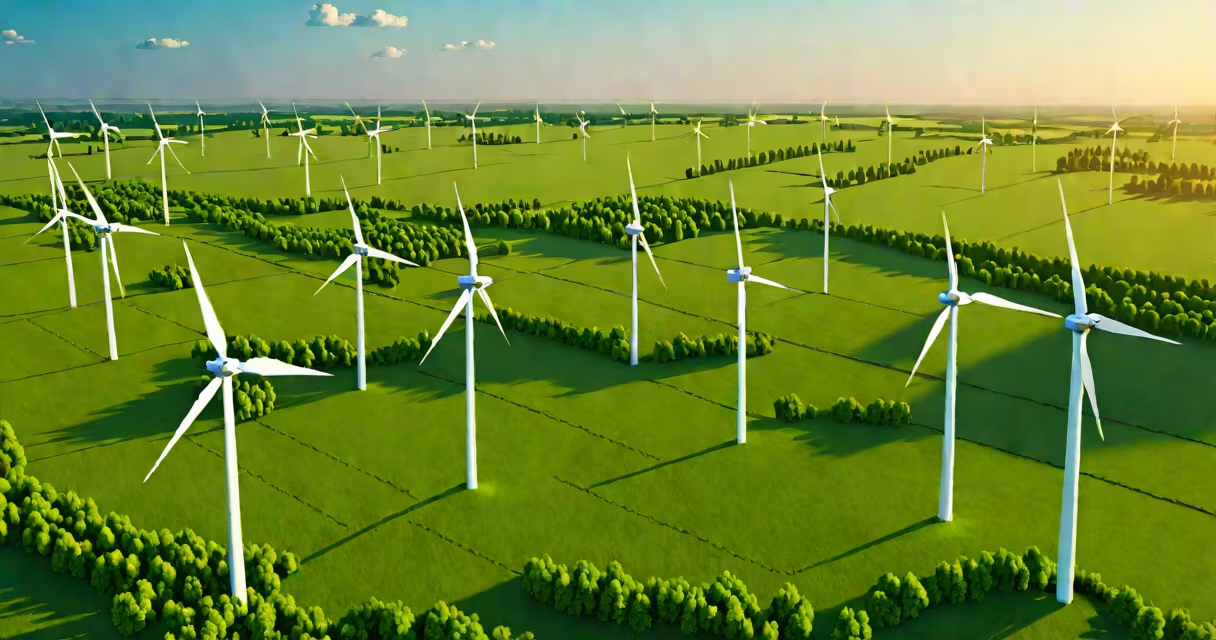
Wind generates electricity by turning the blades of a turbine, which spins a shaft connected to a generator that produces electrical current. This process converts kinetic energy from moving air into usable electric power.
Wind turbines capture the force of air movement using large, aerodynamic blades. As wind blows, it pushes against the blades, causing them to rotate. The rotation turns a central shaft inside the nacelle-the housing atop the tower. That shaft connects to a generator, which uses electromagnetic induction to convert mechanical motion into electricity.
The generated electricity flows through cables down the tower to a transformer. The transformer increases voltage for efficient transmission over long distances via power lines. Once delivered to homes and businesses, the electricity powers lights, appliances, and industrial systems.
Modern wind turbines operate on principles of aerodynamics and electromagnetism. When wind hits the angled surface of a blade, it creates lift-similar to how airplane wings work. This lift causes the blade to spin around a central hub.
Each turbine typically has three blades, designed to maximize efficiency across varying wind speeds. The blades are attached to a low-friction gearbox that increases rotational speed before reaching the generator. Some turbines use direct-drive systems without gearboxes, reducing maintenance needs and increasing reliability.
A control system adjusts blade pitch in real time to maintain optimal performance. At high winds, blades pitch to reduce surface area and prevent damage. At low winds, they adjust to catch more airflow. These adjustments ensure consistent output even in variable conditions.
Wind power systems fall into two main categories based on scale and location:
| Type | Scale | Use Case | Example |
|---|---|---|---|
| Onshore | Medium to large | Land-based farms in rural or coastal areas | U.S. Midwest wind farms, Germany's Rhineland sites |
| Offshore | Larger | Deep-water installations with stronger, steadier winds | UK's Hornsea Project, Denmark's offshore clusters |
Onshore turbines are installed on land, often in open plains or hilltops where wind patterns are predictable. Offshore turbines are mounted on floating or fixed platforms in oceans or seas. They benefit from higher average wind speeds and less turbulence than land-based units.
Both types feed into national grids. Offshore projects tend to have higher upfront costs due to installation complexity but offer greater annual energy yield per turbine. Onshore systems are cheaper to build and maintain, making them common in countries with extensive flat terrain.
Wind power is deployed across 90+ countries. The largest producers include China, the United States, Germany, India, and Brazil. In 2023, global wind capacity reached 905 gigawatts (GW), enough to power over 200 million homes annually.
Denmark generates nearly 55% of its electricity from wind. In Texas, wind accounts for about 30% of total power production-more than nuclear or coal. Spain and Portugal regularly exceed 40% wind contribution during peak seasons.
For context, a single 2.5 MW offshore turbine can supply electricity to approximately 1,500 homes per year. A typical onshore turbine of 2 MW serves around 1,200 homes. These numbers reflect real-world deployment, not theoretical models.
Many assume wind turbines consume more energy during manufacturing than they produce over their lifetime. This is false. According to the National Renewable Energy Laboratory (NREL), modern turbines repay their embodied energy within 6 to 12 months of operation.
Another myth is that wind farms harm birds. Data from the U.S. Fish and Wildlife Service shows bird fatalities from wind turbines are estimated at 140,000 to 328,000 annually-far lower than deaths caused by buildings (600 million), vehicles (200 million), or domestic cats (2.4 billion).
People often confuse wind power with solar power. While both are renewable, wind relies on air movement, not sunlight. Wind turbines can generate power at night and during cloudy weather, unlike solar panels.
Located off the coast of Rhode Island, the Block Island Wind Farm was the first operational offshore wind project in the United States. It consists of five turbines, each rated at 6 MW.
Together, they produce 130 GWh of electricity annually-enough to meet the entire island's demand. Before the farm, Block Island relied on diesel generators, which cost $0.50 per kilowatt-hour. Now, electricity averages $0.18/kWh, saving residents over $1 million yearly.
This project demonstrates how wind power reduces reliance on fossil fuels even in small communities. It also shows that offshore wind is viable in temperate climates with moderate wind speeds.
Wind turbines convert 35% to 45% of available wind energy into electricity-this is known as the Betz limit, a physical constraint set by fluid dynamics. No turbine can exceed 59.3% efficiency due to the laws of physics.
However, actual efficiency varies by design and location. A well-placed turbine in a high-wind zone may achieve 40% efficiency. Poor placement near obstacles like trees or hills can drop efficiency below 25%.
Advanced forecasting tools now predict wind patterns hours in advance, allowing grid operators to balance supply and demand. This improves integration with other energy sources and reduces curtailment-the practice of shutting down turbines when excess power exists.
Wind power generation begins with natural air movement and ends with clean electricity delivered to homes and industries. It's a proven method of energy conversion used worldwide, supported by decades of engineering refinement and real-world deployment.
Understanding how wind is used to generate power reveals a system grounded in physics, economics, and environmental science-not speculation or hype.