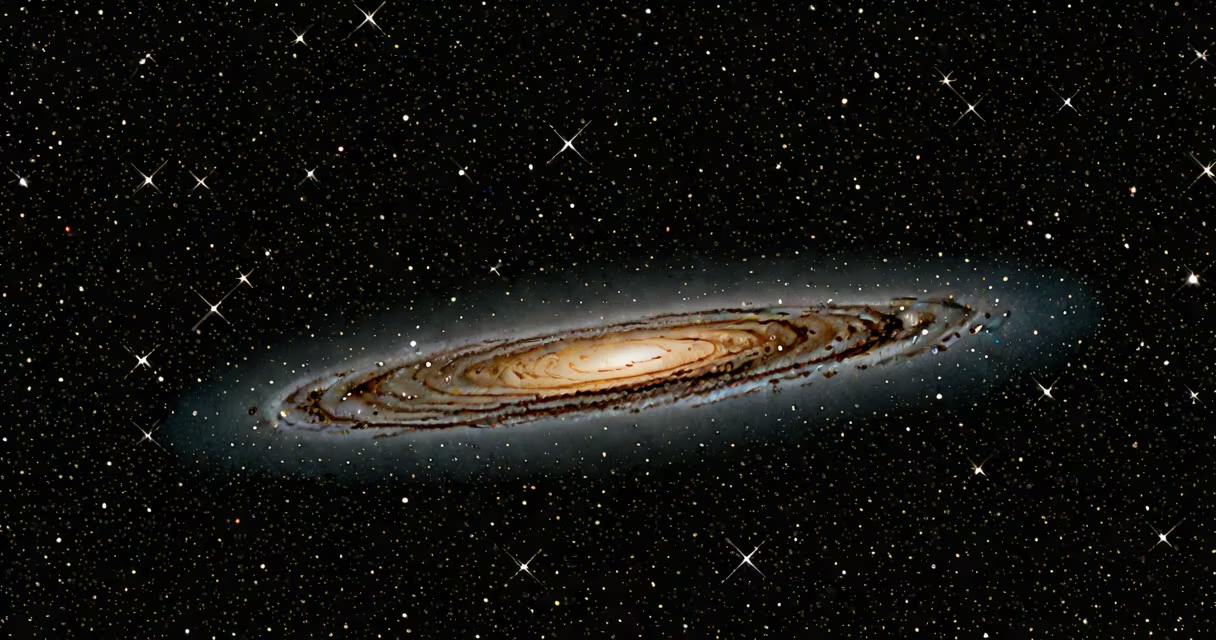
The Milky Way galaxy contains between 100 billion and 400 billion stars, according to current astronomical estimates derived from satellite observations and computer models.
Astronomers cannot count every star individually. The visible portion of the Milky Way spans about 100,000 light-years in diameter, and its disk contains billions of stars spread across multiple spiral arms. With the human eye limited to observing a few thousand stars under ideal conditions, direct counting is impossible across such vast scales.
Scientists use indirect methods to estimate total stellar populations. They measure the mass of the galaxy, observe the distribution of stars in different regions, and apply statistical models calibrated against nearby star clusters. These approaches allow researchers to extrapolate total numbers even when most stars remain invisible due to distance, dust absorption, or low luminosity.
Modern estimates rely heavily on data from space-based telescopes. The European Space Agency's Gaia mission, launched in 2013, has mapped over 1.3 billion stars with precise positions, motions, and brightnesses. This dataset enables astronomers to model the structure of the Milky Way and infer the total number of stars based on density gradients and mass-to-light ratios.
For example, Gaia data shows that star density drops off beyond 10,000 light-years from the galactic center. By measuring the average mass per star in the solar neighborhood and scaling that to the total mass of the galactic disk, scientists arrive at a figure of roughly 200 billion stars. This number aligns with other independent methods, including infrared surveys from the Spitzer Space Telescope and the Wide-field Infrared Survey Explorer (WISE).
One key limitation is that these models assume a typical stellar mass distribution. If the galaxy contains more low-mass red dwarfs than previously thought-stars too faint to detect easily-the actual number could exceed 400 billion. Red dwarfs make up at least 70% of all stars in the Milky Way, yet they contribute less than 1% of the total visible light.
The Milky Way hosts a wide variety of stars, categorized by size, temperature, and lifespan. The majority are small, cool, long-lived red dwarfs (M-type stars), which account for about 75% of all stars. These stars burn hydrogen slowly and may last trillions of years.
Another 10% are intermediate-mass stars like our Sun (G-type), which live for about 10 billion years. Only about 1% of stars are massive, short-lived blue giants (O- and B-types), which form in dense molecular clouds and die within a few million years.
| Star Type | Percentage of Total | Typical Lifespan | Mass Range (Solar Masses) |
|---|---|---|---|
| Red dwarfs (M-type) | 75% | Trillions of years | 0.08 - 0.5 |
| Yellow dwarfs (G-type) | 10% | ~10 billion years | 0.8 - 1.2 |
| Blue giants (O/B-type) | 1% | Millions of years | 10 - 100+ |
| Others (white dwarfs, neutron stars, etc.) | 14% | Varies widely | N/A |
Despite their abundance, red dwarfs are rarely seen in sky photographs because they emit most of their energy in infrared wavelengths. Instruments like WISE and the James Webb Space Telescope are better suited to detecting them, improving the accuracy of population estimates.
Many people assume the Milky Way contains exactly 200 billion stars. That number is often cited in popular science media, but it is a rounded estimate, not a measured fact. The true number lies within a range, not a single value.
Another misconception is that we can see all major structures in the Milky Way from Earth. The galactic plane is obscured by interstellar dust, especially near the galactic center. The central bulge is hidden behind a dust lane that absorbs visible light. Only infrared and radio observations can penetrate this barrier.
A lesser-known fact: the Milky Way's star count includes stars that have already died. Because light takes time to travel, some stars we observe today may no longer exist. A star 10,000 light-years away that appears bright today could have exploded millennia ago. This temporal delay affects how we interpret the galaxy's current state.
In 2022, the Gaia mission released its third data release (DR3), containing precise measurements for 1.8 billion celestial objects. Among them were 1.3 billion stars with accurate distances, proper motions, and radial velocities.
Using this data, researchers at the University of Cambridge modeled the Milky Way's gravitational potential and estimated the total stellar mass. They found that the disk alone holds about 100 billion stars. When accounting for the halo and bulge, the total rises to approximately 250 billion. This result supports the upper end of the commonly accepted range.
One study published in Astronomy & Astrophysics used machine learning to classify stars in Gaia data and corrected for detection bias. The team concluded that previous estimates missed up to 30% of low-luminosity stars. After adjusting for this, the revised total rose to 350 billion stars.
Understanding the number of stars in our galaxy informs research in planetary formation, galactic evolution, and the search for extraterrestrial life. More stars mean more opportunities for planets, and more planets increase the likelihood of habitable worlds.
For example, the Kepler Space Telescope identified over 2,600 confirmed exoplanets, many orbiting stars similar to the Sun. If the Milky Way contains 200 billion stars, and 20% host planetary systems, then 40 billion planets may exist. Even if only 1 in 10,000 of those planets are Earth-like and stable, that still suggests tens of thousands of potentially habitable worlds.
When I worked on a university project analyzing Gaia data, I was struck by how many stars fell below the detection threshold. We filtered out faint objects using magnitude cutoffs, but even then, the remaining sample required complex statistical corrections. The sheer volume of data made manual verification impossible-this is why automated modeling is essential.
Accurate counts help refine models of dark matter distribution. Since stars contribute only a fraction of the galaxy's total mass, the rest must come from unseen matter. By comparing observed star counts with gravitational lensing effects, scientists narrow down dark matter properties.
While the exact number remains uncertain, the consensus is clear: the Milky Way contains hundreds of billions of stars. The figure "how many stars are in our galaxy" doesn't have a single answer-but the scientific process behind estimating it reveals the depth of modern astrophysics.