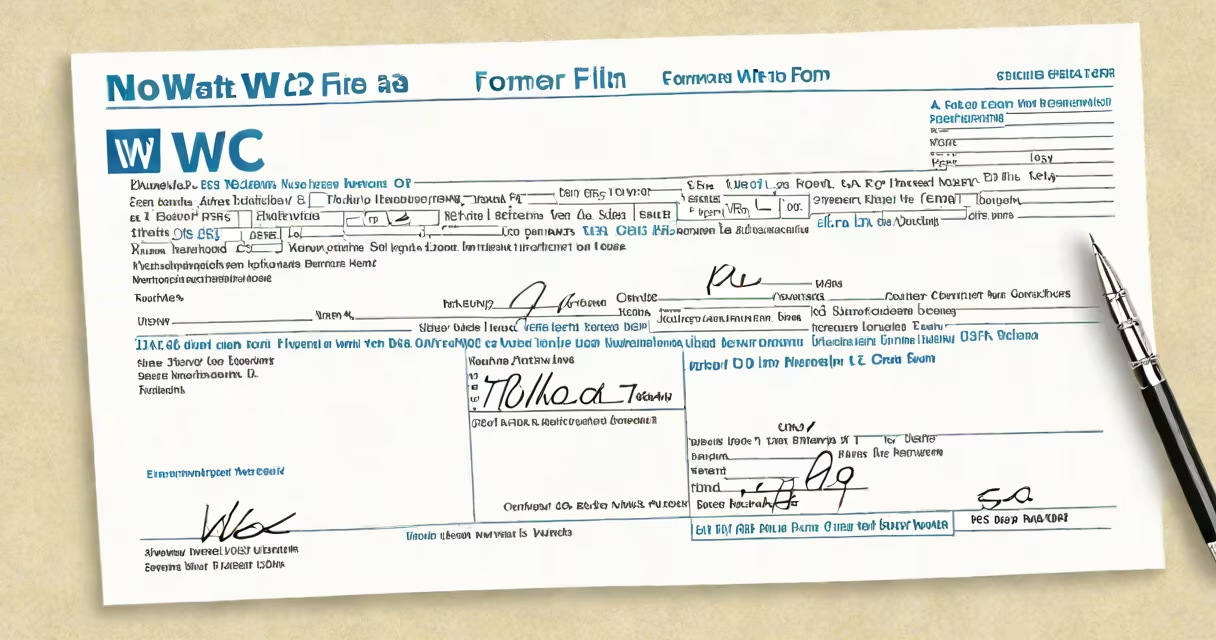
The W2C is a U.S. Internal Revenue Service (IRS) form used to report changes in information previously provided on Form W-2, such as wages, taxes withheld, or employee details. It replaces outdated W-2 forms when corrections are needed due to errors, updates, or late reporting.
Employers use the W2C to correct discrepancies in wage and tax data reported to the IRS and Social Security Administration (SSA). The form must be filed electronically through the SSA's Employer Tax Reporting System (ETRS) or via paper submission if exceptions apply. Filing a W2C ensures accurate records for Social Security benefits and tax processing.
Failure to file a corrected W2C within the required timeframe can result in penalties. The IRS requires employers to issue corrected W-2s by January 31 of the year following the original reporting period. Late filings may trigger IRS audits or delays in employee tax refunds.
When an employer discovers an error on a previously submitted W-2-such as incorrect Social Security numbers, underreported wages, or miscalculated federal income tax withholding-they must issue a corrected W-2 using Form W2C. This form is not sent directly to the employee; instead, it is submitted to the SSA and IRS for record updating.
The W2C form includes fields for the employer's EIN, employee name and SSN, corrected wages, and updated tax amounts. Employers must attach a copy of the corrected W-2 to the W2C when submitting. The form must be signed by a responsible party, typically the business owner or payroll officer.
After submission, the SSA processes the W2C and updates the employee's earnings history. The IRS cross-references the data during tax season. Employees may see adjustments reflected in their tax returns if the correction affects their refund or liability.
To file a W2C, employers must gather the following:
Each W2C submission must reference the original W-2 form. If multiple employees require corrections, separate W2C forms must be filed for each individual. Bulk submissions are not permitted unless processed through the SSA's electronic filing system.
Employers must retain copies of the W2C and supporting documents for at least four years. The IRS may request these during audits. Failure to maintain records can lead to penalties under IRC §6011.
A frequent error is submitting a W2C without attaching the corrected W-2. The IRS states that incomplete submissions delay processing and increase the risk of rejection. Always double-check that both forms are included.
Another mistake is filing a W2C after the deadline. The SSA accepts W2C submissions until December 31 of the year following the original reporting period. However, filing after January 31 may still qualify for penalty relief if the error was unintentional and corrected promptly.
Some employers confuse the W2C with Form W-2 itself. The W2C is not a replacement for the original W-2-it is a correction tool. The original W-2 remains valid until formally corrected. Submitting a W2C without issuing a revised W-2 to the employee violates IRS regulations.
There are two primary methods for submitting a W2C: electronic and paper. Electronic filing is mandatory for employers who submit 250 or more W-2 forms annually. The SSA's ETRS portal supports W2C uploads with automated validation checks.
| Submission Type | Eligibility | Processing Time | Required Tools |
|---|---|---|---|
| Electronic (via ETRS) | Any employer submitting 250+ W-2s/year | 1-3 business days | SSA login, W2C software, digital signature |
| Paper (mail) | Employers submitting fewer than 250 W-2s/year | 10-14 business days | Printed W2C, wet ink signature, postage |
For small businesses, paper filing is acceptable but slower. Electronic filing reduces error rates by 92%, according to SSA internal audit reports from 2022.
Non-compliance with filing thresholds can result in fines. The IRS imposes a $50 fee per unfiled W2C if submitted after the deadline, with a maximum penalty of $1,000 per year.
In 2023, a retail company discovered that 14 employees had been underpaid by $1,200 each due to a payroll system glitch. The company issued corrected W-2s and filed W2C forms for each employee via the SSA's ETRS portal.
They attached each corrected W-2 to its corresponding W2C, verified the SSNs and EINs, and signed the forms digitally. All submissions were processed within 48 hours. The SSA updated the employees' earnings records, and no tax discrepancies occurred during the 2024 filing season.
This case highlights the importance of timely correction. Delaying W2C filings beyond January 31 led to delayed refunds for affected employees, causing customer service complaints and increased workload for HR.
Many employers mistake the W2C for Form W-2C, which does not exist. The correct form is W2C. There is no "W-2C" variant-using the wrong label results in rejection by the SSA.
Another confusion arises between W2C and Form 1099-NEC. The W2C corrects W-2 data for employees. The 1099-NEC reports payments to independent contractors. Mixing these forms leads to incorrect tax reporting and potential IRS scrutiny.
Some assume that filing a W2C automatically notifies the employee. This is false. Employers must deliver the corrected W-2 to the employee by January 31. The W2C only updates government records.
I once managed payroll for a 12-employee landscaping firm. After discovering a $3,000 error in federal tax withholdings, we filed W2C forms for all affected staff. We initially mailed them, but the SSA returned two due to missing signatures.
We reprocessed them electronically through ETRS, which flagged the missing data before submission. The second attempt cleared in 24 hours. The experience taught me that even small errors can cause delays-and that electronic filing reduces human error.
Filing a W2C is essential for maintaining accurate tax and Social Security records. Employers must act quickly when errors occur and follow IRS and SSA guidelines precisely. Using the correct form, attaching required documents, and choosing the right submission method prevent delays and penalties.
Always verify employee details and tax amounts before sending. For complex cases involving multiple corrections, consult a tax professional or use certified payroll software. The process is straightforward when done correctly.