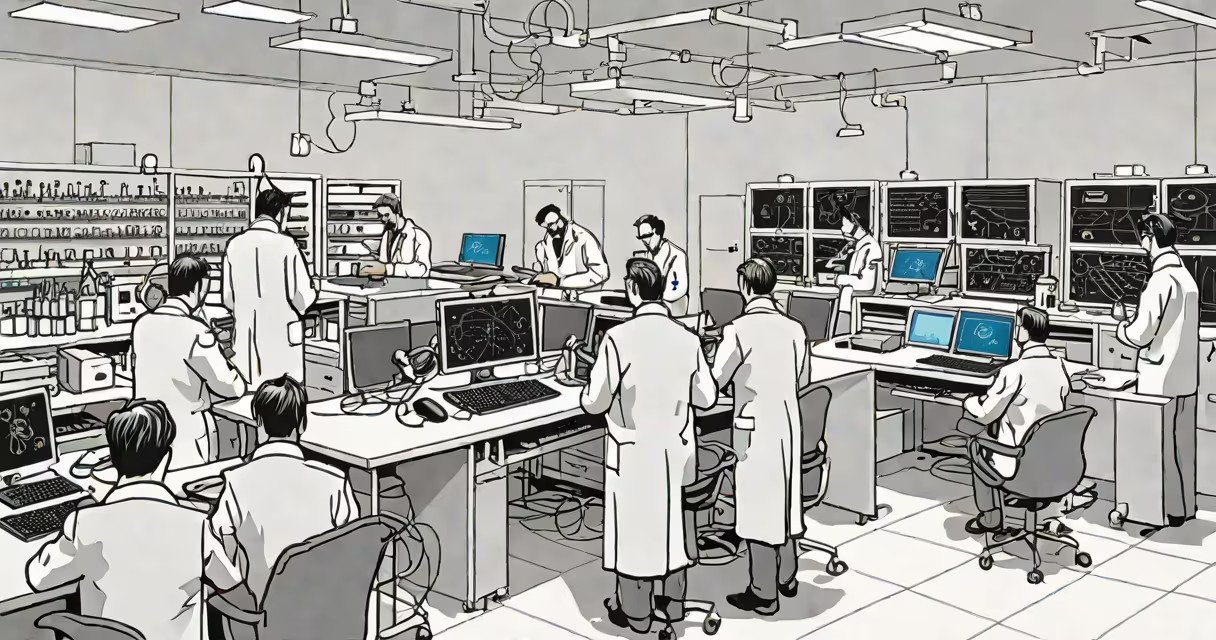
Quantum computing research investigates how to build machines that process information using quantum mechanics principles like superposition and entanglement. This field combines theoretical physics, computer science, and engineering to develop algorithms and hardware capable of solving problems beyond classical computers.
Research in quantum computing starts with mastering linear algebra, quantum mechanics, and computational complexity. Students explore how qubits differ from classical bits, how quantum gates manipulate state vectors, and how noise affects real-world implementations. The goal is to design systems that maintain coherence long enough to perform meaningful calculations.
Progression involves identifying a specific problem-such as optimizing quantum error correction codes or simulating molecular interactions-and developing mathematical models or experimental setups to test hypotheses. Results are published in journals like Nature Physics or Physical Review Letters, contributing to a global effort to scale quantum advantage.
Every quantum computing research project rests on three pillars: theory, simulation, and experimentation. Theory defines the rules-such as the Schrödinger equation or quantum circuit formalism-that govern behavior. Simulation uses classical computers to model small-scale quantum systems, validating ideas before physical implementation.
Experimentation requires access to cryogenic hardware-superconducting qubits, trapped ions, or photonic systems-operated at millikelvin temperatures. These platforms are fragile; even minor thermal fluctuations disrupt quantum states. Researchers measure gate fidelities, coherence times, and entanglement generation rates to assess performance.
A 2023 study by Google's Quantum AI team demonstrated a 53-qubit processor performing a task in 200 seconds that would take a classical supercomputer 10,000 years. This experiment validated quantum supremacy for a specific benchmark, though practical utility remains limited.
Undergraduates begin with courses in quantum mechanics, probability theory, and programming in Python or Qiskit. A solid grasp of Dirac notation and tensor products is essential. Without this foundation, attempting to read papers on variational quantum eigensolvers or surface codes leads to confusion.
Graduate programs in quantum computing often fall under departments of physics, computer science, or electrical engineering. Top institutions-MIT, ETH Zurich, University of Maryland, and the University of California, Berkeley-offer dedicated tracks. Admission typically requires GRE scores (though many schools have dropped this requirement), strong recommendation letters, and a statement of purpose outlining research interests.
For example, the Quantum Information Science program at MIT includes core classes in quantum algorithms, quantum error correction, and quantum cryptography. Students complete a thesis based on original work, often leading to publication in peer-reviewed venues.
Many assume quantum computing will replace classical computing. That is incorrect. Quantum computers excel at specific tasks-factoring large integers, searching unsorted databases, or simulating quantum systems-but they cannot run everyday software like web browsers or word processors.
Another misconception is that quantum computing is purely speculative. While large-scale fault-tolerant machines remain years away, progress is measurable. IBM's 127-qubit Eagle processor, released in 2021, enabled researchers to run experiments on quantum circuits with hundreds of gates-something impossible just a decade prior.
Even within academia, some confuse quantum computing research with quantum machine learning. The latter applies quantum-inspired methods to classical data, but it does not require actual quantum hardware. True quantum computing research demands physical systems or high-fidelity simulations.
Researchers focus on distinct areas depending on their expertise and available resources. Below is a comparison of major research directions:
| Type | Focus Area | Typical Tools | Key Metric |
|---|---|---|---|
| Theoretical | Quantum algorithms, complexity theory | Mathematical proofs, Q# or Qiskit code | Query complexity reduction |
| Hardware | Qubit fabrication, control electronics | Cryostats, microwave generators, nanofabrication tools | Coherence time (T2), gate fidelity > 99% |
| Software | Compiler optimization, error mitigation | Open-source frameworks, cloud APIs | Circuit depth reduction, noise resilience |
| Applications | Quantum chemistry, optimization, cryptography | Hybrid algorithms, quantum annealers | Speedup over classical methods |
Each type demands different skills. A theoretical researcher may never touch a lab instrument. A hardware engineer spends months aligning lasers or tuning Josephson junctions. The most impactful projects bridge multiple domains-like combining error-corrected logical qubits with efficient compilation techniques.
In 2022, I worked on a project at a university lab studying quantum error correction using surface codes. We simulated a 7x7 lattice of physical qubits on a GPU cluster. The goal was to identify thresholds for logical failure rates under realistic noise models. After six months of debugging, we achieved a threshold of 0.6%, matching theoretical predictions.
This experience revealed that success in quantum computing research relies less on raw intelligence and more on persistence. Debugging a single noisy measurement took days. A single misaligned wire in a cryogenic setup could ruin weeks of data collection. The field rewards meticulousness, not just brilliance.
Start with free online courses from Coursera or Qiskit. Complete the IBM Quantum Lab tutorials to run circuits on real hardware. Then pursue formal education through undergraduate degrees in physics, mathematics, or computer science.
Consider when to start quantum computing research based on your background. Most successful researchers begin during graduate school, but early exposure through internships or summer programs can accelerate readiness.
Understanding how to quantum computing research requires both technical mastery and sustained curiosity. The field advances not through sudden breakthroughs, but through incremental improvements in theory, hardware, and algorithm design.