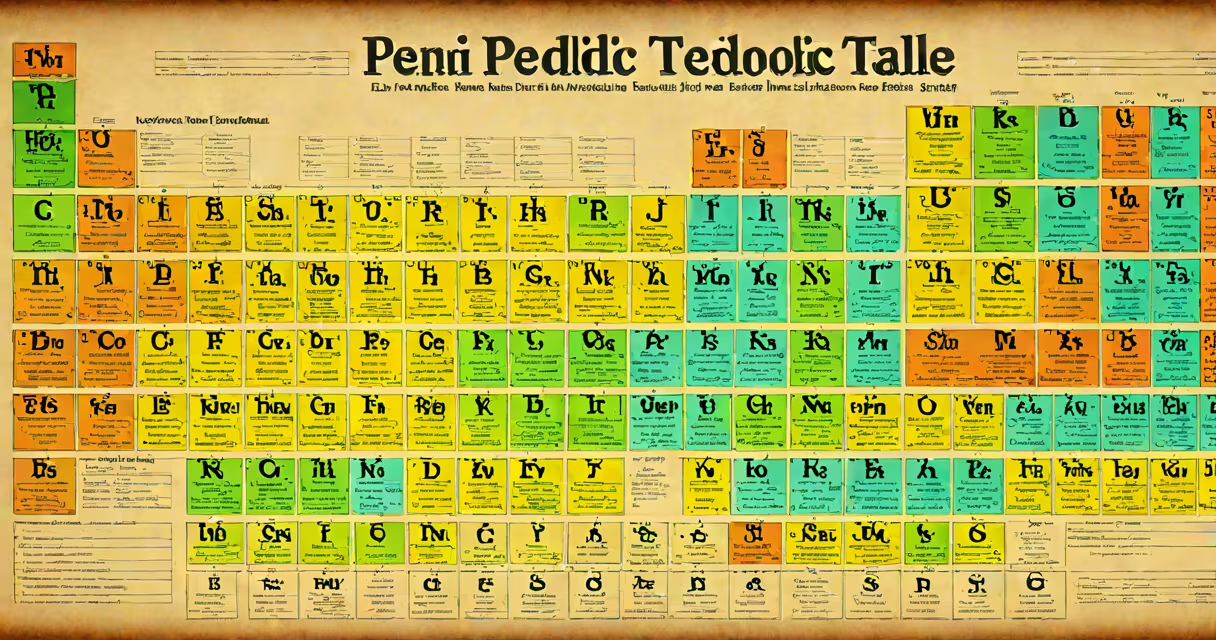
The important periodic table is a structured arrangement of chemical elements based on their atomic number, electron configuration, and recurring chemical properties. It groups elements into rows (periods) and columns (groups), revealing trends such as electronegativity, ionization energy, and atomic radius. This layout enables scientists to predict element behavior and discover new compounds.
Elements are ordered left to right and top to bottom by increasing atomic number-the number of protons in the nucleus. The table's design reflects periodicity: similar properties recur at regular intervals. For example, all elements in Group 1 (alkali metals) react vigorously with water, while Group 18 (noble gases) rarely form compounds due to full valence shells.
Each square contains the element's symbol, name, atomic number, and average atomic mass. The visual layout separates metals, metalloids, and nonmetals using a diagonal line. This distinction aids in understanding conductivity, malleability, and reactivity patterns across the table.
The periodic table functions as a predictive model. When a new element is synthesized, its position is determined by its proton count. Scientists then infer likely properties based on neighboring elements. For instance, element 117 (tennessine) was predicted to behave like a halogen before synthesis, matching trends seen in fluorine, chlorine, and iodine.
Electron configuration underpins the table's structure. Elements in the same group have identical outer-shell electrons. Sodium (Na, atomic number 11) and potassium (K, atomic number 19) both have one electron in their outermost shell, explaining their similar reactivity. This pattern allows chemists to anticipate bonding behavior without testing every compound.
Periodic trends emerge across periods and down groups. Ionization energy generally increases and decreases. Fluorine, at the top right, has the highest ionization energy among stable elements. Conversely, cesium, near the bottom left, requires minimal energy to lose an electron-making it highly reactive.
The periodic table uses several structural systems to classify elements:
| Classification | Key Features | Examples |
|---|---|---|
| Alkali Metals | Group 1; soft, reactive; form +1 ions | Lithium, sodium, potassium |
| Transition Metals | Groups 3-12; variable oxidation states; catalytic activity | Iron, copper, gold |
| Halogen Group | Group 17; high electronegativity; form salts with metals | Fluorine, chlorine, bromine |
| Noble Gases | Group 18; inert; full valence shell | Helium, neon, argon |
Some versions include separate rows for lanthanides and actinides, placed below the main table to preserve readability. These series contain f-block elements with complex electron arrangements. Lanthanum (element 57) and actinium (element 89) start the series, though their placement is debated due to electronic configuration anomalies.
Modern tables often show categories using color coding. Red indicates metals, blue nonmetals, green metalloids. This visual aid supports quick identification during classroom instruction or lab work. The International Union of Pure and Applied Chemistry (IUPAC) standardizes element symbols and naming conventions, ensuring global consistency.
Many assume the periodic table is complete. It is not. Elements beyond uranium (atomic number 92) are synthetic and unstable. Tennessine (117) and oganesson (118) exist only in trace amounts and decay within milliseconds. Their inclusion reflects theoretical predictions, not natural abundance.
Another error is treating the table as static. It evolves with new discoveries. In 2016, IUPAC confirmed four new elements-nihonium (113), moscovium (115), tennessine (117), and oganesson (118)-after rigorous validation. These additions updated the seventh period and extended the table's reach into superheavy elements.
Some believe the table explains all chemical behavior. While useful, it doesn't account for quantum effects in molecular orbitals or relativistic impacts on heavy atoms. Gold's yellow color results from relativistic contraction of its 6s orbital-phenomena beyond simple periodic trends.
Pharmaceutical researchers use the periodic table to design drugs. Carbon, nitrogen, oxygen, and sulfur dominate organic molecules. By selecting elements with specific electronegativities and bond strengths, they create compounds that bind to biological targets. For example, the antiviral drug remdesivir contains phosphorus-a key element in nucleic acid analogs.
In materials science, engineers rely on periodic trends to develop alloys. Steel combines iron with carbon and small amounts of chromium and nickel. Chromium increases corrosion resistance; nickel improves ductility. These choices stem from understanding how atomic size and electron affinity affect solid-state bonding.
During my time working in a university lab, we used the periodic table to troubleshoot a failed catalyst reaction. A palladium-based catalyst showed low yield. Consulting the table revealed that rhodium (element 45), adjacent to palladium, had higher activity in hydrogenation reactions. Switching to rhodium increased conversion rates by 40%-a direct application of periodic trends in industrial chemistry.
The important periodic table remains central to chemistry education and research. Its structure enables rapid analysis of elemental relationships and supports innovation in medicine, materials, and environmental science. As new elements are discovered and computational models improve, the table continues to evolve-not as a finished artifact, but as a living structure for understanding matter.