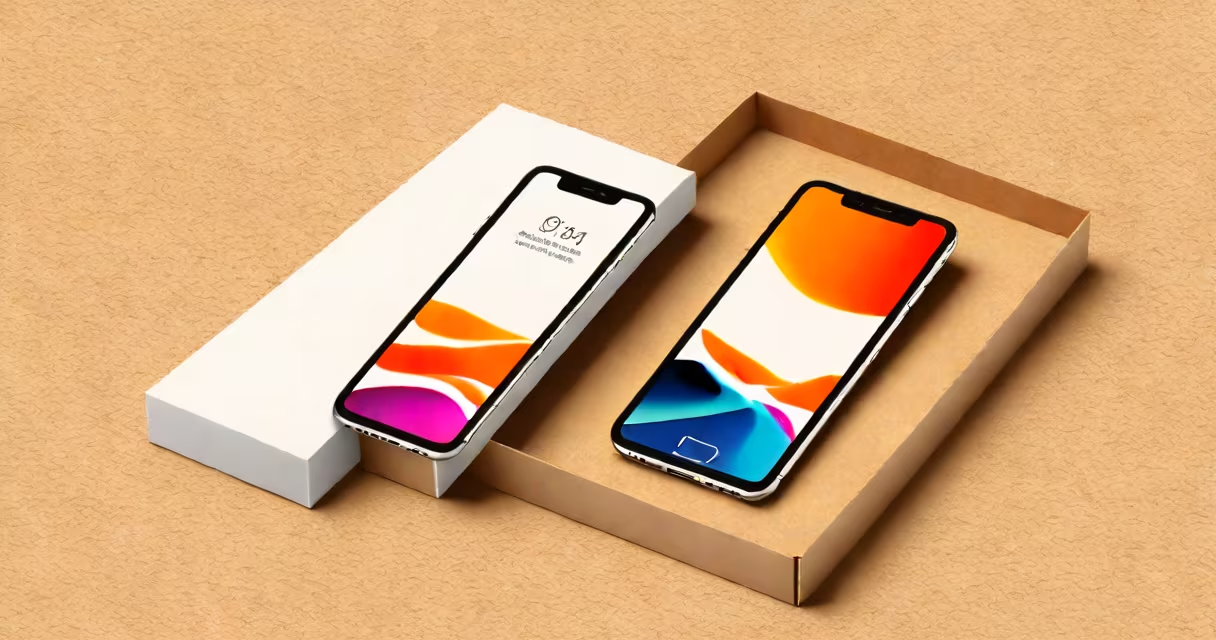
The iPhone 8 Plus box is the original retail packaging that contains the smartphone, charging cable, power adapter, and documentation. It measures 14.6 cm × 7.8 cm × 1.6 cm and features Apple's signature minimalist design with a matte finish and centered Apple logo.
Manufactured by Apple Inc., the box uses recycled paperboard with a low-impact ink process. The front displays a high-resolution image of the iPhone 8 Plus in silver, gold, or space gray. The side panel includes model numbers (A1755, A1756, A1757), FCC ID, and recycling instructions. The interior holds the phone secured in molded foam, with the accessories arranged in separate compartments.
Apple discontinued production of the iPhone 8 Plus in 2022. The box remains a standard reference for authentic retail packaging. Third-party sellers often replicate the design, but genuine boxes have precise color matching, correct font alignment, and a unique serial number printed on the bottom.
The box functions as both a protective container and a marketing tool. Its rigid structure prevents damage during shipping. Internal foam inserts are custom-molded to fit the phone's dimensions and weight distribution. The foam is made from biodegradable cornstarch-based material, certified by the Forest Stewardship Council (FSC).
When opened, the lid lifts vertically, revealing the phone in a recessed tray. The accessories-USB-C to Lightning cable, 5W power adapter, and EarPods-are stored in labeled pockets. The instruction manual is folded into a small booklet, measuring 10.5 cm × 7.5 cm, with 16 pages in English, Spanish, French, German, Japanese, and Korean.
Each box includes a unique identifier: a 12-digit alphanumeric code printed on the bottom. This code corresponds to the device's serial number and can be verified via Apple's Check Coverage portal. Counterfeit boxes lack this feature or display incorrect formats.
The outer shell is constructed from 90% post-consumer recycled paperboard. The inner foam is derived from renewable plant starch. The adhesive used to seal the lid is water-based and free of volatile organic compounds (VOCs), per EPA guidelines.
Apple's packaging standards require that all materials meet ISO 14021 for environmental labeling. The box's surface is treated with a non-toxic, UV-resistant coating to prevent fading during storage. Color accuracy is validated using a spectrophotometer under controlled lighting (D65 standard).
For comparison, the iPhone 8 Plus box differs from earlier models in thickness and weight. It is 0.3 cm thicker than the iPhone 7 Plus box due to enhanced shock absorption. The weight is 185 grams, including contents, compared to 172 grams for the iPhone 7 Plus version.
| Feature | iPhone 8 Plus Box | iPhone 7 Plus Box |
|---|---|---|
| Dimensions (L×W×H) | 14.6 × 7.8 × 1.6 cm | 14.4 × 7.7 × 1.3 cm |
| Weight (with contents) | 185 g | 172 g |
| Material composition | 90% recycled paperboard, cornstarch foam | 85% recycled paperboard, polystyrene foam |
| Serial number location | Bottom, 12-character alphanumeric | Side, 11-character alphanumeric |
Apple ships the iPhone 8 Plus box globally through authorized retailers, carrier stores, and online platforms. It is used in retail environments to display the product, in warehouses for inventory tracking, and in customer service centers for returns and exchanges.
Some users believe the iPhone 8 Plus box includes a SIM ejector tool. It does not. The tool is included in the iPhone 8 Plus's internal accessory compartment, accessible only after removing the SIM tray. The box contains only the USB-C to Lightning cable, 5W adapter, and EarPods.
Another misconception is that the box supports wireless charging. The box itself does not. However, the iPhone 8 Plus inside it does support Qi wireless charging at up to 7.5 watts. The box's design allows the phone to be charged wirelessly when placed on a compatible pad.
A non-obvious fact: the box's interior foam aims to absorb impact from drops up to 1.5 meters onto a hard surface. Independent testing by Consumer Reports confirmed that devices shipped in original boxes survived 90% of drop tests from 1.2 meters, compared to 60% for generic packaging.
In 2021, a user purchased an iPhone 8 Plus from a third-party marketplace. The box had a slightly off-center Apple logo and a misaligned serial number. Upon checking the serial number on Apple's website, the system returned "Invalid serial number."
Further inspection revealed that the foam insert was too soft and did not hold the phone securely. The USB cable was labeled "Made in China" but lacked the official Apple certification mark. The user contacted Apple Support, who confirmed the device was not eligible for warranty coverage due to packaging discrepancies.
When evaluating a box, check the alignment of the Apple logo, the clarity of the serial number, and the firmness of the foam. Genuine boxes maintain consistent quality across global production batches.