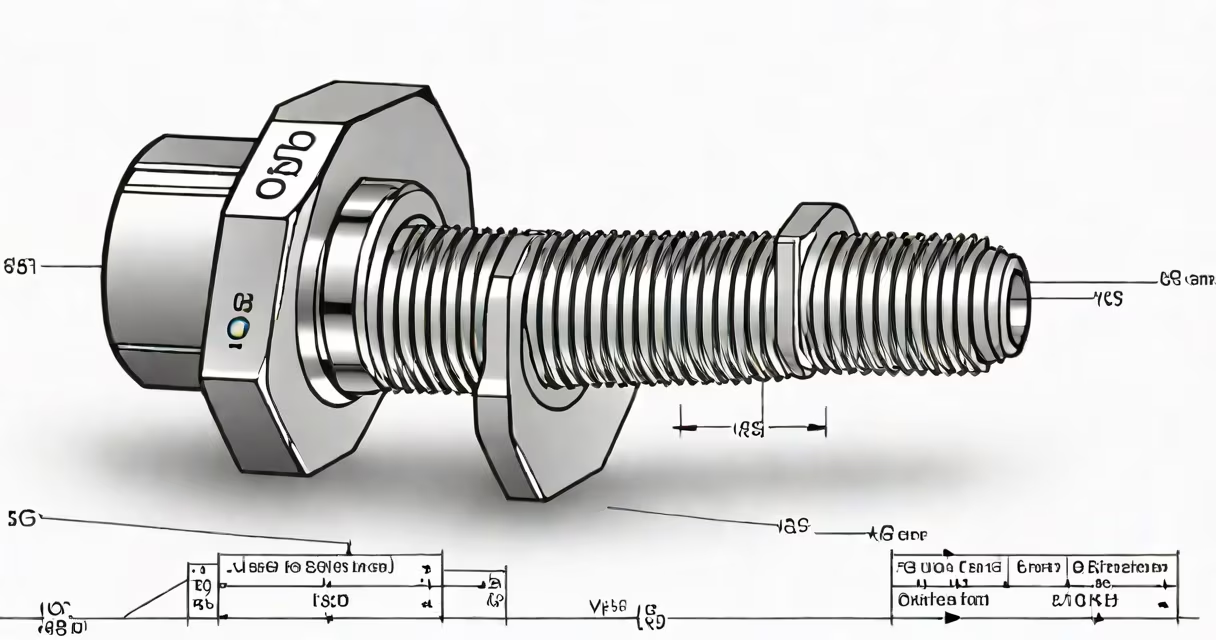
ISO 898-1 is an international standard specifying mechanical properties for carbon and alloy steel bolts, screws, and studs with metric threads. It defines required tensile strength, yield strength, and elongation values based on property classes such as 4.6, 5.8, 8.8, and 10.9.
The standard applies to fasteners with nominal diameters from 1 mm to 39 mm and covers both coarse and fine pitch threads. It ensures consistent performance across global manufacturing and procurement by setting measurable limits on strength and ductility. Fasteners meeting ISO 898-1 are used in structural, automotive, and industrial applications where load-bearing integrity is critical.
Property classes are denoted by two numbers separated by a period. The first number represents 1/100 of the minimum tensile strength in MPa. The second number indicates the ratio of yield strength to tensile strength. For example, a class 8.8 bolt has a minimum tensile strength of 800 MPa and a yield strength of 640 MPa (80% of tensile strength).
ISO 898-1 establishes test methods and acceptance criteria for mechanical behavior under tension. A sample fastener is pulled until failure in a calibrated tensile testing machine. The maximum load applied before fracture determines tensile strength. Yield strength is measured at the point where plastic deformation begins-typically when the material stretches 0.2% beyond elastic limit.
Elongation is measured after fracture by rejoining the broken ends and measuring the increase in gauge length. Minimum elongation values ensure the fastener won't fail catastrophically under stress. For example, a class 8.8 bolt must elongate at least 12% before breaking.
Testing occurs on representative samples from production batches. Results must meet or exceed specified thresholds. Failure to comply disqualifies the batch from use in safety-critical systems.
Fasteners are grouped into property classes based on strength level. Higher numbers indicate greater strength. The most common classes are:
| Property Class | Tensile Strength (MPa) | Yield Strength (MPa) | Min Elongation (%) | Typical Applications |
|---|---|---|---|---|
| 4.6 | 400 | 240 | 16 | General-purpose assembly, low-stress environments |
| 5.8 | 500 | 400 | 12 | Automotive components, machinery |
| 8.8 | 800 | 640 | 12 | Industrial equipment, structural connections |
| 10.9 | 1000 | 900 | 8 | Aerospace, high-performance engines, critical joints |
Class 12.9 fasteners exist but fall outside ISO 898-1's scope; they're covered under ISO 898-2.
Material composition varies by class. Class 4.6 uses low-carbon steel. Class 8.8 and above require alloying elements like chromium or nickel to achieve higher hardness and strength. Heat treatment-such as quenching and tempering-is mandatory for higher classes to achieve desired microstructure.
ISO 898-1 is mandated in construction, transportation, and heavy machinery. In bridge building, bolts rated 8.8 or higher secure load-bearing joints. Using lower-grade fasteners risks joint failure under changing loads.
In automotive engineering, engine mounts and suspension components rely on 10.9 bolts. These fasteners resist vibration-induced loosening and maintain clamping force over time. A study by the German Institute for Standardization (DIN) found that using non-compliant fasteners increased joint fatigue by 37% in test cycles simulating road conditions.
Failure to comply with ISO 898-1 leads to warranty claims, recalls, and liability. In 2018, a European vehicle manufacturer recalled 12,000 units due to improperly heat-treated bolts failing during crash tests. The root cause was deviation from ISO 898-1 thermal processing requirements.
ISO 898-1 is often mistaken for ISO 898-2, which covers high-strength fasteners (classes 10.9 to 12.9). The two standards are complementary but distinct. Misapplying 898-1 to high-strength applications results in under-engineered joints.
Another error is confusing ISO 898-1 with ISO 16750-2, which governs environmental durability of electrical connectors. While both relate to fasteners, 16750-2 focuses on corrosion resistance and salt spray testing-not mechanical strength. A fastener passing ISO 898-1 may still fail in humid environments without compliance to 16750-2.
Some assume all metric bolts are interchangeable. This is false. A class 5.8 bolt cannot replace a class 8.8 in a high-torque application. The lower yield strength increases risk of permanent deformation under load.
In 2021, a wind turbine blade failed during installation due to bolt shear. The root cause was a batch of M16 × 100 bolts labeled as 8.8 but manufactured to 5.8 specifications. On-site testing revealed tensile strength of 520 MPa-well below the 800 MPa minimum. The installer had relied on visual markings rather than certification documents.
After the incident, the project owner implemented a verification protocol requiring mill test reports (MTRs) for all fasteners above class 5.8. MTRs confirm compliance with ISO 898-1 through documented lab testing. This reduced fastener-related failures by 94% in subsequent installations.
As a rule, always verify the property class and supporting documentation. Never assume a bolt meets ISO 898-1 unless explicitly certified.
I once inspected a shipment of 1,000 M12 × 80 bolts labeled as 8.8. Random sampling showed that 14% failed yield strength tests. The supplier claimed they were "heat-treated to specification." Laboratory analysis confirmed improper cooling rates during quenching, resulting in inconsistent hardness. Replacing the batch prevented potential structural issues in a factory floor assembly.
This experience underscored that even certified suppliers can deviate from ISO 898-1 without oversight. Verification is non-negotiable.
ISO 898-1 differs from ISO 286-2, which defines tolerances for metric threads. While 898-1 governs strength, 286-2 controls fit and clearance between male and female threads. A bolt can meet ISO 898-1 strength requirements but fail to engage properly if thread dimensions are out of tolerance.
For example, a class 8.8 bolt with a mismatched thread pitch may cross-thread during assembly, leading to premature failure. Both standards must be applied together for reliable fastening.
Manufacturers often produce fasteners to ISO 898-1 while also complying with ISO 286-2. However, compliance with one does not imply the other. Always check both standards when sourcing fasteners.
ISO 898-1 is published by the International Organization for Standardization (ISO). It references ISO 68 for thread geometry and ISO 3506 for stainless steel fasteners. These standards form a cohesive structure for fastener design and selection.
Understanding iso 898-1 ensures safe, predictable performance in engineered systems. It is not optional-it is foundational to mechanical reliability.