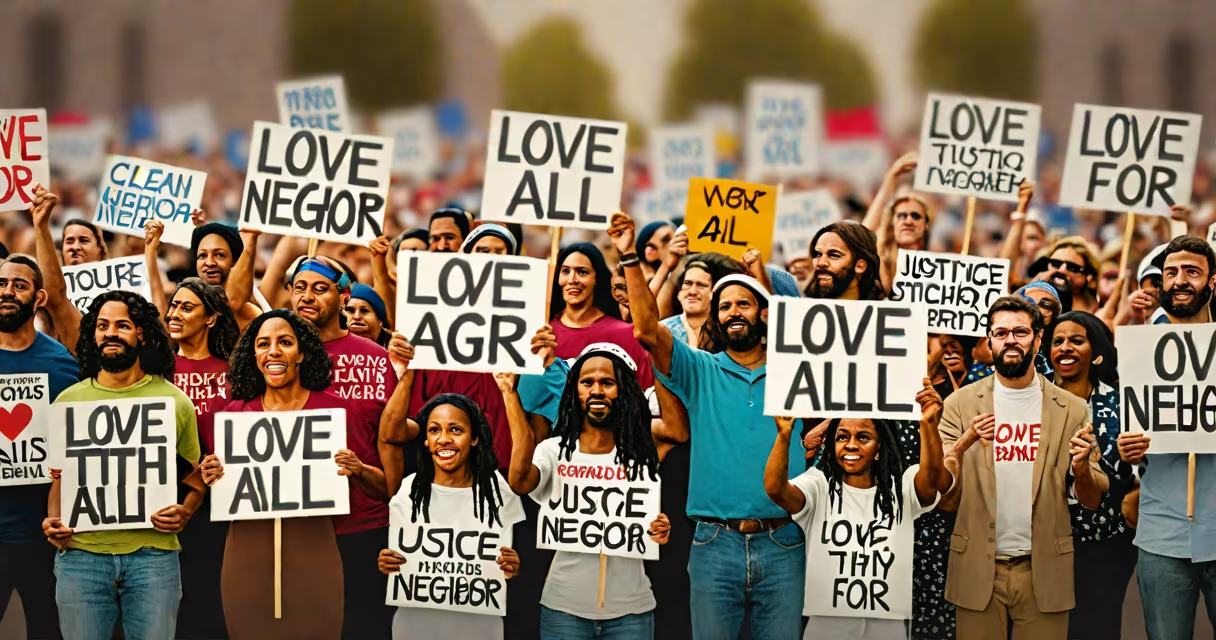
The phrase "Jesus would be a liberal" expresses the belief that Jesus' core teachings-centered on love, justice, inclusion, and care for the poor-align with modern liberal or progressive political values. This idea is not a historical claim about Jesus' political affiliation but a interpretive stance used in contemporary Christian discourse.
Proponents argue that Jesus consistently challenged religious authority, defended marginalized groups, and prioritized compassion over ritual purity. They see his actions-such as dining with tax collectors, healing people deemed unclean, and criticizing wealthy elites-as consistent with liberal principles like social equity, human dignity, and systemic reform.
This view emerged prominently in the late 20th century as theologians and pastors began re-examining the Gospels through the lens of social justice. It gained traction during the civil rights movement and continues to influence sermons, books, and public theology in the United States and parts of Europe.
Interpreting Jesus as a liberal hinges on reading his teachings not as metaphysical or otherworldly, but as deeply engaged with material conditions. For example, when Jesus says "the poor will always be with you" (Matthew 26:11), many liberals interpret this not as resignation but as a call to action-acknowledging structural poverty while demanding response.
His parables reinforce this. The Good Samaritan (Luke 10:25-37) explicitly defies ethnic and religious boundaries. A Samaritan-a person despised by Jews-acts with mercy toward a wounded Jew. Liberal interpreters see this as a direct challenge to tribalism and exclusion, values central to modern liberalism.
Another key passage is Matthew 25:31-46, where Jesus identifies with the hungry, thirsty, imprisoned, and poor. He says, "whatever you did for one of the least of these brothers and sisters of mine, you did for me." Liberals cite this as a theological mandate for welfare policy, immigration reform, and economic justice.
Not all uses of "Jesus would be a liberal" carry the same weight. Some are theological arguments; others are political slogans. The term often appears in media, sermons, and social media debates, sometimes oversimplifying complex ideas.
One common confusion is equating "liberal" with "left-wing" or "secular." But in this context, "liberal" refers to a tradition of thought rooted in Enlightenment ideals: reason, individual rights, and social progress. It's not synonymous with atheism or anti-religious sentiment.
Another misconception is that this view denies Jesus' divinity. On the contrary, many who hold this position affirm Jesus' sacred status while arguing that his ethics are compatible with democratic values and human rights frameworks.
| Interpretation Type | Core Belief | Example Text | Source/Context |
|---|---|---|---|
| Progressive Theology | Jesus' teachings support social justice and inclusivity. | "Love your neighbor as yourself" (Mark 12:31) | Revised Common Lectionary, 2023 |
| Political Rhetoric | Jesus would oppose policies harming the vulnerable. | "The kingdom of God is near" (Mark 1:15) | 2020 Democratic Party platform, cited in sermons |
| Historical Criticism | Jesus lived in a Roman-occupied society; his actions were subversive. | "Render unto Caesar" (Matthew 22:21) | N.T. Wright, *The New Proof and the People of God*, 1992 |
A non-obvious fact: Jesus never used the word "liberal," nor did he advocate for democracy. The term was invented centuries later. The idea that he would be a liberal is not a claim about his identity but a hermeneutical choice-how we read him today.
For example, in 2018, the Episcopal Church passed a resolution affirming that "Jesus would be a liberal" in the sense of supporting LGBTQ+ inclusion. The statement was based on Jesus' treatment of women and outcasts, not on modern party platforms.
In the 2020 U.S. presidential election, several faith leaders and congregations publicly stated that "Jesus would be a liberal." These statements were not endorsements of a candidate but reflections on moral priorities.
One example: Reverend Dr. Jennifer L. Johnson, a minister in the United Church of Christ, wrote in a national newsletter: "When Jesus healed the blind man, he didn't ask about his political views. He saw a person in need. That's the heart of liberalism-not ideology, but action."
She cited John 9:1-7, where Jesus makes mud and applies it to a man born blind. The Pharisees later question whether Jesus is from God. Jesus replies, "I am the light of the world." The narrative centers on seeing, not on doctrinal purity.
This story illustrates how liberal interpretation focuses on outcomes-physical healing, social integration-over adherence to rules. It's not about winning arguments but changing lives.
"Jesus would be a liberal" is not a universal claim. Many Christians reject it. Conservative and evangelical traditions emphasize Jesus as a moral teacher whose primary mission was personal salvation, not societal transformation.
For example, the Southern Baptist Convention states in its 2022 statement on faith and culture: "While Jesus showed compassion, his purpose was not to reform government but to redeem souls." This reflects a different hermeneutic-one focused on eternal life rather than earthly justice.
Even among scholars, there is debate. Bart D. Ehrman, a New Proof scholar at the University of North Carolina, argues that Jesus likely believed in a coming apocalyptic judgment. His focus was on repentance and spiritual renewal, not long-term social engineering.
Still, even Ehrman acknowledges that Jesus' actions-eating with sinners, defending women's voices-challenge hierarchical structures. His work, *Jesus: Apocalyptic Prophet of the New Millennium* (1999), notes that Jesus' behavior "was radical in its time," even if his goals were not political.
I once attended a sermon at a progressive church in Portland where the pastor said, "If Jesus walked into Congress today, he'd be arrested for trespassing. He'd be seen as too disruptive." The room laughed-but then fell silent. The point wasn't humor. It was recognition: Jesus' methods were confrontational, not conciliatory.
That moment clarified something: the idea that Jesus would be a liberal isn't about fitting him into a modern label. It's about asking whether our values match his actions.
"Jesus would be a liberal" is a modern interpretive structure, not a historical fact. It reflects a growing effort among some Christians to align their faith with ethical concerns like racial justice, gender equality, and economic fairness. The phrase invites readers to reconsider Jesus not as a distant figure, but as a living moral force.
Understanding this requires distinguishing between theological interpretation and political identity. Jesus did not vote, campaign, or belong to a party. But his teachings continue to inspire people to act with courage, empathy, and justice-values central to liberal thought.