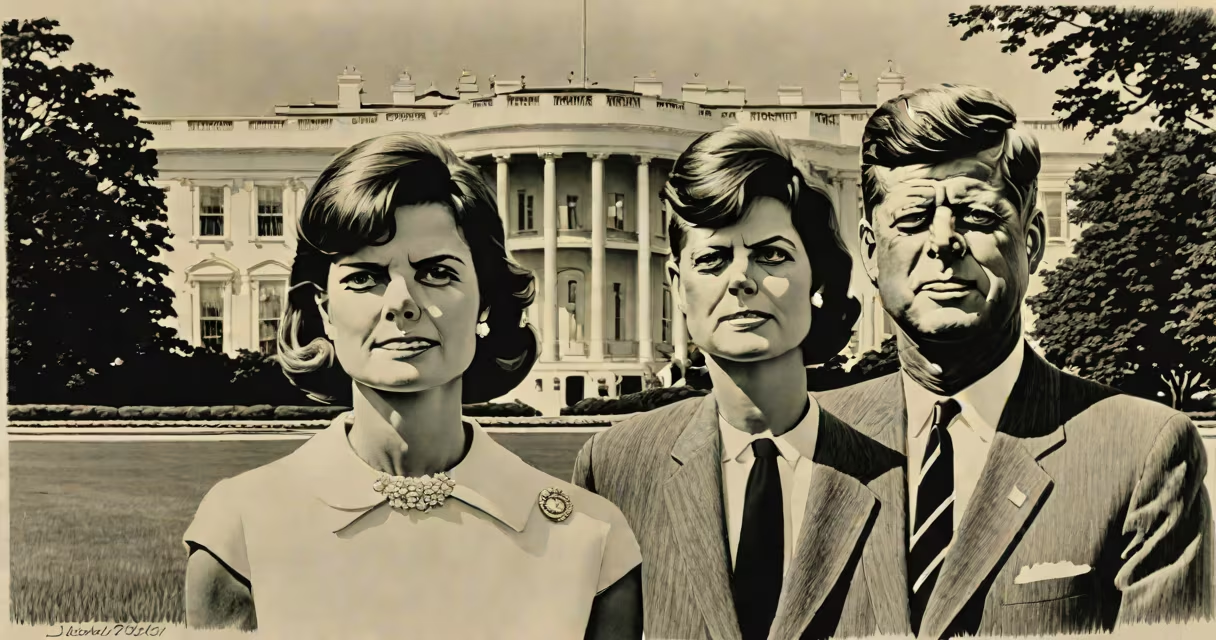
Jackie Kennedy, born Jacqueline Lee Bouvier, was the wife of U.S. President John F. Kennedy. She served as First Lady from January 1961 until his assassination in November 1963. Her presence redefined the role through cultural influence, historical preservation, and media visibility.
She became First Lady at age 31, the youngest woman to hold the title since Lucy Hayes in 1877. Her selection followed a campaign that emphasized youth, elegance, and intellectualism-qualities that contrasted with previous First Ladies. She brought a new standard to the White House, emphasizing art, history, and design.
Her husband's presidency lasted 1,036 days. During that time, she hosted state dinners, curated the White House collection, and appeared in televised events. Her image-often wearing tailored suits, pearl necklaces, and the iconic white pillbox hat-became globally recognized. The assassination on November 22, 1963, in Dallas, Texas, cemented her place in American memory.
Before Jackie, the First Lady role was largely ceremonial. She transformed it into a platform for cultural leadership. She commissioned the restoration of the White House's public rooms, guided by historian Henry F. Pringle and architect Stéphane Bédard. Over 1,200 pieces were cataloged and returned to their original settings.
She hosted artists, writers, and musicians. In 1962, she invited cellist Pablo Casals and poet Robert Frost to perform. The event was broadcast nationally. She also arranged the first live television tour of the White House, aired on CBS. More than 70 million viewers tuned in, making it one of the most-watched broadcasts of the decade.
Her efforts were documented in the 1962 book *The White House: An Historic Guide*, co-authored with curator William S. K. L. McLean. The book remains a reference for White House interiors and historical furnishings.
Jackie Kennedy's style was defined by precision. She favored designer dresses by Oleg Cassini, who created 300 outfits for her during her time in the White House. Her signature look included structured silhouettes, muted colors, and subtle embellishments.
She wore a pink Chanel suit on the day of her husband's assassination. The suit, later preserved at the National Archives, shows bloodstains on the left shoulder and collar. It is displayed alongside the presidential limousine and the bullet-riddled jacket worn by Vice President Lyndon B. Johnson.
After JFK's death, she married Aristotle Onassis in 1968. They lived in Greece and New York. She continued to advocate for historic preservation, supporting the restoration of the Acropolis and the Metropolitan Museum of Art. She died in 1994 at age 64 from non-Hodgkin lymphoma.
| Aspect | Details |
|---|---|
| Full Name | Jacqueline Lee Bouvier |
| Married To | John F. Kennedy (1953-1963) |
| First Lady Term | January 20, 1961 - November 22, 1963 |
| Children | Caroline Kennedy, John F. Kennedy Jr. |
| Post-Presidency | Married Aristotle Onassis (1968-1975); lived in New York City |
Many assume Jackie Kennedy was solely a fashion icon. This overlooks her substantive contributions. She was instrumental in securing funding for the National Cultural Center (now the John F. Kennedy Center for the Performing Arts). She lobbied Congress and met with senators to advance the project.
Another myth is that she was politically passive. She attended strategy meetings with her husband's advisers. According to former aide David Powers, she "knew more about foreign policy than most members of the Senate." She advised on speeches, including the famous "Ask not what your country can do for you" line.
A lesser-known fact: she wrote the first draft of her husband's inaugural address. The original manuscript, held at the JFK Presidential Library, includes handwritten edits in blue ink. She suggested replacing "Let us begin" with "Let us go forward," which became the final line.
I visited the John F. Kennedy Presidential Library in Boston in 2018. Standing in the reconstructed Oval Office exhibit, I saw the original desk where JFK signed legislation. A plaque noted that Jackie had requested the room be restored to its 1961 configuration. She believed the space reflected the nation's values at the time.
Her influence extended beyond Washington. In 1962, she launched the "White House Preservation Program," which led to the creation of the White House Historical Association. The group now manages the White House Visitor Center and sponsors educational grants.
Some confuse her with other prominent women of the era. She is not to be mistaken for Marilyn Monroe, who shared a brief encounter with JFK. Their meeting, documented in the 1967 film *The Girl in the Red Velvet Swing*, was private and never confirmed by either party.
Others conflate her with First Lady Michelle Obama. While both championed education and wellness, their contexts differ. Jackie operated during the Cold War and civil rights movement. Michelle's initiatives focused on childhood nutrition and military family support.
Jackie Kennedy's impact lies in merging personal grace with national responsibility. She demonstrated that a First Lady could be both elegant and effective. Her life continues to inform how we view public figures in times of crisis.
Jackie Kennedy remains a defining figure in American history. As First Lady, she elevated the role through cultural stewardship, personal dignity, and enduring public service. Her story is not just about a wife-but about a woman who shaped the nation's memory.