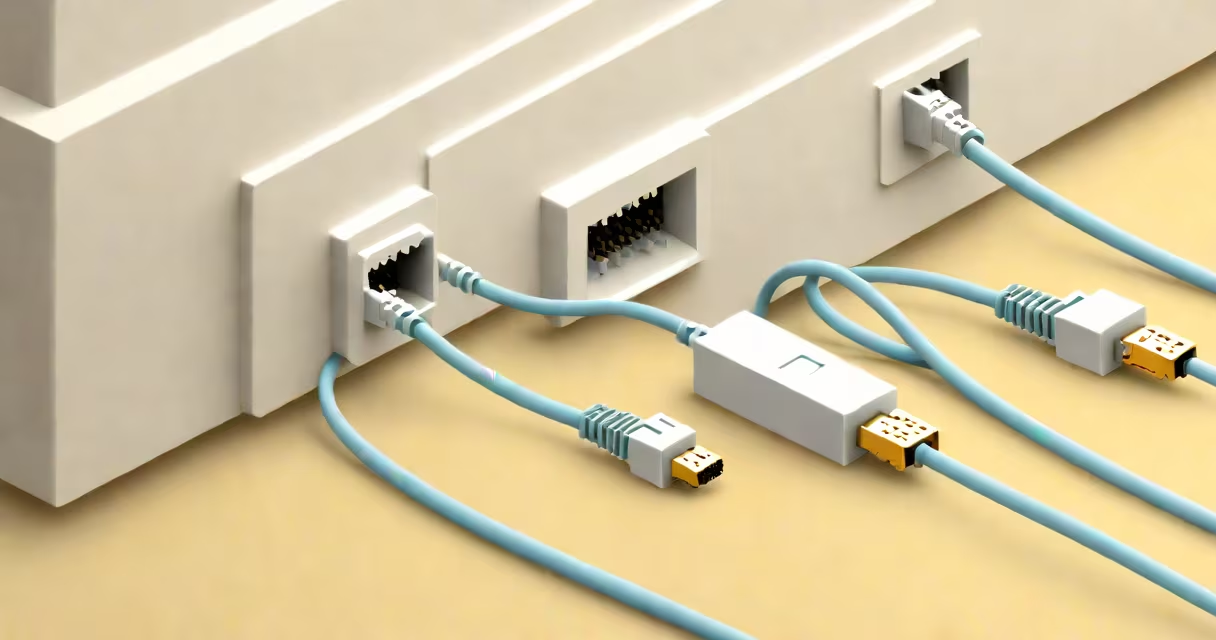
A lan cable meaning refers to a twisted-pair Ethernet cable designed to connect devices within a local area network (LAN), enabling data transmission between computers, routers, switches, and modems. These cables use standardized connectors-typically RJ45-and follow specifications like Cat5e, Cat6, or Cat6a to support varying speeds and distances.
LAN cables transmit digital signals through insulated copper wires arranged in twisted pairs. This twisting reduces electromagnetic interference and crosstalk, ensuring reliable communication. The most common types are Cat5e (up to 1 Gbps), Cat6 (up to 10 Gbps over short runs), and Cat6a (higher bandwidth and reduced interference). Each category defines performance limits for frequency, attenuation, and near-end crosstalk.
For example, a Cat6 cable supports 10 Gbps data rates at distances up to 55 meters. This makes it suitable for high-performance applications such as video streaming, online gaming, and large file transfers. A single LAN cable can carry data at speeds exceeding 100 Mbps even over 100-meter lengths, depending on the category and installation quality.
LAN cables operate using differential signaling across four twisted pairs of copper wire. Each pair transmits data in opposite directions simultaneously, reducing noise and improving signal integrity. The cable's performance depends on consistent twist rate, shielding (if present), and proper termination at both ends.
Data travels from a device-like a desktop computer-to a router or switch via the RJ45 connector. The physical layer (Layer 1 of the OSI model) handles the electrical signals, while higher layers manage packet routing and error checking. A properly wired cable helps pin assignments match standards such as T568A or T568B, which define wire color sequences.
For instance, a Cat6 cable wired with T568B uses the following sequence: white/orange, orange, white/green, blue, white/blue, green, white/brown, brown. Miswiring causes connectivity issues or reduced speed. Testing tools like a cable certifier verify continuity, crosstalk, and signal loss.
Different categories of LAN cables serve distinct performance levels. The table below outlines key differences:
| Cable Type | Max Speed | Frequency | Use Case |
|---|---|---|---|
| Cat5e | 1 Gbps | 100 MHz | Basic home networks, office setups |
| Cat6 | 10 Gbps (up to 55m) | 250 MHz | Gaming, 4K streaming, high-speed backups |
| Cat6a | 10 Gbps (up to 100m) | 500 MHz | Enterprise environments, server rooms |
Shielded versions (STP) reduce interference in electrically noisy environments. Unshielded (UTP) cables are standard in most residential and small business installations due to lower cost and ease of handling.
Many assume all LAN cables perform equally. This is false. A Cat5e cable may fail under sustained 10 Gbps loads, while a Cat6a cable maintains stability. Performance degradation occurs when cables exceed their rated length or are bent too tightly around corners.
Another misconception is that longer cables always equal better coverage. In reality, signal loss increases with distance. Beyond 100 meters, data integrity drops. Most networks limit cable runs to 90 meters, with 10 meters reserved for patch cords.
I once installed a Cat6 cable in a basement for a NAS system. Despite using a reputable brand, the connection dropped intermittently. After testing with a cable tester, I discovered a loose connection at the wall plate. Replacing the jack resolved the issue-proof that even high-grade cables fail if improperly terminated.
LAN cables are frequently mistaken for power cables, USB cables, or fiber optic lines. Unlike power cables, they do not carry electricity. They differ from USB cables, which are designed for device-to-computer communication and have different connectors and protocols. Fiber optic cables transmit light signals over glass fibers and are used in long-distance or high-security applications.
People confuse "LAN cable" with "network cable." While both terms refer to the same physical component, "LAN cable" specifically denotes a cable used in a local network context. "Network cable" is a broader term that can include wireless connections or fiber-based systems.
The lan cable meaning centers on a physical medium that enables structured, high-speed data exchange within a localized environment. It is not a wireless protocol, nor is it a software configuration. Its function is purely hardware-based-connecting endpoints through standardized wiring and connectors.
Understanding the lan cable meaning helps users choose the correct cable type for their needs. Whether setting up a home office or managing a corporate network, selecting the right category and ensuring proper installation prevents downtime and improves reliability.